About Chip Capacitor Applications A Complete Guide for Engineers
Top 5 FAQs About Chip Capacitor Applications: A Complete Guide for Engineers
- What Are the Most Common Electronic Devices That Use Chip Capacitors?
- How to Match Chip Capacitors of Different Capacitance Values to Specific Application Scenarios?
- Can Chip Capacitors Replace Through-Hole Capacitors in Consumer Electronics Applications?
- What Parameter Requirements Must Chip Capacitors Meet for Industrial Control Equipment Applications?
- What Are the Key Selection Factors for Chip Capacitors in High-Frequency Circuit Applications?
- Final Thoughts: Mastering Chip Capacitor Applications
Chip capacitors (also known as surface mount capacitors, SMCs) are indispensable components in modern electronics, prized for their compact size, high reliability, and versatile performance. As an engineer or electronics enthusiast, you may have questions about how to best leverage these components in your projects. Below, we address the 5 most common FAQs about chip capacitor applications, providing actionable insights to help you make informed decisions—whether you’re designing consumer gadgets, industrial controls, or high-frequency circuits.
1. What Are the Most Common Electronic Devices That Use Chip Capacitors?
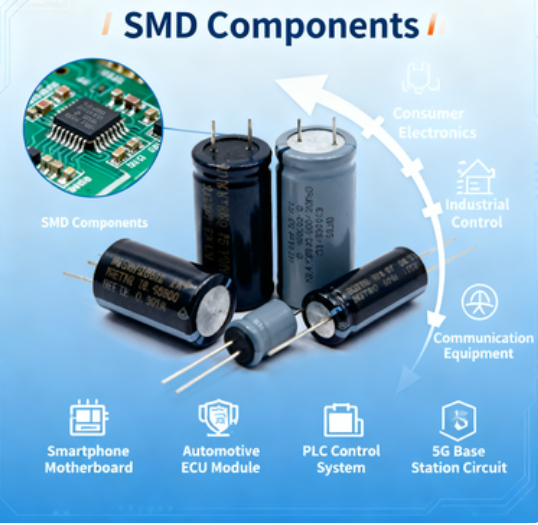
Chip capacitors are ubiquitous across nearly every electronic device due to their ability to save space while delivering critical functions like filtering, decoupling, and voltage regulation. Here are the top applications:
- Consumer Electronics: Smartphones, laptops, tablets, and wearables rely on chip capacitors for power supply stabilization (decoupling) and signal filtering. Their small footprint (down to 01005 size) fits tightly packed PCBs.
- Automotive Electronics: Modern vehicles use chip capacitors in infotainment systems, ADAS (Advanced Driver Assistance Systems), engine control units (ECUs), and battery management systems (BMS). They must withstand extreme temperatures (-40°C to 125°C) and vibration—making ceramic chip capacitors (X5R, X7R dielectrics) the top choice.
- Industrial Control Equipment: PLCs (Programmable Logic Controllers), motor drives, and sensors use chip capacitors for noise suppression and power conditioning. Industrial-grade chip capacitors often meet AEC-Q200 or IEC 60384 standards for reliability.
- IoT Devices: Smart home sensors, wearables, and connected devices use low-profile chip capacitors to minimize power consumption and fit in compact enclosures.
- Aerospace & Defense: High-reliability chip capacitors (e.g., tantalum or niobium oxide types) are used in avionics, radar systems, and military gear, where performance under harsh conditions is non-negotiable.
The key advantage here is versatility—chip capacitors adapt to diverse form factors and environmental demands, making them the go-to choice for miniaturized, high-performance electronics.
2. How to Match Chip Capacitors of Different Capacitance Values to Specific Application Scenarios?
Capacitance value (measured in farads, F—most commonly µF, nF, or pF) determines a chip capacitor’s ability to store charge, so matching it to your circuit’s needs is critical. Here’s a practical breakdown:
- pF Range (1 pF – 1000 pF): Ideal for high-frequency applications (RF circuits, oscillators, filters). For example:
- 10–100 pF: Used in RF transceivers (e.g., Bluetooth modules) for impedance matching.
- 100–1000 pF: Signal filtering in audio circuits or sensor interfaces.
- nF Range (1 nF – 1000 nF): Balanced performance for general-purpose use:
- 1–100 nF: Decoupling capacitors for microcontrollers (e.g., Arduino, Raspberry Pi) to stabilize power supply voltage.
- 100–1000 nF (1 µF): Power rail filtering in consumer electronics (e.g., USB ports, voltage regulators).
- µF Range (1 µF – 100 µF+): Focused on energy storage and low-frequency applications:
- 1–10 µF: Decoupling for power-hungry components (e.g., LEDs, small motors).
- 10–100 µF: Bulk capacitance in power supplies (e.g., AC-DC converters) to reduce voltage ripple.
Pro tip: For decoupling, use a combination of small (100 nF) and large (10 µF) chip capacitors near the component’s power pin—this addresses both high-frequency noise and voltage droop. Always refer to your component’s datasheet for recommended capacitance values.
3. Can Chip Capacitors Replace Through-Hole Capacitors in Consumer Electronics Applications?
In most consumer electronics (e.g., smartphones, laptops, TVs), yes—chip capacitors are the preferred replacement for through-hole capacitors—and for good reason:
- Space Savings: Chip capacitors mount directly on the PCB surface, eliminating the need for lead holes. This reduces PCB size by up to 50%, critical for miniaturized devices.
- Automated Assembly: Surface mount technology (SMT) allows for high-speed pick-and-place assembly, lowering production costs and improving consistency (vs. manual through-hole soldering).
- Performance: Modern chip capacitors (e.g., MLCCs—Multilayer Ceramic Chip Capacitors) offer equivalent or better performance than through-hole types: higher capacitance density, lower ESR (Equivalent Series Resistance), and better high-frequency response.
However, there are exceptions where through-hole capacitors may still be better:
- High-Voltage Applications: Through-hole capacitors often handle higher voltages (1000V+) than standard chip capacitors (typically up to 500V).
- Mechanical Stress: In devices prone to heavy vibration (e.g., power tools), through-hole leads provide better mechanical stability than surface-mount connections.
- Legacy Designs: Older equipment with through-hole PCBs may require retrofitting with matching through-hole components.
For most consumer electronics projects, though, chip capacitors (especially MLCCs) are the superior choice—offering a perfect balance of size, cost, and performance.
4. What Parameter Requirements Must Chip Capacitors Meet for Industrial Control Equipment Applications?
Industrial control equipment (e.g., PLCs, motor drives, factory automation systems) operates in harsh environments (temperature extremes, electrical noise, vibration) and requires long-term reliability. Here are the non-negotiable parameters for chip capacitors in this sector:
- Temperature Range: Industrial-grade chip capacitors must withstand -40°C to 125°C (or wider for extreme environments). Look for dielectrics like X7R (stable capacitance over temperature) or C0G/NP0 (ultra-stable for precision circuits).
- Voltage Rating: Choose a voltage rating (VR) at least 2x the maximum operating voltage of your circuit to account for voltage spikes. For example, if your circuit runs at 24V, use a 50V chip capacitor.
- Reliability Standards: Compliance with AEC-Q200 (automotive/industrial standard) or IEC 60384-1 is mandatory. These standards ensure resistance to humidity, thermal shock, and mechanical stress.
- ESR & ESL: Low ESR (≤100 mΩ) and ESL (Equivalent Series Inductance) are critical for power conditioning and noise suppression. MLCCs and polymer chip capacitors excel here.
- Humidity Resistance: Industrial environments often have high humidity—look for chip capacitors with a humidity rating of 85°C/85% RH for 1000+ hours (per IEC 60068-2-30).
Ignoring these parameters can lead to premature failure, costly downtime, or safety hazards. Always prioritize industrial-grade components from reputable manufacturers (e.g., Murata, TDK, Kemet) for critical applications.
5. What Are the Key Selection Factors for Chip Capacitors in High-Frequency Circuit Applications?
High-frequency circuits (e.g., RF modules, Wi-Fi/Bluetooth devices, radar systems) demand chip capacitors that minimize signal loss and maintain stability at GHz frequencies. Here’s what to focus on:
- Dielectric Material: C0G/NP0 dielectrics are ideal—they offer near-zero capacitance drift with frequency, temperature, and voltage. X7R is a budget-friendly alternative for less critical high-frequency applications.
- ESR & ESL: Low ESR (preferably <50 mΩ) reduces power dissipation, while low ESL (achieved via small package sizes like 0201 or 0402) minimizes impedance at high frequencies.
- Package Size: Smaller packages (01005, 0201) have lower ESL and are better for high-frequency routing. Avoid large packages (1206+) unless higher capacitance is required.
- Voltage Rating: Overrating (2x operating voltage) is even more important here—high-frequency signals can create voltage spikes that exceed the nominal voltage.
- Parasitic Effects: Choose chip capacitors with minimal parasitic inductance and capacitance. MLCCs are preferred over tantalum or aluminum electrolytic capacitors for high-frequency use.
Example: For a 2.4 GHz Wi-Fi module, a 100 pF C0G/NP0 chip capacitor in a 0201 package (ESR <30 mΩ, voltage rating 25V) would provide optimal filtering and impedance matching.
Final Thoughts: Mastering Chip Capacitor Applications
Chip capacitors are the backbone of modern electronics, and understanding how to select and apply them based on your project’s needs is key to building reliable, high-performance devices. Whether you’re designing consumer gadgets, industrial controls, or high-frequency circuits, the answers above address the most critical questions engineers face.
If you’re still unsure about the right chip capacitor for your application—consider factors like capacitance, voltage rating, dielectric material, and environmental conditions—or consult with a component supplier for tailored recommendations.
Have more questions about chip capacitors? Drop a comment below, or share your application challenges—we’d love to help!
About Products Used With Chip Capacitors A Complete Guide for Engineers
Understanding SMD Capacitors and SMD Ceramic Capacitors
مقالات لها صلة