High Voltage MLCC Manufacturer (1kV–3kV+): Reliable Ceramic Capacitors for Demanding Applications
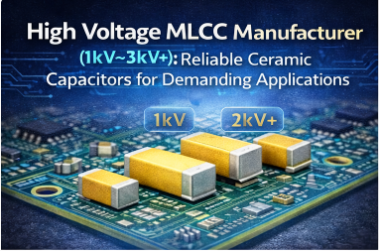
High Voltage MLCC Manufacturer (1kV–3kV+): Reliable Ceramic Capacitors for Demanding Applications
Choosing the right high voltage MLCC manufacturer is critical for applications that require 1kV, 2kV, or even 3kV+ ceramic capacitors. High-voltage multilayer ceramic capacitors (MLCCs) must meet strict requirements for dielectric strength, reliability, and long-term stability.
This article explains what high voltage MLCCs are, where they are used, key technical considerations, and how to select a reliable high voltage MLCC manufacturer.
What Are High Voltage MLCCs?
High voltage MLCCs (Multilayer Ceramic Capacitors) are ceramic capacitors designed to operate at rated voltages from 1kV up to 3kV and above.
They use specialized ceramic dielectric materials and reinforced internal structures to withstand high electric fields without breakdown.
Compared with standard MLCCs, high voltage MLCCs feature:
-
Thicker dielectric layers
-
Optimized electrode design
-
Enhanced insulation resistance
Typical Voltage Ranges: 1kV–3kV+
High voltage MLCC manufacturers commonly offer products in the following ranges:
-
1kV – 1.5kV MLCCs
-
2kV MLCCs
-
3kV MLCCs
-
Custom designs for >3kV applications
Each voltage class requires different material formulations and manufacturing controls.
Common Dielectric Types for High Voltage MLCCs
Not all dielectric materials are suitable for high-voltage operation.
C0G (NP0)
-
Extremely stable capacitance
-
Low dielectric loss
-
Suitable for precision and high-frequency circuits
X7R (High Voltage Grade)
-
Higher capacitance values
-
Wider temperature range
-
Requires proper voltage derating
High voltage MLCC manufacturers often focus on C0G and specialized X7R formulations for reliability.
Applications of High Voltage MLCCs
High voltage MLCCs are widely used in industries where electrical stress and reliability are critical.
Power and Energy Systems
-
High-voltage power supplies
-
DC-DC converters
-
Inverters
Automotive and EV Electronics
-
On-board chargers (OBC)
-
Battery management systems (BMS)
-
High-voltage control modules
Industrial Equipment
-
Industrial power modules
-
Automation systems
-
High-voltage sensing circuits
Medical and Communication Equipment
-
X-ray systems
-
RF and high-voltage signal coupling
Key Technical Requirements for High Voltage MLCCs
When evaluating a high voltage MLCC manufacturer, engineers typically consider:
-
Rated voltage and recommended derating
-
Capacitance stability under DC bias
-
Insulation resistance
-
Partial discharge performance
-
Temperature rating and aging behavior
Strict quality control is essential to ensure long-term reliability.
Manufacturing Challenges for High Voltage MLCCs
Producing MLCCs rated at 1kV–3kV+ requires:
-
Advanced ceramic material processing
-
Precise layer thickness control
-
High-voltage testing and screening
-
Stable sintering and electrode technology
Not all MLCC manufacturers have the capability to consistently produce high voltage components.
How to Choose a Reliable High Voltage MLCC Manufacturer
A reliable high voltage MLCC manufacturer should provide:
-
Verified voltage ratings and test data
-
Consistent batch quality
-
Engineering support for application design
-
Custom voltage and capacitance options
-
Long-term supply stability
For purchasing teams, second-source capability and lead time stability are also key considerations.
Custom High Voltage MLCC Solutions (1kV–3kV+)
Many applications require non-standard capacitance, voltage, or package sizes.
An experienced manufacturer can support:
-
Custom voltage ratings
-
Specialized dielectric formulations
-
Application-specific reliability testing
This is especially important in automotive, industrial, and energy applications.
Conclusion
If you are sourcing 1kV–3kV+ ceramic capacitors, selecting the right high voltage MLCC manufacturer is essential for product reliability and long-term performance.
High voltage MLCCs require advanced materials, strict quality control, and application-level engineering support. Working with a qualified manufacturer helps reduce design risk and ensures stable supply for demanding high-voltage applications.
MLCC for EV: Reliable Ceramic Capacitors for Electric Vehicle Applications
What Is the Difference Between Ceramic and Electrolytic SMD Capacitors?
مقالات لها صلة