MLCC for EV: Reliable Ceramic Capacitors for Electric Vehicle Applications
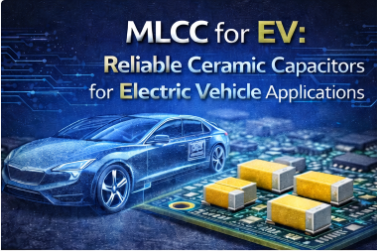
MLCC for EV: Reliable Ceramic Capacitors for Electric Vehicle Applications
The rapid growth of electric vehicles (EVs) is driving higher requirements for reliability, safety, and performance in electronic components.
MLCC for EV (Multilayer Ceramic Capacitors for Electric Vehicles) play a critical role in ensuring stable operation across high-voltage, high-temperature, and high-vibration environments.
This article explains why MLCCs are essential for EV systems, key application areas, technical requirements, and how to choose the right MLCC supplier for EV applications.
What Is MLCC for EV?
MLCC for EV refers to multilayer ceramic capacitors specifically designed or qualified for electric vehicle electronics.
Compared with general-purpose MLCCs, EV-grade MLCCs must withstand:
-
High operating voltages
-
Wide temperature ranges
-
Severe mechanical stress and vibration
-
Long service life requirements
These capacitors are widely used in powertrain, battery systems, and vehicle control electronics.
Key EV Applications Using MLCCs
1. Battery Management Systems (BMS)
MLCCs are used in BMS for:
-
Voltage sensing and signal filtering
-
MCU and IC decoupling
-
Noise suppression
High reliability and stable capacitance are essential to ensure battery safety.
2. On-Board Chargers (OBC)
In OBC systems, MLCCs support:
-
High-voltage DC filtering
-
EMI suppression
-
Power control circuits
High-voltage MLCCs (1kV–3kV+) are often required in these applications.
3. DC-DC Converters
MLCCs help stabilize:
-
Input and output voltages
-
Transient current response
Low ESR and excellent high-frequency performance make MLCCs ideal for DC-DC converters in EVs.
4. Inverters and Power Control Units
In high-power EV subsystems, MLCCs are used for:
-
Gate drive circuits
-
Signal conditioning
-
EMI filtering
Components must maintain performance under continuous electrical stress.
5. ADAS and Infotainment Systems
EVs integrate advanced electronics for:
-
ADAS sensors and controllers
-
Infotainment and connectivity
MLCCs ensure signal integrity and noise reduction in these systems.
Technical Requirements for MLCC for EV
When selecting MLCCs for EV applications, engineers typically consider:
-
High voltage rating and derating margin
-
Wide operating temperature range (–40°C to +125°C or higher)
-
Capacitance stability under DC bias
-
Low ESR and ESL
-
High insulation resistance
-
Mechanical robustness (anti-cracking design)
Automotive-grade MLCCs often comply with AEC-Q200 standards.
Common Dielectric Types Used in EV MLCCs
C0G (NP0)
-
Extremely stable capacitance
-
Low dielectric loss
-
Suitable for precision and high-frequency circuits
X7R (Automotive Grade)
-
Higher capacitance values
-
Wide temperature range
-
Commonly used for decoupling and filtering
Reliability Challenges in EV Applications
EV environments introduce unique challenges:
-
High vibration and mechanical stress
-
Thermal cycling
-
High-voltage stress
-
Long service life expectations
Using automotive-grade MLCCs with proper PCB design and derating helps prevent early failures.
How to Choose the Right MLCC Supplier for EV
A reliable MLCC supplier for EV applications should offer:
-
Automotive-grade (AEC-Q200) qualified products
-
High-voltage MLCC capability
-
Stable long-term supply
-
Engineering support for application-specific selection
-
Custom solutions for EV platforms
From a purchasing perspective, supplier reliability directly impacts production stability.
MLCC for EV: Custom and High-Voltage Solutions
EV designs often require:
-
High-voltage MLCCs (1kV–3kV+)
-
Custom package sizes
-
Specialized dielectric formulations
Experienced manufacturers can provide application-driven MLCC solutions for EV platforms.
Conclusion
MLCC for EV applications are essential components that support safety, efficiency, and reliability in electric vehicles.
From BMS and OBC to inverters and ADAS systems, selecting the right MLCC—and the right supplier—ensures long-term performance in demanding EV environments.
High Voltage MLCC for EV & Power Modules: Reliable Ceramic Capacitors for High-Power Applications
High Voltage MLCC Manufacturer (1kV–3kV+): Reliable Ceramic Capacitors for Demanding Applications
مقالات لها صلة