Common Capacitor Questions Expert Answers to Solve Your Design Sourcing Challenges
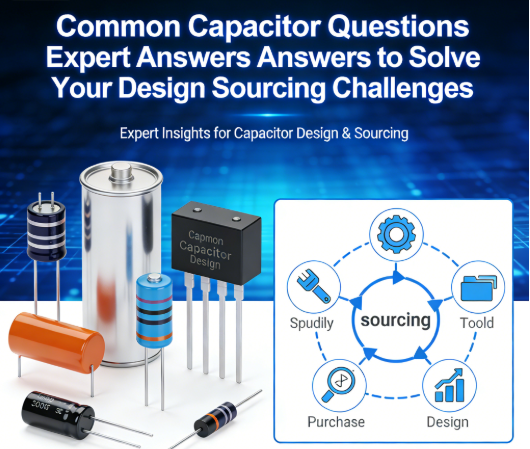
Common Capacitor Questions: Expert Answers to Solve Your Design & Sourcing Challenges
Capacitors are essential components in nearly every electronic device, from consumer electronics to industrial machinery and automotive systems. Yet, engineers, procurement professionals, and even seasoned technicians often encounter confusion when selecting, using, or troubleshooting capacitors. To help you avoid costly mistakes and optimize performance, we’ve compiled the most common questions about capacitors—along with clear, actionable answers tailored to 2026 industry standards.
1. What’s the Difference Between MLCCs and Other Capacitor Types, and When Should I Choose Each?
The market offers several capacitor types, but MLCCs (Multi-Layer Ceramic Capacitors) are among the most widely used—thanks to their compact size, high reliability, and fast response. Here’s how they compare to other common types and when to select each:
- MLCCs: Best for miniaturized devices (e.g., smartphones, IoT sensors) and high-frequency applications. They offer low equivalent series resistance (ESR) and long lifespans, but are less ideal for high-capacitance needs (typically up to 100µF).
- Aluminum Electrolytic Capacitors: Ideal for high-capacitance requirements (1µF to 10,000µF) in power supplies and audio equipment. They are cost-effective but larger and have shorter lifespans due to electrolyte degradation.
- Tantalum Capacitors: Suitable for high-reliability applications (e.g., medical devices, aerospace) with moderate capacitance needs. They offer stable performance but are more expensive and sensitive to voltage spikes.
- Film Capacitors: Perfect for high-voltage, high-frequency circuits (e.g., power inverters) where low leakage and high stability are critical. They are durable but bulkier than MLCCs.
Pro Tip: For most modern compact electronics, MLCCs are the go-to choice—pair them with aluminum electrolytic capacitors for designs that require both small size and high capacitance.
2. Why Does Capacitance Drop Over Time, and How Can I Prevent It?
A common frustration with capacitors is gradual capacitance loss, which can lead to device malfunctions or premature failure. The primary causes vary by capacitor type, but there are simple steps to mitigate this issue:
- MLCCs: Capacitance loss is often due to the DC bias effect (capacitance decreases under applied DC voltage) or temperature fluctuations. To prevent this, oversize the capacitor’s voltage rating by 50–100% and choose dielectrics like X7R (stable across -55°C to +125°C) instead of Y5V (prone to large capacitance drops at high temperatures).
- Electrolytic Capacitors: Capacitance loss occurs as the electrolyte dries out over time, especially in high-temperature environments. Opt for low-temperature coefficient electrolytic capacitors and avoid operating them near their maximum temperature rating.
Regularly testing capacitors with a multimeter can also help detect capacitance loss early, allowing you to replace components before they cause issues.
3. How Do I Select the Right Capacitor Voltage Rating for My Circuit?
Choosing the correct voltage rating is critical—using a capacitor with a voltage rating too low can cause it to fail (or even explode), while overrating can increase cost and size unnecessarily. Follow these guidelines:
- Identify the maximum voltage in your circuit: This includes peak voltage (not just average) and any voltage spikes (common in power supplies or motor-driven circuits).
- Add a safety margin: For most applications, select a capacitor with a voltage rating that is 1.5–2 times the maximum circuit voltage. For example, if your circuit has a peak voltage of 12V, choose a 25V capacitor.
- Consider environmental factors: High temperatures reduce a capacitor’s effective voltage rating—if your device operates in high-heat settings (e.g., automotive engine bays), increase the safety margin to 2x the maximum voltage.
Note: MLCCs are particularly sensitive to voltage derating, so always check the manufacturer’s datasheet for voltage vs. capacitance curves.
4. Can Capacitors Be Used Interchangeably, and What Happens If I Use the Wrong One?
While it may be tempting to interchange capacitors based on capacitance alone, this can lead to serious issues. Capacitors are not interchangeable unless they match key specifications:
- Voltage Rating: As mentioned, using a lower voltage rating than required will cause failure. Using a higher rating is safe but may not be cost-effective.
- Capacitance Value: A capacitor with too low capacitance may not filter noise effectively or store enough charge, while too high capacitance can cause circuit delays or damage sensitive components.
- Dielectric Type: For MLCCs, dielectrics like X7R and Y5V have different stability characteristics—swapping them can lead to unpredictable performance.
- ESR/ESL: Equivalent Series Resistance (ESR) and Equivalent Series Inductance (ESL) affect high-frequency performance—using a capacitor with higher ESR/ESL than specified can cause overheating or signal distortion.
If you need to substitute a capacitor, always match voltage rating, capacitance, and dielectric type first—then verify ESR/ESL with the manufacturer’s datasheet.
5. How to Ensure Capacitor Compliance with Global Regulations?
With global regulations like EU RoHS, California Prop 65, and China’s GB/T 26572, ensuring capacitor compliance is non-negotiable for most industries. Here’s how to avoid compliance risks:
- Choose lead-free capacitors: Most regulations restrict lead content to <0.1%. Look for capacitors marked with the "Pb-free" symbol or RoHS certification.
- Verify manufacturer credentials: Work with suppliers who provide RoHS, REACH, and IATF 16949 (for automotive) certificates. Avoid uncertified suppliers, as non-compliant capacitors can lead to product recalls.
- Check for hazardous substances: Ensure capacitors do not contain other restricted substances (e.g., cadmium, mercury) as specified by regional regulations.
For automotive or medical applications, additional compliance requirements may apply—always consult the relevant industry standards (e.g., AEC-Q200 for automotive capacitors).
Final Takeaways
Selecting and using capacitors correctly is key to building reliable, high-performance electronic devices. By understanding the differences between capacitor types, addressing capacitance loss, choosing the right voltage rating, avoiding interchangeability mistakes, and ensuring compliance, you can minimize risks and optimize your designs.
At Barron MLCC, we offer a wide range of high-quality MLCCs and other capacitors, backed by engineering expertise to help you find the perfect solution for your application. Contact our team today for personalized advice or to explore our product line.
Frequently Asked Questions About Capacitors A Comprehensive Guide for Engineering and Procurement Professionals
Top 5 Most Common Capacitor Questions
مقالات لها صلة