MLCC Alternative Selection End-of-Life Risk Mitigation for Automotive Electronics
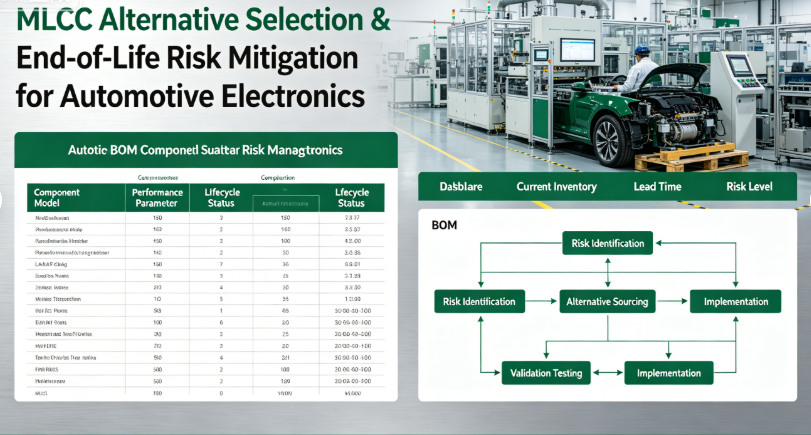
MLCC Alternative Selection & End-of-Life Risk Mitigation for Automotive Electronics
musen laidun Introduction
In automotive electronics and high-frequency power projects, MLCC supply shortage, long lead time, manufacturer end-of-life (EOL) and material discontinuance have become normal industry pain points. Many R&D and procurement teams face huge risks: improper alternative selection leads to circuit instability, EMI failure, temperature drift, batch cracking, and even re-certification and production line shutdown losses.
Different from consumer-grade replacement, automotive-grade MLCC alternative cannot only look at package and capacitance value. It must comprehensively match certification standard, dielectric material, temperature range, DC-bias characteristic, ESR/ESL performance and mechanical reliability.
This article shares practical principles, standard guidelines, common alternative scenarios and EOL emergency strategies, helping engineering and supply chain teams quickly complete compatible replacement while avoiding reliability risks and re-certification costs.
Quick Key Takeaways
- Replacement must follow AEC-Q200 consistency, same dielectric system and full temperature range matching.
- Pin-to-pin replacement needs consistent voltage rating, tolerance, ESR/ESL and DC-bias attenuation curve.
- High-frequency and motor drive applications cannot simply replace with general-purpose MLCCs; high-frequency characteristics must be verified.
- Establish multi-supplier backup, safety inventory and pre-qualified alternative library to respond to EOL and shortage.
- Complete parameter testing, thermal cycling and board-level verification before mass replacement.
1. Core Principles of Automotive MLCC Replacement
Automotive electronic projects cannot adopt blind replacement only by appearance and nominal capacitance. The following principles must be followed:
- Certification Consistency
Replacements must maintain AEC-Q200 qualification; non-automotive-grade MLCCs are prohibited from being used in vehicle-related safety and power modules. - Dielectric & Temperature Coefficient Consistency
Keep the same dielectric type such as X7R / X8R; ensure the temperature drift range is consistent within -40°C~125°C. Changing dielectric will directly cause capacitance drift and filtering failure. - DC-Bias Characteristic Matching
In high-voltage inverter, OBC and motor drive circuits, the alternative model must have similar DC-bias attenuation ratio. Simply replacing with ordinary MLCCs will lead to sharp effective capacitance drop under working bias. - Electrical Parameter Margin Retention
Maintain or upgrade voltage rating, capacitance tolerance and ripple current resistance; never downgrade specifications for cost or delivery time. - Mechanical Structure Consistency
For high-vibration scenarios, keep the same anti-crack package or flexible termination structure to avoid PCB bending and vibration-induced cracking.
2. Pin-to-Pin Compatible Selection Guidelines
For direct drop-in replacement, all key dimensions and electrical performance must be fully aligned:
- Same package size: 0201 / 0402 / 0603 / 1206 without pad modification
- Rated voltage: keep the same or higher, cannot be reduced
- Capacitance tolerance: maintain ±5%, ±10% consistency
- ESR / ESL: close impedance parameters to avoid high-frequency filtering deviation
- Self-resonant frequency: match the original working frequency band
- Solder terminal structure: the same plating layer and bending stress tolerance
Only when all above items are consistent can it be regarded as true pin-to-pin replacement without PCB modification, software adjustment and re-certification.
3. Common Alternative Scenarios & Matching Rules
Scenario 1: General MLCC upgrade to automotive-grade
Rule: Unify X7R/X8R dielectric, upgrade to AEC-Q200, retain original package, voltage and capacitance; priority select low DC-bias attenuation version.
Scenario 2: High-frequency power & motor drive replacement
Rule: Prioritize low ESR / low ESL high-frequency MLCCs; ensure SRF higher than operating frequency; prohibit replacing high-frequency dedicated MLCCs with general medium-high capacitance models.
Scenario 3: High DC-bias working condition replacement
Rule: Select X8R low-attenuation material; reserve 30%–50% effective capacitance margin after bias decay.
Scenario 4: Large package downgrade to small package for space optimization
Rule: Ensure the same voltage, capacitance and reliability grade; verify mechanical stress and soldering thermal shock adaptability before switching.
4. EOL & Supply Shortage Emergency Response Strategy
4.1 Build Pre-Qualified MLCC Alternative Library
Classify by package, capacitance, voltage and application (automotive / industrial / high-frequency); pre-test and reserve 2–3 compatible alternative models for each commonly used part number. When shortage or EOL occurs, it can be switched directly without repeated verification.
4.2 Multi-Supplier Dual-Source Supply
Avoid single-supplier dependence; cooperate with qualified manufacturers such as Musen Leyton with complete AEC-Q200 production lines, stable delivery and full batch traceability. Realize flexible order allocation and risk hedging.
4.3 Safety Inventory & Long-Term Lifecycle Planning
Set reasonable safety inventory for core automotive MLCCs; make annual demand forecast with suppliers, lock capacity and price, and prevent raw material price fluctuation and capacity cut-off.
4.4 Advance EOL Notification Mechanism
Establish regular communication with suppliers to obtain EOL plan, replacement recommendation and last order schedule in advance, leaving sufficient time for design switching and verification.
5. Necessary Verification Before MLCC Replacement
Before mass production switching, complete the following validation items to avoid batch quality risks:
- LCR parameter test at 1kHz and 1MHz
- DC-bias capacitance attenuation test (0–80% rated voltage)
- Temperature drift test across full temperature range
- Thermal cycling and damp heat reliability test
- Board-level EMI and power ripple actual measurement
- SMT soldering adaptability and X-ray internal structure inspection
Only after all test items pass can the alternative model be officially imported into BOM and mass production.
6. How Musen Leyton Supports MLCC Replacement & Risk Avoidance
Dongguan Musen Leyton Electronic Technology Co., Ltd., with more than 20 years of SMD MLCC and resistor manufacturing experience, provides one-stop alternative matching service for automotive and industrial customers:
- Rich AEC-Q200 automotive-grade MLCC model library, supporting pin-to-pin replacement of mainstream brand specifications
- Provide DC-bias curve, ESR frequency characteristic, reliability test report for alternative approval
- Fast sample delivery, supporting customer qualification and board-level verification
- Stable monthly capacity, dual-source backup supply and long-term lifecycle supply guarantee
- Professional engineering team provides free BOM review, alternative recommendation and risk evaluation
Conclusion
MLCC alternative selection and EOL risk management are essential systematic work for automotive electronic R&D, procurement and supply chain teams.
Adhering to certification consistency, dielectric matching, electrical parameter synchronization and mechanical reliability equivalence can avoid hidden failures, re-certification costs and production line shutdown losses.
Building a pre-qualified alternative library, dual supplier mechanism and complete verification process is the most effective way to deal with material shortage, price fluctuation and manufacturer discontinuance.
If you need BOM MLCC alternative sorting, automotive-grade replacement recommendation and free sample testing, welcome to contact our technical team.
Contact Us | WhatsApp Support
Common MLCC Selection Mistakes in Automotive Electronics & Practical Avoidance Guide
MLCC Typical Failure Cases & Root-Cause Solutions in Automotive High-Frequency Applications
مقالات لها صلة