Top 5 Most Common Capacitor Questions
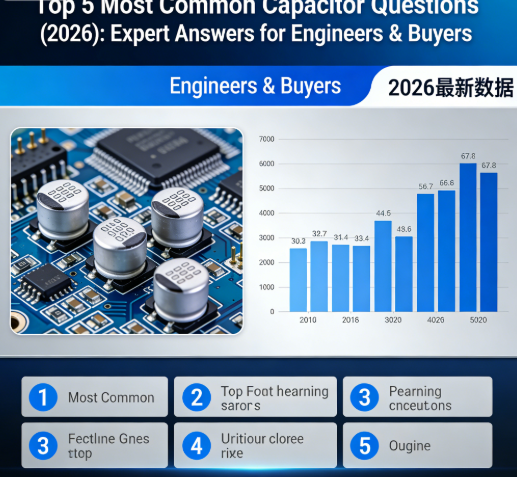
Top 5 Most Common Capacitor Questions (2026): Expert Answers for Engineers & Buyers
MLCC Expert Guide | Automotive, Industrial IoT & Medical Electronics
When selecting, using, or sourcing capacitors—whether for automotive electronics, industrial IoT, or medical devices—engineers and procurement teams often face critical questions that directly impact product performance and cost. Below are the 5 most common, under-addressed capacitor FAQs we’ve compiled from years of serving MLCC (Multi-Layer Ceramic Capacitor) clients, with actionable insights tailored to 2026 industry demands.
1. Why Do Capacitors Fail Prematurely in High-Temperature Environments?
Premature capacitor failure in high-heat settings (e.g., automotive engine bays, industrial power supplies) is a top complaint—but the root cause is rarely "low quality." Most failures stem from mismatched dielectric materials and operating temperature ranges, combined with neglect of DC bias effects.
For MLCCs, the key fix is selecting the right dielectric:
- X7R dielectrics perform reliably between -55°C and +125°C, making them ideal for automotive and industrial applications;
- Y5V dielectrics, while cost-effective, lose up to 80% of capacitance above +85°C—avoid them in high-temperature scenarios.
Additionally, derate capacitance by 20-30% when operating near the maximum temperature rating, as heat accelerates electrolyte degradation (for electrolytic capacitors) or dielectric leakage (for MLCCs).
Pro Tip: For EV battery management systems (BMS), choose "high-temperature MLCCs" with a +150°C rating and low ESR (Equivalent Series Resistance) to minimize heat generation.
2. How to Choose Between MLCCs and Aluminum Electrolytic Capacitors for Power Supply Designs?
The MLCC vs. aluminum electrolytic capacitor debate hinges on four core factors: capacitance needs, space constraints, lifespan, and cost. Here’s a clear decision framework for 2026 designs:
| Factor | MLCCs | Aluminum Electrolytic Capacitors |
| Capacitance Range | Ideal for low-to-medium capacitance (1pF–100µF) | Better for high capacitance (1µF–10,000µF) |
| Size | Compact (0402–2220 case sizes) – perfect for miniaturized devices | Larger footprint – requires more board space |
| Lifespan | 20,000+ hours at +125°C (no electrolyte leakage) | 1,000–10,000 hours at +105°C (electrolyte degrades over time) |
| Cost Efficiency | Cost-effective for low capacitance; higher per µF for large values | Lower cost per µF for high capacitance needs |
Use Case Example: For 5G base station power supplies (needing high capacitance + compact size), combine MLCCs (for decoupling) with polymer electrolytic capacitors (for bulk capacitance) to balance performance and cost.
3. What Is DC Bias Effect, and How Does It Impact Capacitor Performance?
The DC bias effect—where a capacitor’s effective capacitance decreases under applied DC voltage—is one of the most misunderstood phenomena in capacitor selection, especially for MLCCs.
Here’s the critical breakdown:
- For X7R MLCCs, applying 50% of the maximum rated voltage can reduce capacitance by 10–30%; for Y5V MLCCs, this drop can exceed 50%.
- This matters for applications like voltage regulators or audio circuits, where stable capacitance is critical for signal integrity.
Solution: Oversize the capacitor’s voltage rating by 50–100% to mitigate DC bias. For example, if your circuit applies 12V DC, choose a 25V MLCC instead of a 16V model. Use manufacturer-provided DC bias curves (often found in technical datasheets) to verify capacitance retention at your operating voltage.
4. How to Calculate the Right Capacitor Value for Decoupling Applications?
Decoupling capacitors stabilize voltage for sensitive components (e.g., microcontrollers, FPGAs) by filtering out noise—but choosing the wrong value can lead to signal distortion or component failure.
Follow this 3-step calculation method for 2026 designs:
- Identify the maximum current draw (I) of the component (e.g., 100mA);
- Determine the allowable voltage ripple (ΔV) – typically 5–10% of the supply voltage (e.g., 0.3V for a 5V supply);
- Use the formula: C = I × Δt / ΔV, where Δt is the time between power supply pulses (e.g., 1µs for high-speed components).
Example: C = (100mA × 1µs) / 0.3V = 333nF. Round up to the nearest standard value (330nF or 470nF) and pair with a 0.1µF MLCC for high-frequency noise filtering.
Bonus Tip: For high-speed digital circuits (≥1GHz), use 0402 or 0603 case size MLCCs—their low parasitic inductance improves decoupling efficiency.
5. Are Lead-Free Capacitors Mandatory, and How to Verify Compliance?
With global regulations like EU RoHS, California Prop 65, and China’s GB/T 26572 tightening, lead-free capacitors are mandatory for most commercial, automotive, and medical products in 2026. However, many buyers struggle to verify compliance.
Here’s how to ensure your capacitors meet lead-free standards:
- Check the manufacturer’s RoHS compliance certificate (look for "Pb < 0.1%" in the material declaration);
- Verify the capacitor’s case marking: Lead-free MLCCs often include a "Pb-free" symbol or "RoHS" label;
- For automotive applications, confirm compliance with IATF 16949 (quality management standard) and ELV (End-of-Life Vehicle) regulations, which restrict lead and other hazardous substances.
Warning: Avoid "lead-free claimed" capacitors from uncertified suppliers—non-compliant components can lead to product recalls or import bans.
Final Thoughts
Addressing these five common capacitor questions not only solves immediate design and sourcing challenges but also ensures your products meet 2026 industry standards and performance expectations. Whether you’re selecting MLCCs for EVs, decoupling capacitors for IoT devices, or high-temperature capacitors for industrial equipment, focusing on dielectric matching, DC bias mitigation, and compliance will minimize risks and maximize reliability.
For personalized capacitor selection advice or to explore Barron MLCC’s lead-free, high-performance product line, contact our engineering team today.
Contact Barron MLCC
Common Capacitor Questions Expert Answers to Solve Your Design Sourcing Challenges
Top 5 Questions About Barron MLCC Website Updates 2026 MLCC Industry Trends
مقالات لها صلة