What Is the Difference Between Ceramic and Electrolytic SMD Capacitors?
What Is the Difference Between Ceramic and Electrolytic SMD Capacitors?
What is the difference between ceramic and electrolytic SMD capacitors?
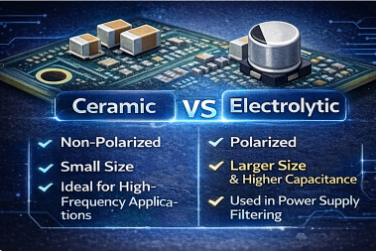
The main difference lies in dielectric material, polarity, capacitance range, frequency behavior, size, and reliability. Ceramic SMD capacitors are non-polarized with excellent high-frequency performance, while electrolytic SMD capacitors are polarized and offer much higher capacitance for bulk energy storage.
This article compares ceramic vs electrolytic SMD capacitors from an engineering and sourcing perspective, helping you choose the right capacitor for your application.
What Is a Ceramic SMD Capacitor?
A ceramic SMD capacitor, also known as an MLCC (Multilayer Ceramic Capacitor), uses a ceramic dielectric material stacked in multiple layers to achieve capacitance in a compact package.
Key Characteristics of Ceramic SMD Capacitors
-
Non-polarized
-
Very low ESR and ESL
-
Excellent high-frequency performance
-
Small package sizes (0402, 0603, 0805, etc.)
Common Dielectric Classes
-
C0G (NP0): Ultra-stable, low loss
-
X7R: Balanced performance and stability
-
X5R: Higher capacitance, lower stability
Typical Applications
-
Decoupling and bypassing
-
RF and high-speed digital circuits
-
EMI noise suppression
What Is an Electrolytic SMD Capacitor?
An electrolytic SMD capacitor uses an electrolyte as part of its dielectric system.
The most common types are aluminum electrolytic and tantalum electrolytic capacitors.
Key Characteristics of Electrolytic SMD Capacitors
-
Polarized (positive and negative terminals)
-
Much higher capacitance values
-
Larger physical size
-
Higher ESR compared to ceramic capacitors
Typical Applications
-
Bulk energy storage
-
Power supply input/output filtering
-
DC voltage smoothing
Ceramic vs Electrolytic SMD Capacitors: Key Differences
| Feature | Ceramic SMD Capacitor | Electrolytic SMD Capacitor |
|---|---|---|
| Dielectric material | Ceramic | Electrolyte (liquid or solid) |
| Polarity | Non-polarized | Polarized |
| Capacitance range | pF to ~100 µF | µF to thousands of µF |
| ESR | Very low | Higher |
| Frequency performance | Excellent | Limited at high frequency |
| Package size | Very small | Larger |
| Lifetime | Very long | Limited (electrolyte aging) |
How Ceramic and Electrolytic Capacitors Work Together
In many designs, ceramic and electrolytic SMD capacitors are used together, not as replacements.
-
Ceramic capacitors handle high-frequency noise and fast transients
-
Electrolytic capacitors provide bulk capacitance and energy storage
This combination ensures both stability and efficiency in power circuits.
Which One Should You Choose?
Choose Ceramic SMD Capacitors When:
-
High-frequency performance is critical
-
Space is limited
-
Non-polarized operation is required
Choose Electrolytic SMD Capacitors When:
-
Large capacitance is needed
-
Power supply smoothing is required
-
Cost per µF matters more than size
From a purchasing perspective, electrolytic capacitors may require closer attention to lifetime, temperature rating, and sourcing stability.
Reliability and Sourcing Considerations
Ceramic capacitors generally offer:
-
Longer lifetime
-
Better temperature stability
-
Lower failure rates
Electrolytic capacitors require:
-
Proper voltage derating
-
Lifetime estimation
-
Reliable suppliers
Understanding these differences helps reduce field failures and redesign risks.
Conclusion
So, what is the difference between ceramic and electrolytic SMD capacitors?
Ceramic SMD capacitors are non-polarized, compact, and ideal for high-frequency applications, while electrolytic SMD capacitors are polarized, larger, and designed for bulk energy storage.
Selecting the right type—or combining both—ensures optimal circuit performance and long-term reliability.
High Voltage MLCC Manufacturer (1kV–3kV+): Reliable Ceramic Capacitors for Demanding Applications
What Are the Types of SMD Capacitors? A Complete Guide for Engineers
Article associé