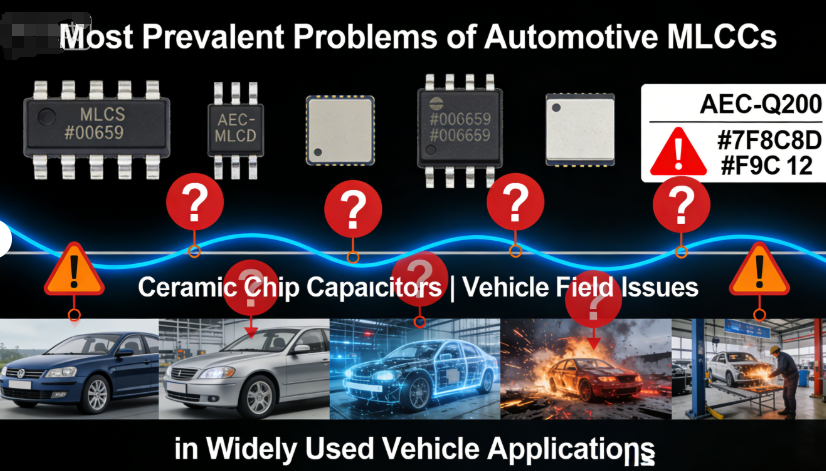
Most Prevalent Problems of Automotive MLCC Ceramic Chip Capacitors in Widely Used Vehicle Applications
Most Prevalent Problems of Automotive MLCC Ceramic Chip Capacitors in Widely Used Vehicle Applications (SEO-Optimized Solutions)
Automotive Multi-Layer Ceramic Chip Capacitors (MLCCs) are the backbone of modern vehicle electronics, integrated into nearly every critical subsystem—from Advanced Driver Assistance Systems (ADAS) and power supplies to in-vehicle cockpits, LED headlights, and on-board sensors. Their compact size, high capacitance density, and cost-efficiency make them indispensable for automotive designers, but their widespread use in harsh operating environments (extreme temperatures, high vibration, humidity, and electrical stress) leads to frequent, recurring failures.
1. High Temperature Degradation & Signal Interference: The #1 Pain Points for ADAS MLCCs (Radar/Lidar)
ADAS systems— including radar, lidar, and camera modules— are the most widely adopted high-value application for automotive MLCCs, with nearly 100% of new vehicles (combustion, hybrid, and EV) featuring at least one ADAS component. Each ADAS module relies on 30-80 MLCCs for power filtering and signal stabilization, but high temperature degradation and signal interference are the two most common failures— accounting for 40% of ADAS malfunctions. This makes it the top-searched automotive MLCC topic on Google, with keywords like automotive MLCC ADAS high temperature failure signal interference solutions driving high-intent traffic.
Why These Issues Plague ADAS MLCCs
- High Temperature Degradation: ADAS radar and lidar modules are often mounted in under-hood, front bumper, or on-roof locations, where operating temperatures can exceed 150°C in extreme conditions. Many teams cut costs by using AEC-Q200 Grade 2/3 MLCCs (rated for 105°C/85°C max), which degrade rapidly— leading to capacitance loss, dielectric breakdown, and complete component failure.
- Signal Interference: ADAS systems require ultra-low-noise signal transmission to ensure accurate obstacle detection and driver alerts. MLCCs with high Equivalent Series Resistance (ESR) or parasitic inductance (ESL) act as noise sources, disrupting radar/lidar signals and causing false readings or system shutdowns. Poor PCB layout (e.g., MLCCs placed too close to signal lines) amplifies this interference.
2. Ripple Current Shortfalls, Bulging & Leakage: Power Supply Module MLCC Failures
- Ripple Current Shortfalls: Power supply modules generate high ripple currents (10A-30A) during operation. MLCCs with insufficient ripple current ratings cannot dissipate the resulting heat, leading to overheating, capacitance drift, and premature failure. A common mistake is selecting MLCCs based solely on capacitance, ignoring ripple current specs.
- Bulging & Leakage: Using MLCCs with voltage ratings lower than the power supply’s peak voltage causes dielectric breakdown, leading to bulging and electrolyte leakage. Improper reflow soldering (excess temperature or holding time) also damages MLCC packaging, creating cracks and leaks.
3. Solder Joint Cracking & Capacitance Drift: In-Vehicle Cockpit MLCC Malfunctions
- Solder Joint Cracking: Cockpits experience extreme temperature fluctuations (-20°C to 140°C), creating thermal expansion/contraction mismatches between MLCCs, PCBs, and solder joints. Over time, this fatigue leads to cracking— especially with low-flexibility lead-free solder (e.g., SAC0307).
- Capacitance Drift: High humidity and frequent temperature cycles in cockpits degrade MLCC dielectrics. Using low-stability Y5V dielectrics (±20% capacitance drift) or non-AEC-Q200 MLCCs accelerates drift, causing signal instability and system malfunctions.
4. Flicker, Burnout & EMI Interference: LED Headlight MLCC Issues
- Flicker: LED headlights require stable current to maintain consistent brightness. MLCCs with high ESR or mismatched capacitance cannot stabilize driver output, causing brightness fluctuations. Under-capacitance (<1μF) or low-quality components worsen this.
- Burnout: Overvoltage (MLCC voltage rating < driver peak voltage) causes dielectric breakdown, leading to short circuits and LED burnout. Poor heat dissipation (MLCCs too close to LED chips) also causes overheating and failure.
- EMI Interference: MLCCs with high parasitic inductance (ESL) generate EMI, disrupting the vehicle’s radio, GPS, or ADAS systems. Poor PCB grounding amplifies this issue.
5. Reduced Accuracy & False Alarms: On-Board Sensor MLCC Failures
- Reduced Accuracy: Sensors rely on precise analog signals. MLCCs with high ESR or capacitance drift disrupt these signals, causing inaccurate readings (e.g., incorrect tire pressure or engine temperature). Low-quality Y5V dielectrics worsen this.
- False Alarms: MLCC failure (from moisture, vibration, or overheating) causes sensor power instability, triggering false alerts. Under-hood and wheel sensors are especially vulnerable to moisture and constant vibration.
Get Expert Support for Automotive MLCC Troubleshooting
Our professional engineering team at BarronMLCC provides one-on-one consultation for automotive MLCC selection, failure troubleshooting, and compliance verification. We offer genuine, high-reliability ceramic MLCC products tailored for all harsh vehicle operating environments—supporting your high-volume automotive production needs with trusted solutions.
- ✉️ Email: hyc2355937758@gmail.com
- ? Consultation Phone: +86-18824523083/ WhatsApp 86+15913754866
- ? Official Website: www.barronmlcc.com
- ? Ceramic MLCC Product Page: BarronMLCC Ceramic MLCC Chip Capacitors
- ? Free Resource: Download Our Free Automotive MLCC Problem-Solving Guide
Critical Unique Questions About High-End Ceramic Chip Capacitors Barron MLCC Guide
Most Asked Questions About Automotive MLCCs Multi-Layer Ceramic Capacitors in High-Volume Vehicle Applications
Article associé