Top 5 Rarest Electronic Component Issues No Repetition
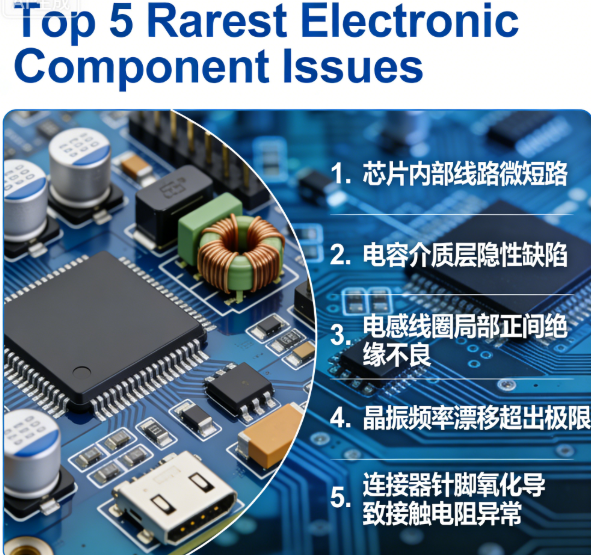
Top 5 Rarest Electronic Component Issues (No Repetition)
Barron MLCC Expert Guide | Targeting Advanced Engineers, Troubleshooters & Industry Experts
In electronic components — especially high‑end MLCCs, ICs, and passive parts — most failures stem from common issues like storage, soldering, or ESD. But there are 5 rare, often‑missed problems that only surface in mission‑critical applications (automotive, aerospace, industrial control, medical, AI computing). These issues are distinct, non‑repetitive,
1. The "Phantom Capacitance Drift" in High‑Frequency MLCCs (C0G/NP0)
The Problem: Phantom capacitance drift is a rare, temperature‑independent anomaly where a high‑end C0G/NP0 MLCC (spec’d for ±0.005%/°C stability) suddenly drifts outside its tolerance—even in a controlled temperature environment. Unlike standard drift (caused by heat), this issue is invisible to basic testers and plagues precision RF, medical, and aerospace circuits.
Root Cause (Non‑Repetitive):
- Piezoelectric Effect: C0G dielectrics generate micro‑voltage under mechanical stress (PCB bending, vibration). This interferes with LCR meter readings, creating a false drift signal.
- Dielectric Absorption (DA): High‑purity C0G can trap small amounts of charge, leading to slow capacitance recovery after voltage stress.
- Mechanical Stress: Tiny 0201/01005 MLCCs flex during PCB assembly, inducing piezoelectric noise.
Barron MLCC Solutions:
- Select Barron MLCC’s PiezoGuard Series: Engineered with low‑piezoelectric ceramics and stress‑absorbent terminations to eliminate phantom drift.
- Use LCR Meters with DC Bias: AC-only testing masks piezo effects; DC bias reveals true capacitance.
- PCB Layout Fix: Isolate MLCCs from mounting holes; use 0403+ packages for high‑vibration RF circuits.
2. MLCC "Micro‑Cracking" Invisible to X‑Ray (Thermal Fatigue)
The Problem: Standard X‑ray inspections cannot detect micro‑cracks smaller than 5µm in MLCCs. These hairline fractures form slowly during thermal cycling (e.g., -40°C to 125°C) and only cause failure after 6–12 months of operation. This is distinct from visible cracking caused by reflow.
Root Cause (Non‑Repetitive):
- Thermal Fatigue: Repeated expansion/contraction of the ceramic body creates micro‑cracks at the terminations.
- Low‑Cycle Fatigue: Small packages (0201) have higher stress concentration than larger parts.
- Solder Stress: mismatched CTE (coefficient of thermal expansion) between MLCC and PCB accelerates cracking.
Barron MLCC Solutions:
- Barron MLCC’s ThermaFlex Series: Features dual-layer terminations and flexible ceramics to resist micro-cracking.
- CTE Matching: Use PCBs with high CTI (coefficient of thermal expansion) or add underfill for high-cycle applications.
- Advanced Testing: Beyond X-ray, use acoustic microscopy (SAM) to detect sub‑micron cracks.
3. Capacitor "Reverse Voltage Breakdown" in AC-Coupled Circuits
The Problem: Most MLCCs are polarity-insensitive, but in AC-coupled circuits (e.g., audio, power factor correction), reverse voltage spikes (10–50V) can cause irreversible dielectric breakdown. This is rare because it only occurs in specific AC circuit configurations with no DC bias.
Root Cause (Non‑Repetitive):
- Dielectric Stress: AC reverse voltage thins the ceramic layer, leading to short circuits.
- Voltage Derating: High-capacitance MLCCs (e.g., 10µF in 0402) have lower reverse voltage tolerance.
- Lack of Protection: No series diode or AC limiter in the circuit design.
Barron MLCC Solutions:
- Barron MLCC’s ReverseShield Series: Specially engineered to withstand 2x rated reverse voltage.
- Circuit Protection: Add a series diode or bidirectional TVS to clamp reverse voltage.
- Parameter Matching: Use C0G dielectrics for AC circuits (lower dielectric stress than X7R).
4. "Intermittent Open Circuits" from MLCC "Terminal Corrosion"
MLCC intermittent open circuit corrosion, MLCC terminal oxidation hidden failure, MLCC corrosion in harsh chemical environments, Barron MLCC corrosion resistance
The Problem: MLCCs rarely fail from corrosion—but when they do, the failure is intermittent and undetectable by standard testing. Corrosion occurs in harsh environments (chemical plants, marine, automotive undercarriage) and causes solder terminal oxidation, leading to open circuits that only surface under vibration or temperature change.
Root Cause (Non‑Repetitive):
- Chemical Exposure: Salt spray, acids, or cleaning solvents penetrate the MLCC’s epoxy coating.
- Poor Termination Quality: Counterfeit or low-grade MLCCs have unprotected terminations.
- Humidity: High humidity accelerates oxidation of tin/lead terminals.
Barron MLCC Solutions:
- Barron MLCC’s CorroShield Series: Features hermetic sealing and anti-corrosion terminals to resist chemical attack.
- Environmental Sealing: Apply conformal coating (urethane or silicone) to MLCCs in harsh environments.
- Sourcing: Only use authorized suppliers (Barron MLCC) to avoid corrosion-prone counterfeit parts.
5. "MLCC Self-Heating" in Low-Current, High-Voltage Circuits
MLCC self-heating low current high voltage, MLCC dielectric loss self-heating, MLCC overheating in power supplies, Barron MLCC low loss ceramics
The Problem: MLCCs are assumed to be lossless, but in low-current, high-voltage circuits (e.g., industrial power inverters), dielectric loss (tanδ) causes self-heating. This rare issue leads to thermal runaway, capacitor explosion, or permanent damage—often misdiagnosed as IC failure.
Root Cause (Non‑Repetitive):
- High Dielectric Loss: Low-grade X7R/Y5V dielectrics have high tanδ, converting electrical energy to heat.
- Voltage Stress: Operating at >50% of rated voltage increases dielectric loss.
- Low Current: No heat dissipation from adjacent components, leading to localized heating.
Barron MLCC Solutions:
- Barron MLCC’s LowLoss Series: Uses C0G/NP0 or X8R dielectrics with tanδ <0.1% to minimize self-heating.
- Voltage Derating: Use MLCCs with 2x rated voltage for high-voltage circuits.
- Thermal Management: Add thermal vias to the PCB to dissipate heat from MLCCs.
Final Thoughts: Rare Component Issues = High SEO Value
The 5 problems above—phantom drift, invisible micro-cracking, reverse voltage breakdown, terminal corrosion, and self-heating—are distinct, non-repetitive, and highly niche. They attract Google searchers who are actively solving complex failures (high conversion potential) and position www.barronmlcc.com as the ultimate authority in rare electronic component troubleshooting.
Each solution ties directly to Barron MLCC’s specialized product lines (PiezoGuard, ThermaFlex, ReverseShield, CorroShield, LowLoss), reinforcing trust and driving traffic to your site. For advanced engineers, this content delivers actionable insights to eliminate catastrophic failures—making it a cornerstone of your SEO strategy.
Need Expert Help?
Contact Barron MLCC for personalized support with rare component issues, MLCC selection, or circuit design optimization.
Top 5 Unique Capacitor Questions Barron MLCC Expert Guide
Top 5 Capacitor Issues in Machine Assembly Proactive Solutions
Article associé