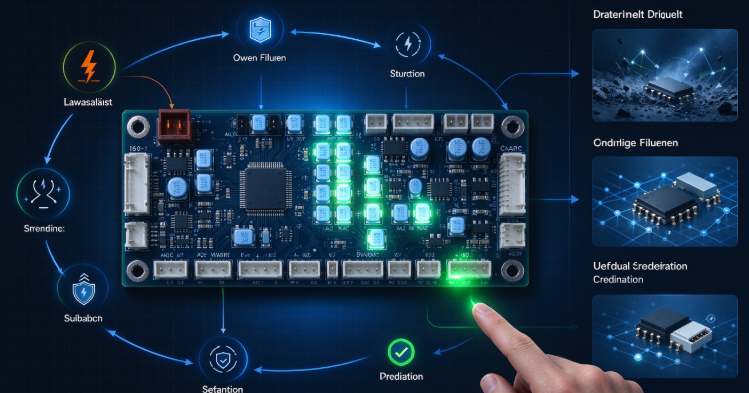
MLCC Capacitors for HVAC Control Boards A Practical Selection Guide
MLCC Capacitors for HVAC Control Boards: A Practical Selection Guide
Heating, ventilation, and air conditioning (HVAC) systems rely on electronic control boards to regulate temperature, manage fans, monitor sensors, and control compressors. These boards need reliable components that can operate under changing temperatures, electrical noise, and long operating hours.
Multilayer ceramic capacitors (MLCCs) are commonly used in HVAC electronics for power supply decoupling, signal filtering, and circuit stabilization. However, selecting the right MLCC requires more than matching capacitance and package size.
This guide explains what engineers and purchasing teams should consider when sourcing MLCC capacitors for HVAC control boards.
1. Where Are MLCCs Used in HVAC Electronics?
Modern HVAC equipment can include a main control board, temperature sensors, motor drivers, communication interfaces, and auxiliary power supplies. MLCCs may support different functions across these circuits.
Common applications include:
- Microcontroller decoupling: Helps stabilize the supply voltage near processors and control ICs.
- Temperature sensor circuits: Supports filtering where electrical noise could affect sensor readings.
- Fan and motor control boards: Provides local decoupling and filtering around driver and control circuits.
- Communication interfaces: Helps manage high-frequency noise on local power rails.
- Auxiliary power supplies: Supports filtering in low-voltage circuits that power control electronics.
The requirements vary with the circuit. A capacitor in a low-voltage temperature-sensing circuit may need different characteristics from one near a switching power supply.
Identifying the capacitor's actual function is the first step toward selecting a suitable part.
2. Choose the Right Dielectric Material
Dielectric material affects capacitance stability, temperature behavior, available capacitance, and cost.
C0G/NP0 for Stable Capacitance
C0G/NP0 MLCCs provide excellent capacitance stability over temperature and low dielectric loss. They may be suitable for precision sensing, timing, and frequency-sensitive circuits.
Their limitation is that high capacitance values are generally less available than with Class 2 ceramic dielectrics in comparable package sizes.
X7R for General Control Circuits
X7R capacitors offer a practical balance between capacitance and temperature performance. They are often considered for decoupling and filtering in control boards.
However, their effective capacitance can decrease under DC bias and change with temperature and time. Check the manufacturer's specifications when the circuit requires a minimum capacitance.
X5R for Compact Designs
X5R MLCCs can provide relatively high capacitance in a small package. They may suit space-constrained control boards, provided their temperature range and effective capacitance meet the design requirements.
Practical tip: Use C0G/NP0 when stability is a priority. Consider X7R or X5R when greater capacitance in a compact package is needed and the resulting electrical behavior is acceptable.
3. Check the Actual Voltage Conditions
HVAC equipment can contain low-voltage logic circuits alongside higher-voltage power sections. A capacitor suitable for one section may be unsuitable for another.
Before choosing an MLCC, identify:
- Normal operating voltage across the component.
- Expected startup and shutdown conditions.
- Switching transients or other foreseeable voltage stresses.
- Required effective capacitance under DC bias.
- The manufacturer's recommended operating limits.
For Class 2 MLCCs, such as X7R and X5R, DC bias can reduce effective capacitance. This means the nominal value in the product specification may not represent the capacitance available in the finished circuit.
Do not select a component based on voltage rating alone. Review the DC-bias curve and confirm that sufficient capacitance remains at the actual operating voltage.
For circuits connected to mains electricity, also check the applicable safety and insulation requirements. An ordinary MLCC should not be treated as an automatic replacement for a capacitor specifically designed and certified for a safety function.
4. Consider Temperature Changes Inside the Equipment
HVAC systems are designed to regulate temperature, but their electronic boards may still experience substantial temperature changes.
A control board installed near a compressor, motor driver, or power conversion section may experience a different thermal environment from one located in a remote wall controller.
When selecting an MLCC, consider:
- Expected minimum and maximum ambient temperatures.
- Heat generated by nearby components.
- The dielectric's temperature characteristics.
- Changes in effective capacitance across the operating range.
- Long-term aging and the expected service life of the equipment.
For circuits that require stable timing or measurement, temperature-related capacitance changes can be especially important.
For general power decoupling, a Class 2 capacitor may be appropriate if its electrical performance remains within the circuit's requirements.
Always evaluate the component at the temperature and voltage conditions expected in the actual product rather than relying only on room-temperature measurements.
5. Reduce Noise in Sensor and Motor Control Circuits
HVAC control boards often combine sensitive sensor inputs with switching circuits and motor-control electronics. These different functions can create noise-management challenges.
MLCCs can support filtering and local decoupling, but the correct component depends on the frequency and source of the disturbance.
For example, a temperature sensor input may require a filter designed around the sensor's signal bandwidth. A capacitor near a switching regulator may instead be selected to help manage high-frequency supply noise.
Engineers should consider:
- The frequency range that needs filtering.
- The capacitor's impedance across that frequency range.
- PCB trace length and grounding.
- The location of switching devices and sensitive signals.
- Interaction between multiple capacitors and PCB parasitics.
Simply increasing capacitance does not guarantee better noise performance. The complete circuit should be evaluated to confirm that the selected value and placement achieve the intended result.
6. Select a Package That Fits the Board and Assembly Process
HVAC control boards may have different space constraints depending on the product. A compact thermostat has different layout priorities from a larger air-conditioning or ventilation controller.
Smaller MLCC packages can help reduce PCB area, while larger packages may provide different capacitance and voltage options.
Package selection should account for:
- PCB footprint and available space.
- Capacitance and voltage requirements.
- Component placement near the relevant IC or signal.
- SMT assembly capability.
- Mechanical stress during board handling and installation.
Ceramic capacitors can crack when subjected to excessive mechanical stress. PCB bending, depanelization, and unsuitable assembly conditions may increase this risk.
The smallest package is therefore not always the best option. Choose a size that meets electrical needs while remaining compatible with the manufacturing process.
7. Common Sourcing Mistakes to Avoid
Purchasing teams can reduce component-selection problems by checking more than the nominal specification.
Mistake 1: Matching only capacitance and package size.
Two MLCCs with the same nominal capacitance may have different voltage, temperature, or dielectric characteristics.
Mistake 2: Ignoring DC bias.
A Class 2 MLCC may deliver less effective capacitance than expected at its operating voltage.
Mistake 3: Using the same component everywhere on the board.
Sensor circuits, power supplies, and communication interfaces may have different requirements. One specification should not be assumed to suit every position.
Mistake 4: Changing manufacturers without reviewing the datasheet.
A replacement should be checked for capacitance, voltage rating, dielectric, tolerance, temperature range, dimensions, and other relevant parameters.
Mistake 5: Buying only according to the lowest unit price.
For products expected to remain in production for years, consistent specifications, traceability, and future availability can be important to total procurement cost.
8. What Information Should You Provide When Requesting a Quote?
Clear specifications help suppliers identify suitable MLCC options and reduce unnecessary quotation delays.
| Item | Information to confirm |
|---|---|
| Capacitance | Nominal value and required effective value |
| Rated voltage | Required voltage rating and operating conditions |
| Dielectric | C0G/NP0, X7R, X5R, or another specified type |
| Tolerance | Required capacitance tolerance |
| Package size | PCB footprint and dimensions |
| Temperature range | Expected operating environment |
| Part number | Original manufacturer part number or approved alternative |
| Quantity | Prototype, trial production, or mass production |
| Documentation | Traceability and applicable inspection requirements |
If you are replacing an existing component, providing the original part number is usually the easiest starting point. Any proposed substitute should be checked against the circuit requirements before approval.
For long-running HVAC product lines, it is also helpful to discuss forecast quantities and future replenishment needs early.
Conclusion
MLCC capacitors support important functions in HVAC control boards, including power decoupling, sensor filtering, and noise management. The right component depends on the circuit's electrical requirements, temperature environment, dielectric characteristics, package size, and manufacturing conditions.
A practical selection process begins with the function of each capacitor, verifies its performance under real operating conditions, and confirms that the selected part can be sourced consistently.
If you are sourcing MLCCs for HVAC control boards, thermostats, fan controllers, or other climate-control electronics, send your required part number, specifications, and estimated quantity to Barron MLCC. We can help you review suitable component options for your purchasing needs.
Contact Barron MLCC
Email: hyc2355937758@gmail.com
WhatsApp: +86 15913754866
Tel: +86 18824523083
Website: barronmlcc.com
MLCC Capacitors for Elevator Control Systems A Practical Selection Guide
MLCC Capacitors for Solar Inverters How to Choose the Right Components
Related Article