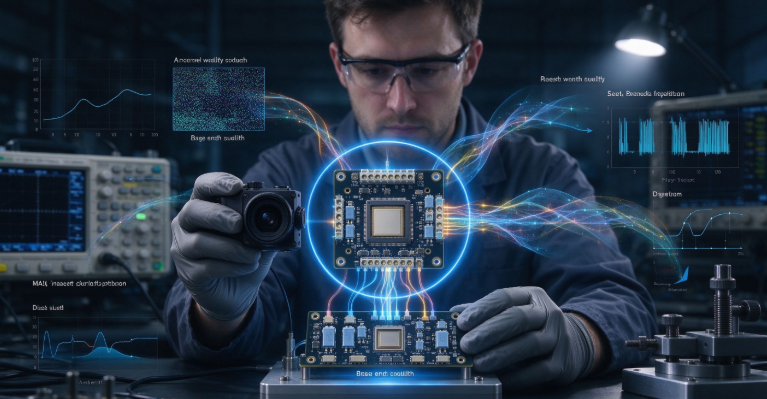
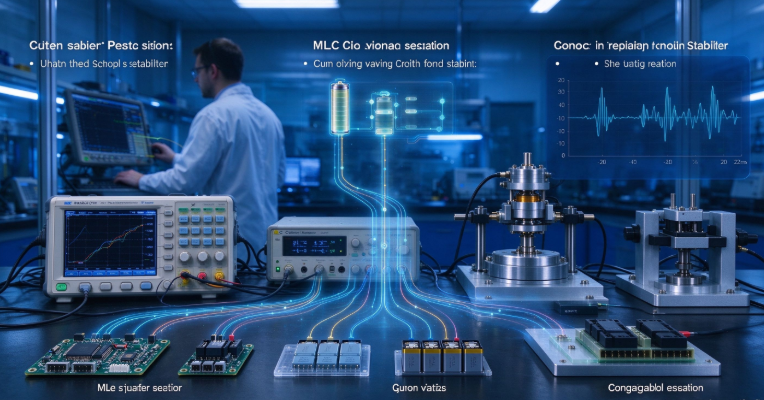
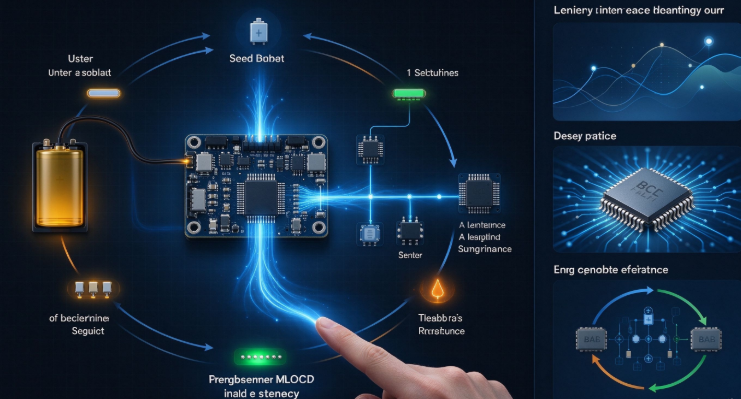
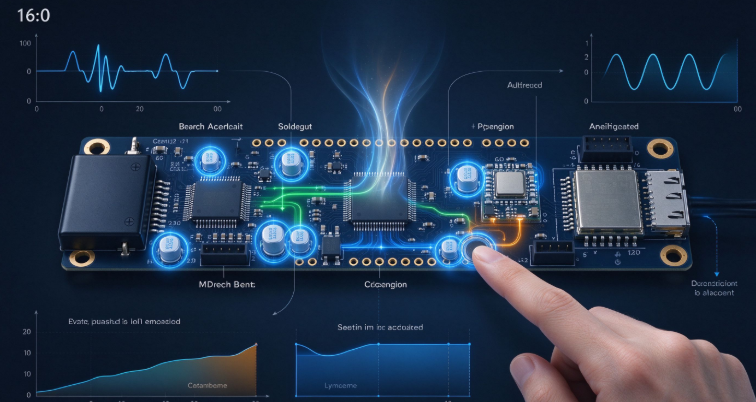
MLCCs for Industrial Ethernet Devices Power Integrity Noise Control and Reliability
MLCCs for Industrial Ethernet Devices: Power Integrity, Noise Control, and Reliability
Industrial Ethernet connects programmable logic controllers (PLCs), remote I/O modules, industrial computers, sensors, drives, and other equipment across factory networks. Unlike many office networking products, industrial Ethernet devices may need to operate continuously in environments with electrical noise, temperature changes, and demanding maintenance requirements.
Multilayer ceramic capacitors (MLCCs) help these devices maintain stable power supplies, reduce high-frequency disturbances, and support sensitive communication circuits.
However, industrial Ethernet hardware combines digital processing, communication interfaces, and power conversion. A capacitor that works well on a processor power rail may not be suitable for a PHY supply, an isolated DC-DC converter, or a precision clock circuit.
This guide explains where MLCCs are used in industrial Ethernet equipment and what engineers and purchasing teams should check before selecting components.
1. Where Are MLCCs Used in Industrial Ethernet Devices?
Industrial Ethernet equipment can include network switches, Ethernet interface modules, PLC communication boards, remote I/O devices, and industrial gateways.
Depending on the design, MLCCs may be used in several circuit areas.
Ethernet PHY power supplies: Local decoupling capacitors help provide high-frequency current near the physical-layer transceiver IC.
Processor and controller rails: Microcontrollers, FPGAs, and processors may require multiple supply rails with different decoupling requirements.
Isolated power converters: MLCCs may serve as input or output filtering and decoupling components, subject to the converter's design requirements.
Clock and timing circuits: Stable capacitors may be needed in selected oscillator or timing circuits.
Analog and sensing circuits: Capacitors can support filtering and decoupling for monitoring functions and analog interfaces.
Each position has a different electrical purpose. The first step is to identify the circuit function and follow the relevant IC manufacturer's reference design.
2. Ethernet PHY Decoupling: Why Placement Matters
The Ethernet PHY handles the physical-layer signaling between the digital system and the network interface. Its supply pins require appropriate power integrity to support reliable operation.
MLCCs are commonly used for local decoupling because they can provide low-impedance paths for high-frequency current when selected and mounted appropriately.
Three factors are especially important.
Follow the PHY manufacturer's recommendations
Different PHY devices may have different supply voltages, current demands, and decoupling requirements.
Review the reference schematic, recommended capacitor values, package requirements, and PCB layout guidance. Do not assume that the same capacitor arrangement is suitable for every Ethernet PHY.
Keep the decoupling loop short
A capacitor's real high-frequency performance depends on the complete mounting path, including PCB traces, vias, and return-current connections.
Place the capacitor close to the relevant power pin and provide a suitable return path. Long connections can add parasitic inductance and reduce the effectiveness of high-frequency decoupling.
Check effective capacitance
Class II MLCCs, including X7R and X5R, can lose capacitance under DC bias. The effective capacitance may be lower than the nominal value printed in the datasheet.
When a circuit requires a minimum capacitance, check the manufacturer's DC-bias data at the actual operating voltage.
Good component selection and good placement must work together. Neither can fully compensate for deficiencies in the other.
3. Power Filtering in Industrial Ethernet Switches
Industrial Ethernet switches often contain multiple digital devices, PHY channels, and power rails. Switching regulators may generate the different voltages required by the processor, memory, communication interfaces, and other circuits.
MLCCs can support the input and output filtering of these power supplies, but the correct configuration depends on the converter topology.
Input-side capacitors
Input capacitors help supply high-frequency current to the converter and reduce disturbances on the input rail.
The required capacitance depends on the input source, switching behavior, converter design, and transient conditions. Engineers should check the recommended input-capacitor range rather than select a value based on package size alone.
Output-side capacitors
Output capacitors help the regulator maintain its output voltage as the load changes. The required capacitance and ESR characteristics depend on the control architecture.
An MLCC replacement that appears equivalent by nominal capacitance may behave differently in the actual converter.
Before approving a substitute, verify compatibility with the regulator's requirements and test the circuit under the intended input and load conditions.
Multiple voltage rails
A switch may contain several supply domains. Each rail should be evaluated independently because its voltage, current demand, noise sensitivity, and decoupling requirements can differ.
The design objective is to provide suitable local power integrity for every circuit, not to use one universal capacitor value everywhere.
4. Electrical Noise and Industrial Environments
Industrial equipment may operate near motors, variable-frequency drives, switching power supplies, contactors, and other potential sources of electrical disturbance.
MLCCs can help reduce high-frequency noise on suitable power rails, but they are only one part of the overall electromagnetic compatibility (EMC) strategy.
Engineers should consider:
- Noise entering through the equipment's power input
- Switching noise generated by onboard DC-DC converters
- Coupling between noisy power circuits and sensitive communication circuitry
- Ground-return paths and PCB geometry
- Cable shielding, grounding, and enclosure design
- The applicable EMC requirements for the finished product
Adding capacitors without understanding the noise path may produce little improvement or change the circuit's behavior in an undesirable way.
A better approach is to measure the disturbance, identify its source, and evaluate the complete filtering and grounding design.
5. Isolated Power Supplies and Capacitor Selection
Some industrial Ethernet devices use isolated power supplies to separate different electrical domains. Isolation may be needed for reasons related to the system architecture, safety requirements, or interface design.
MLCCs can be used in certain locations around isolated converters, but their suitability depends on where they are connected and what electrical function they perform.
Engineers should distinguish between ordinary power filtering and components used across an isolation barrier.
An ordinary MLCC must not be treated as a substitute for a component with required safety approvals or insulation characteristics. If a capacitor crosses an isolation barrier or connects to a safety-related circuit, its suitability must be assessed against the applicable standards and system requirements.
For standard input and output decoupling, check the converter manufacturer's recommended capacitance, voltage rating, and placement.
6. Choosing the Right Dielectric for Industrial Ethernet
MLCC dielectric selection depends on the function of the capacitor.
| Dielectric | General characteristics | Potential use |
|---|---|---|
| C0G/NP0 | Very stable capacitance and low dielectric losses; generally lower capacitance density | Precision timing, selected filters, and sensitive analog circuits |
| X7R | High capacitance density with a specified temperature range | Power decoupling and filtering when effective capacitance is sufficient |
| X5R | High capacitance density, with a narrower rated temperature range than X7R in common classifications | Compact power rails where temperature and bias conditions permit |
These are general selection guidelines. The specific part must meet the requirements of the actual circuit.
When comparing MLCCs, check capacitance, tolerance, rated voltage, effective capacitance under DC bias, operating temperature, package size, and ESR or ESL where relevant.
For industrial equipment, it is also important to understand the expected operating environment. A component's rated temperature range does not by itself establish the reliability of the finished assembly.
7. Reliability During Continuous Operation
Industrial Ethernet devices may remain powered for long periods and can be difficult to access for maintenance. Component selection should therefore consider both electrical performance and mechanical reliability.
Temperature and operating conditions
Check the expected ambient and PCB temperatures, including heat generated by processors, regulators, and nearby components.
Verify that the chosen dielectric and part specifications meet the operating requirements. For Class II MLCCs, consider both temperature behavior and DC-bias-related capacitance loss.
PCB bending and mechanical stress
MLCCs contain brittle ceramic bodies. PCB bending during depanelization, connector installation, enclosure assembly, or mounting can contribute to cracking.
Review the location of capacitors relative to board edges, connectors, and mounting holes. Use suitable assembly and handling procedures to reduce mechanical stress.
Component substitution
When an original capacitor becomes unavailable, avoid approving a replacement based only on nominal capacitance and package size.
Compare the full specifications, confirm compatibility with the surrounding circuit, and conduct validation testing where necessary.
Environmental validation
Depending on the intended installation, the product may need testing for temperature variation, vibration, electrical disturbance, or other environmental conditions.
Reliability must be assessed at the system level. A suitable MLCC helps meet the design requirements but cannot guarantee product reliability on its own.
8. A Practical Selection Checklist
Before finalizing MLCCs for industrial Ethernet equipment, review these items:
- Identify the capacitor's function and circuit location.
- Confirm operating voltage and relevant transient conditions.
- Check effective capacitance under DC bias.
- Verify dielectric characteristics and operating temperature.
- Follow the PHY, processor, and regulator manufacturers' recommendations.
- Review PCB placement and return-current paths.
- Evaluate power-supply noise and communication performance.
- Check any isolation-related or safety-related requirements.
- Assess mechanical stress and assembly conditions.
- Validate the complete device under representative operating conditions.
For purchasing teams, the original manufacturer part number is a useful starting point. If an alternative is required, provide the complete electrical specifications and application details so that engineering compatibility can be assessed before production.
Frequently Asked Questions
What do MLCCs do in industrial Ethernet devices?
They commonly provide local power decoupling, power-supply filtering, and selected timing or signal-conditioning functions. The exact role depends on the device's circuit architecture.
Are X7R capacitors suitable for Ethernet PHY power rails?
They may be suitable for many PHY decoupling positions, provided the selected component meets the PHY manufacturer's recommendations, effective-capacitance requirements, voltage rating, and operating-temperature conditions.
Can MLCCs eliminate industrial Ethernet communication errors?
No. Communication errors can result from many causes, including power instability, signal-integrity problems, cable issues, grounding, configuration, or electromagnetic interference. MLCCs can help with power integrity but cannot address every failure mechanism.
Why is DC-bias performance important when replacing an MLCC?
Class II ceramic capacitors can lose effective capacitance under applied DC voltage. A replacement with the same nominal capacitance may therefore provide less usable capacitance under actual operating conditions.
What information should buyers provide when sourcing MLCCs for industrial Ethernet equipment?
Provide the manufacturer part number if available, capacitance, tolerance, voltage rating, dielectric, package size, required quantity, operating temperature, and any relevant environmental or reliability requirements.
Conclusion
MLCCs support industrial Ethernet equipment by helping stabilize PHY and processor supply rails, filter power-converter noise, and maintain suitable electrical conditions for communication circuits.
Successful selection requires attention to the circuit's actual function, effective capacitance, voltage and temperature conditions, PCB layout, and mechanical reliability.
Need MLCC Samples & Quotation for Industrial Ethernet Projects?
If you are sourcing MLCCs for industrial Ethernet switches, PLC communication modules, gateways, or other industrial networking equipment, visit Barron MLCC at www.barronmlcc.com to review product information. Share your specifications and target quantities with the team to discuss sourcing options.
Email: hyc2355937758@gmail.com
WhatsApp:8615913754866
Tel: 86+18824523083
Website: www.barronmlcc.com
MLCCs for Machine Vision Systems Image Sensor Power Noise Control and Reliability
Related Article