
5 Critical Chip Capacitor Questions Answered A Guide for Electronics Professionals
автор: 11
2025-12-23
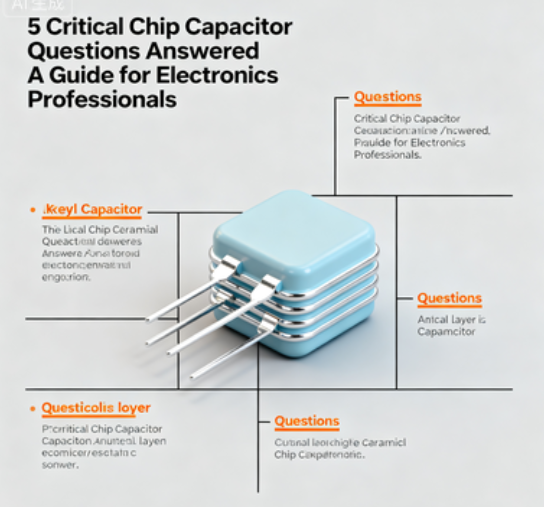
5 Critical Chip Capacitor Questions Answered: A Guide for Electronics Professionals
Chip capacitors are foundational components in modern electronics, enabling the functionality of devices ranging from smartphones and wearables to automotive systems and 5G infrastructure. For electronics engineers, procurement specialists, and product designers, mastering the nuances of chip capacitors—from strategic selection to troubleshooting and supply chain resilience—is essential to delivering high-performance, reliable products.
This guide addresses the 5 most pressing questions about chip capacitors, leveraging industry expertise, actionable best practices, and compliance insights. Whether you’re designing a high-frequency RF module, navigating component shortages, or resolving circuit failures, this resource equips you with the knowledge to make informed decisions and optimize your electronic designs.
1. What are the key factors to consider when selecting chip capacitors for different electronic applications?
Choosing the right chip capacitor directly impacts circuit performance, longevity, and cost-efficiency. Below are the non-negotiable factors to align capacitors with your application’s requirements:
-
Dielectric Material: The most critical factor. X7R (stable capacitance, -55°C to 125°C) is ideal for consumer electronics; C0G/NP0 (zero drift, -55°C to 125°C) is suited for high-frequency/RF applications; X5R (similar to X7R with a narrower temperature range) works for cost-sensitive designs.
-
Capacitance & Voltage Rating: Select capacitance based on circuit function (e.g., 100nF for decoupling, 1µF for filtering). The voltage rating must exceed the maximum circuit voltage by 50% (e.g., a 25V capacitor for a 12V circuit) to prevent breakdown.
-
Package Size: Smaller packages (01005, 0201) save space for compact devices like wearables and smartphones; larger sizes (0805, 1206) offer higher capacitance and easier assembly for industrial equipment.
-
ESR (Equivalent Series Resistance): Low ESR (≤100mΩ) is vital for high-current circuits (e.g., power supplies) to minimize heat generation and voltage ripple.
-
Industry Compliance: Automotive applications require AEC-Q200 certification; medical devices need ISO 13485 compliance; general electronics adhere to IPC standards.
2. What is the difference between MLCC chip capacitors and other types of chip capacitors?
MLCCs (Multi-Layer Ceramic Chip Capacitors) are the most widely used chip capacitor type, but understanding their differences from alternatives helps you select the right component for your use case. Here’s a detailed comparison:
-
MLCC vs Tantalum Chip Capacitors: MLCCs are non-polar, cost-effective, and low-ESR. Tantalum capacitors offer higher capacitance density (e.g., 10µF in an 0805 package) but are polarity-sensitive, more expensive, and prone to thermal runaway if exposed to overvoltage.
-
MLCC vs Film Chip Capacitors: Film capacitors (polyester, polypropylene) excel in high-voltage (up to 1kV) and high-temperature (up to 150°C) environments with minimal capacitance drift. MLCCs are smaller but less suitable for ultra-high-voltage designs.
-
MLCC vs SMD Electrolytic Capacitors: SMD electrolytic capacitors provide bulk capacitance (100µF+) for power supplies but have larger footprints, higher ESR, and shorter lifespans (5,000–10,000 hours) compared to MLCCs (20,000+ hours).
Use case guidance: MLCCs for general electronics (smartphones, PCs); tantalum capacitors for low-voltage, high-capacitance IoT devices; film capacitors for industrial motor drives; SMD electrolytic capacitors for budget-friendly power supply designs.
3. How to solve common failure problems of chip capacitors in circuit design?
Chip capacitor failures—such as overheating, capacitance loss, and short circuits—often result from poor selection or layout. Here’s how to diagnose and resolve these issues:
-
Overheating & Voltage Breakdown: Caused by undersized voltage ratings. Solution: Upgrade to a capacitor with a voltage rating 1.5x the maximum circuit voltage (e.g., replace a 16V capacitor with a 25V one in a 12V power supply).
-
Capacitance Loss in High-Temperature Environments: Use X7R or C0G dielectric instead of X5R. For automotive under-hood applications (temperatures up to 150°C), select AEC-Q200-certified MLCCs with a 150°C operating range.
-
Excessive Voltage Ripple: Caused by high ESR. Solution: Use parallel MLCCs (e.g., two 220nF capacitors in parallel for 440nF total) to reduce ESR, or switch to a low-ESR grade (e.g., Murata GRM series).
-
Static Damage (ESD): Add ESD protection diodes (e.g., Bourns SMBJ series) near chip capacitors, especially in portable electronics. Store and handle capacitors in anti-static packaging.
-
PCB Layout Issues: Minimize trace length between capacitors and ICs (critical for decoupling), avoid placing capacitors near thermal hotspots (e.g., LEDs, power amplifiers), and use ground planes to reduce noise.
4. Which chip capacitor specifications are critical for high-frequency electronic products?
High-frequency electronic products (5G modules, Wi-Fi 6 devices, RF transceivers) require chip capacitors that maintain performance at frequencies above 1GHz. The following specifications are essential for these applications:
-
Dielectric Material: C0G/NP0: The only dielectric with zero capacitance drift over frequency (0–10GHz) and temperature. X7R/X5R capacitors lose 10–30% capacitance at 1GHz, making them unsuitable for high-frequency use.
-
Low ESR & ESL: ESR ≤50mΩ (measured at 1MHz) and ESL ≤1nH minimize signal loss and impedance fluctuations. Look for “high-frequency optimized” MLCCs (e.g., TDK C3216X7R1H104K series).
-
Package Size: Smaller packages (01005, 0201) have lower parasitic inductance (ESL) than larger sizes. For 5G mmWave applications, 01005 C0G capacitors are preferred.
-
Capacitance Accuracy: ±5% tolerance (vs. ±10% or ±20%) ensures consistent resonant circuit performance, critical for RF filters and oscillators.
-
RoHS Compliance: All high-frequency consumer electronics require RoHS-compliant capacitors (free of lead, mercury, and cadmium) to meet global regulatory standards.
Example: A 5G smartphone’s RF front-end uses 10pF C0G 0201 capacitors with a 25V rating, low ESR (≤30mΩ), and ±5% tolerance to ensure stable signal transmission and reception.
5. What are the reliable alternatives for chip capacitors during supply chain shortages?
Chip capacitor shortages—especially for high-demand MLCC grades—can disrupt production. Below are reliable alternatives that maintain form-fit-function and performance:
-
Alternative MLCC Manufacturers: Source from second-tier suppliers with identical specifications (e.g., Yageo instead of Murata, Kemet instead of TDK). Verify specs via datasheet comparison and sample testing.
-
Tantalum Chip Capacitors: Replace low-voltage (≤16V) MLCCs (e.g., 100nF 16V X7R) with tantalum capacitors (e.g., AVX TAJA series) for IoT and portable devices. Note: Tantalum capacitors are polar—reverse polarity causes failure.
-
Film Chip Capacitors: For high-voltage (≥50V) or high-temperature applications, replace MLCCs with film capacitors (e.g., Vishay MKP series). They are less prone to shortages and offer better long-term stability.
-
Parallel MLCC Combinations: Use two or more smaller MLCCs in parallel to achieve the target capacitance (e.g., two 100nF capacitors for 200nF). This works for decoupling and filtering applications.
-
SMD Electrolytic Capacitors: For non-space-constrained designs (e.g., industrial power supplies), replace bulk MLCCs (10µF+) with SMD electrolytic capacitors (e.g., Nichicon UMV series). They are cost-effective and widely available.
Conclusion: Key Takeaways for Chip Capacitor Success
Chip capacitors are indispensable to electronic circuit performance, and their success depends on strategic selection, proper design, and supply chain resilience. By focusing on application-specific specifications (dielectric, ESR, voltage rating), understanding component tradeoffs (MLCC vs. tantalum/film), and preparing for shortages with reliable alternatives, you can avoid common pitfalls and deliver high-quality electronics.
For more insights, explore our guides on MLCC Selection for Automotive Applications and High-Frequency Capacitor Design Best Practices. Have questions about your specific project? Leave a comment below or contact our electronics engineering team for personalized support.
Recommended Chip Capacitor Products
Perfect for consumer electronics decoupling. AEC-Q200 certified with low ESR.
Zero capacitance drift for 5G/RF applications. RoHS compliant and compact.
Reliable MLCC alternative for low-voltage IoT devices. Polarized design.
High-voltage/high-temperature stability for industrial control systems.
Cost-effective bulk capacitance alternative for power supply designs.
5 Critical Questions About Chip Capacitors Resistors Answered A Guide for Electronics Pros
Top 5 FAQs About Associated Products with Chip Capacitors A Practical Guide for Electronics Professionals
Связанная статья
Датчики Интернета вещей (IoT) с батарейным питанием предназначены для сбора данных и передачи информации, потребляя при этом как можно меньше энергии. Типичные примеры включают датчики температуры, мониторы окружающей среды, устройства отслеживания активов, беспроводные дверные датчики и устройства удаленного промышленного мониторинга.
MLCC для датчиков Интернета вещей с батарейным питанием. Стабильность электропитания. Низкое энергопотребление и надежность.

Технология Power over Ethernet (PoE) позволяет совместимому сетевому оборудованию передавать электроэнергию и данные по одному и тому же кабелю Ethernet. Он широко используется в таких приложениях, как IP-камеры, точки беспроводного доступа, VoIP-телефоны и датчики, подключенные к сети.
MLCC в вопросах проектирования оборудования PoE для коммутаторов Ethernet
Внутри оборудования PoE многослойные керамические конденсаторы (MLCC) помогают стабилизировать шины питания, фильтровать высокочастотные шумы и поддерживать работу схем преобразования энергии. Их производительность может повлиять на целостность электропитания, электромагнитную совместимость и надежность всего устройства.
MLCC в вопросах проектирования оборудования PoE для коммутаторов Ethernet и устройств с питанием

Зарядные устройства USB-C Power Delivery (PD) должны обеспечивать регулируемую мощность при различных сочетаниях напряжения и тока, оставаясь при этом компактными, эффективными и надежными. Внутри этих адаптеров многослойные керамические конденсаторы (MLCC) помогают стабилизировать шины питания, снизить высокочастотный шум и поддерживать работу импульсных преобразователей мощности.
Где важны MLCC в зарядных устройствах USB-C PD Фильтрация входного шума при переключении и стабильность выходного сигнала
