The Hidden Force Behind Light Speed Transmission MLCC High-Frequency Survival Rules in 800G 1.6T Optical Module
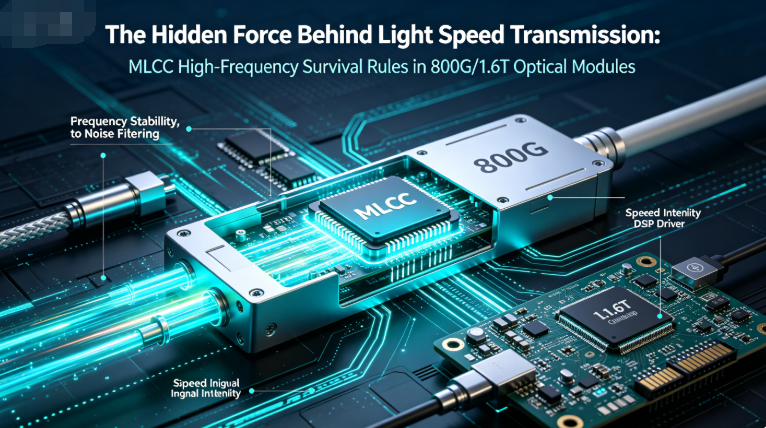
The Hidden Force Behind Light Speed Transmission: MLCC High-Frequency Survival Rules in 800G/1.6T Optical Modules
In AI computing power clusters, massive data exchange between GPUs and distributed synchronization of large model parameters generate astronomical amounts of traffic every moment. However, traditional copper cables often encounter severe signal attenuation and bandwidth bottlenecks when facing ultra-long-distance, ultra-high-rate data transmission. As a result, high-speed optical transceivers — the "blood vessels" of data centers — have stepped into the spotlight of the times.
From the early 100G and 400G to today's fully popularized 800G and even evolution toward 1.6T, the conversion rate of electrical and optical signals inside optical modules is soaring at an alarming rate. Inside this palm-sized module, there are integrated photoelectric conversion chips (TIA/Driver), lasers (EML/Silicon Photonics), and complex clock data recovery (CDR) circuits.
In this light speed race pursuing "ultimate bandwidth and extremely low bit error rate," MLCCs (Multilayer Ceramic Capacitors), as behind-the-scenes heroes, are shouldering an unprecedented heavy responsibility of high-frequency decoupling and impedance matching.
1Entering the High-Speed No-Man's Land: Electromagnetic and High-Frequency Fog Faced by Optical Modules
When the transmission rate of optical modules突破 100Gbps or even 200Gbps per channel (PAM4 modulation), the rising edge of signals becomes extremely steep, and any tiny flaw on the circuit board will trigger catastrophic signal integrity (SI) deterioration:
The "Curse" of Parasitic Inductance at High Frequencies
In microwave frequency bands of several GHz or even tens of GHz, ordinary MLCCs are highly prone to表现出 inductive characteristics due to internal electrode structures and pin parasitic effects (ESL), thereby completely losing filtering and decoupling capabilities, leading to eye diagram closure and soaring bit error rate (BER).
Double Squeeze of Thermal Power Consumption and Space Limits
The internal component density of 800G/1.6T optical modules is extremely high, and the local high temperature generated during chip operation continuously bakes surrounding components. Capacitors must maintain extremely low dielectric loss (Low Loss) at high temperatures; otherwise, their own heating will trigger cascading thermal failures. Additionally, the narrow space inside optical modules poses extreme demands for MLCC miniaturization (such as 0201/01005 packages).
Extreme Stability Requirements for Bias Current
Lasers are extremely sensitive to fluctuations in driving current. If the power decoupling network cannot instantly smooth out transient noise, the extinction ratio of optical signals will deteriorate, directly affecting the transmission distance and quality of fiber optic links.
2Barron High-Speed Optical Communication Series MLCCs: Escorting Light Speed Transmission
To help optical module manufacturers conquer the high-frequency no-man's land of 800G/1.6T, Barron has achieved key technological leaps in high-frequency RF and miniaturized capacitor series:
Ultra-Low ESL (Equivalent Series Inductance) Structural Design
Through innovative multi-terminated capacitor or optimized electrode arrangement designs, we suppress the ESL of RF bypass capacitors to the picohenry (pH) level, ensuring that capacitors remain purely "capacitive" at high frequency bands,开辟 an unobstructed high-frequency discharge channel for high-speed signals.
Ultra-High Q Value and Extremely Low Dielectric Loss C0G High Purity
Using specially made ultra-high purity C0G ceramic dielectrics and precious metal internal electrode systems, we greatly reduce energy loss when high-frequency alternating current passes through, ensuring that signal energy is not "consumed" during long-term full-load operation of optical modules.
Ultimate Miniaturization and High Capacitance Achieved Simultaneously
In the tiny packages of 0201 and 0402, through nano-scale casting and high-precision lamination processes, the golden balance of large capacity and small volume is perfectly achieved, providing the closest "personal energy supply" for compact laser drivers and TIA chips inside optical modules.
3Practical Exercise: Core Positions of MLCCs in 800G/1.6T Optical Modules
In the precision hardware architecture of high-speed optical modules, Barron MLCCs are active at several decisive critical points:
Power Decoupling for Laser Driver Chips and TIAs
Around high-speed modulators and transimpedance amplifiers, densely deploy Barron's ultra-low ESL, high-frequency decoupling capacitor arrays, ensuring that at nanosecond-level level jump moments, current can be "sourced locally," guaranteeing perfect eye diagrams of optical signal output.
DC Blocking for High-Speed Differential Signal Pairs
In the serial transmission path of high-speed electrical signals, precise DC blocking capacitors are needed to block DC bias. Barron's high-frequency RF series capacitors, with extremely low insertion loss and precise capacitance tolerances, become a sharp tool for maintaining impedance continuity and eliminating signal reflection.
Bias Network Filtering for Circulators and Optical Components (TOSA/ROSA)
At the control and bias ports of optoelectronic components, use Barron's high-stability, thermal shock-resistant MLCCs to build multi-stage filter networks, completely isolating conducted electromagnetic interference from the motherboard.
4Conclusion: With Tiny Light, Illuminating the Underlying Meridians of the Digital World
From the computing power explosion of AI large models to the high-speed interconnection of global data centers, optical modules are well-deserved "nerve endings" of the modern digital world. On this track running at the speed of light, it is precisely countless tiny yet outstanding MLCCs that silently smooth out every high-frequency wave.
Is your 800G, 1.6T optical module or high-speed photoelectric conversion hardware project looking for a passive component partner that can break through high-frequency loss and signal integrity bottlenecks?
Welcome to visit www.barronmlcc.com to explore our optical communication high-speed dedicated MLCC series products. Let Barron, with ultimate high-frequency performance and reliable craftsmanship, help your light speed transmission reach far and wide!
Get Free High-Speed Optical MLCC Samples & SI Simulation SupportEmail: hyc2355937758@gmail.com WhatsApp: +86 15913754866 WhatsApp: +86 18824523083 Official Website: www.barronmlcc.com
Awakening Mechanical Touch MLCC Neural Veins Behind Embodied AI and Humanoid Robots
Knocking on Quantums Door Disruptive Evolution of MLCCs in Cryogenic and Quantum Computing Frontiers
Related Article