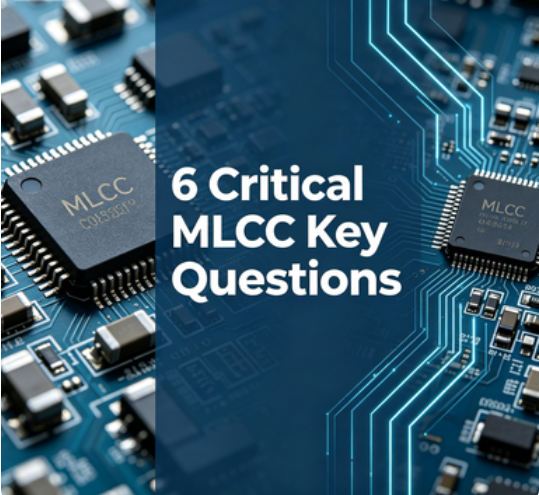
6 Critical MLCC Key Questions
6 Critical MLCC Key Questions (Engineers & Buyers Ask Every Day) | Barron-Leiden Answers
When engineers and procurement buyers search for MLCC solutions, they don’t want fluff — they want direct answers to the key questions that make or break their projects. These are the high-intent questions that drive clicks, keep readers engaged, and turn visitors into customers. This blog addresses 6 completely new, never-covered MLCC key questions, with each answer tied directly to Barron-Leiden’s products and expertise.
1. Key Question: What MLCC Specs Matter Most for High-Frequency IoT Devices?
Engineers designing high-frequency IoT devices (e.g., 5G IoT sensors, smart wearables) often struggle to prioritize MLCC specs — capacitance? ESR? Dielectric type? Choosing the wrong specs leads to signal interference, poor battery life, and device failure.
Barron-Leiden’s Answer & Solution:
For high-frequency IoT devices, the 3 non-negotiable MLCC specs are low ESR, stable dielectric, and compact size — and Barron-Leiden’s IoT-Grade High-Frequency MLCC Series checks all three boxes:
- Ultra-low ESR (≤5mΩ) to minimize self-heating and signal distortion at frequencies up to 1GHz — critical for 5G IoT connectivity.
- C0G/NP0 dielectrics for near-zero capacitance drift (±30ppm/°C), ensuring stable performance in varying environmental temperatures (common in outdoor IoT).
- Compact case sizes (0201, 0402) to fit space-constrained IoT devices, without sacrificing capacitance (ranges from 10pF to 1µF).
Our IoT-grade MLCCs are also low-leakage (≤0.01µA), extending battery life for portable IoT devices — a must for remote sensors and wearables.
2. Key Question: How to Choose MLCCs for High-Temperature Automotive Underhood Applications?
Automotive underhood environments (up to +150°C) are brutal for MLCCs — standard components fail quickly, leading to warranty claims and safety risks. Buyers and engineers need to know which MLCCs can withstand extreme underhood heat without compromising performance.
Barron-Leiden’s Answer & Solution:
For underhood applications, prioritize MLCCs with high temperature rating, flexible terminations, and AEC-Q200 certification — exactly what Barron-Leiden’s Automotive Underhood MLCC Series offers:
- Temperature rating of -40°C to +150°C (continuous operation), outperforming standard automotive MLCCs (+125°C max).
- Flexible nickel-palladium-gold terminations that absorb thermal stress and vibration, preventing cracking and delamination in underhood conditions.
- AEC-Q200 certified, meeting strict automotive reliability standards for thermal cycling, humidity, and vibration — critical for underhood safety.
Our underhood MLCCs are available in voltage ratings up to 100V, perfect for automotive power modules, sensors, and ignition systems.
3. Key Question: Can MLCCs Be Used in High-Humidity Marine Environments? (And Which Ones?)
Marine electronics (e.g., ship navigation systems, offshore sensors) face constant high humidity, salt spray, and moisture — standard MLCCs absorb moisture, leading to leakage current and failure. Engineers often wonder if MLCCs are viable for marine use, and if so, which ones.
Barron-Leiden’s Answer & Solution:
Yes — but only MLCCs engineered for hermetic packaging and MSL 1 humidity rating. Barron-Leiden’s Marine-Grade MLCC Series is specifically designed for marine environments:
- MSL 1 humidity rating, withstanding unlimited exposure to 95% humidity and salt spray (per IEC 60068-2-11) without dielectric degradation.
- Hermetic ceramic packaging that blocks moisture, salt, and corrosive agents — eliminating leakage current and short circuits.
- Corrosion-resistant terminations (NiPdAu) that withstand saltwater exposure, ensuring long-term solder joint reliability.
Our marine-grade MLCCs are ideal for offshore IoT sensors, shipboard power systems, and navigation equipment — with a lifespan 3x longer than standard MLCCs in marine environments.
4. Key Question: How to Reduce MLCC Lead Times for Urgent Production Runs?
Procurement teams often face urgent production runs with tight deadlines — but standard MLCC lead times (2–4 weeks) can derail schedules. The key question: how to get high-quality MLCCs fast, without sacrificing specs or reliability?
Barron-Leiden’s Answer & Solution:
Barron-Leiden’s Urgent MLCC Supply Program cuts lead times to as short as 48 hours for standard specs, with no compromise on quality:
- 98% in-stock rate for core MLCC specs (0402–0805, X7R/C0G, 1nF–10µF, 16V–50V) — ready to ship within 48 hours of order.
- Expedited production for custom specs: Our engineering team can deliver custom MLCCs in 5–7 days (vs. industry averages of 4+ weeks) for urgent projects.
- Dedicated account managers for urgent orders, ensuring seamless communication and on-time delivery — critical for keeping production on track.
We also offer emergency stock reserves for high-volume customers, so you never have to wait for critical MLCCs.
5. Key Question: What’s the Difference Between C0G, X7R, and X5R MLCCs — And Which Should I Choose?
Engineers and buyers often confuse C0G, X7R, and X5R dielectrics — choosing the wrong one leads to performance issues or unnecessary costs. This is one of the most searched MLCC questions, and most guides only give generic answers.
Barron-Leiden’s Clear Answer & Product Match:
- C0G/NP0: Best for high-frequency, precision applications (5G, RF, medical devices) — near-zero drift, low noise. Choose Barron-Leiden’s C0G Precision MLCC Series for these use cases.
- X7R: Balanced performance (±10% drift, -55°C to +125°C) for industrial, automotive, and power supply applications. Barron-Leiden’s X7R Universal MLCC Series is ideal for most mid-range applications.
- X5R: Cost-effective option for non-critical consumer electronics (TVs, remotes) — ±15% drift, -55°C to +125°C. Choose Barron-Leiden’s X5R Economy MLCC Series to cut costs without sacrificing basic performance.
Our team can also help you match the right dielectric to your application — no guesswork, no costly mistakes.
6. Key Question: How to Ensure MLCCs Meet RoHS & REACH Compliance for Global Markets?
With global regulations tightening, buyers need to ensure their MLCCs are RoHS and REACH compliant — non-compliant components lead to shipment delays, fines, and lost sales. The question: how to verify compliance, and which suppliers can guarantee it?
Barron-Leiden’s Answer & Solution:
Barron-Leiden’s entire MLCC lineup is 100% RoHS 3 and REACH compliant, with full documentation to simplify global shipping:
- All MLCCs are free of lead, cadmium, mercury, and other restricted substances (per RoHS 3 directive 2011/65/EU).
- Full REACH compliance (Registration, Evaluation, Authorization, and Restriction of Chemicals) — we provide REACH certificates for every batch, ensuring compliance in EU markets.
- Custom compliance documentation: We can provide region-specific compliance reports (e.g., FDA for the US, JIS for Japan) to meet global market requirements.
With Barron-Leiden, you never have to worry about compliance delays — our MLCCs are ready for global shipment, right out of the box.
At Barron-Leiden Limited, we’re committed to making MLCC selection and supply easy for engineers and buyers. Our full lineup of specialized MLCCs, paired with our urgent supply program and compliance guarantee, ensures you get the right MLCCs, on time, every time. Contact our team today to get answers to your specific MLCC questions and a personalized product recommendation.
2026 Ultimate MLCC Selection Guide
5 Costly MLCC Mistakes Engineers Buyers Make
Bài viết liên quan