What Is an SMD Capacitor?
What Is an SMD Capacitor? Engineer & Purchasing Guide for Reliable Sourcing
In modern electronic design and manufacturing, SMD capacitors play a critical role in circuit performance, reliability, and production efficiency.
But what is an SMD capacitor, and how should engineers and purchasing teams select the right one for real-world applications?
This guide explains what SMD capacitors are, how they work, their main types, package sizes, and how to choose reliable SMD capacitors for design and sourcing.
What Is an SMD Capacitor?
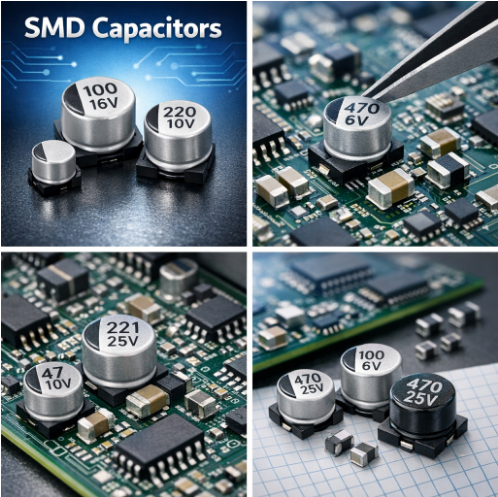
An SMD capacitor (Surface Mount Device capacitor), also known as a surface mount capacitor, is a capacitor designed to be mounted directly onto the surface of a printed circuit board (PCB) using surface-mount technology (SMT).
Unlike through-hole capacitors, SMD capacitors:
-
Have no wire leads
-
Are optimized for automated assembly
-
Support high-density and high-frequency PCB designs
They are widely used in consumer electronics, power supplies, automotive electronics, and industrial control systems.
How Does an SMD Capacitor Work?
An SMD capacitor works by storing electrical energy in an electric field formed between two conductive electrodes separated by a dielectric material.
When voltage is applied:
-
Electrical charge accumulates on the electrodes
-
Energy is stored within the dielectric
-
The capacitor releases energy to stabilize voltage, reduce noise, or support transient loads
Although physically smaller, SMD capacitors perform the same electrical functions as traditional capacitors—with lower parasitic inductance and better high-frequency behavior.
Types of SMD Capacitors
Different applications require different electrical characteristics. The most common SMD capacitor types include:
Ceramic SMD Capacitors (MLCC)
-
Non-polarized
-
Small size, low ESR
-
Common dielectrics: C0G (NP0), X7R, X5R
Typical applications:
Decoupling, bypass, RF circuits, signal conditioning
? For detailed comparison, see:
Types of SMD Capacitors and Their Applications
Tantalum SMD Capacitors
-
Polarized
-
Stable capacitance over temperature
-
Higher capacitance than MLCC at similar size
Typical applications:
Power rails, consumer electronics
Aluminum Electrolytic SMD Capacitors
-
High capacitance values
-
Polarized
-
Larger package size
Typical applications:
Power supplies, DC filtering
Polymer SMD Capacitors
-
Very low ESR
-
Excellent ripple current capability
Typical applications:
High-current, high-reliability power designs
SMD Capacitor Package Sizes Explained
SMD capacitors use standardized package sizes, usually defined by imperial codes:
| Package Size | Metric (mm) | Common Use |
|---|---|---|
| 0402 | 1.0 × 0.5 | Compact consumer electronics |
| 0603 | 1.6 × 0.8 | General-purpose designs |
| 0805 | 2.0 × 1.25 | Power and filtering |
| 1206 | 3.2 × 1.6 | Higher voltage or capacitance |
? Engineering note:
Smaller packages reduce board space but may require voltage derating and careful mechanical design.
? See full details:
SMD Capacitor Size Chart: 0402 vs 0603 vs 0805
How Engineers Choose the Right SMD Capacitor
For engineers, proper capacitor selection directly impacts performance, EMC behavior, and long-term reliability.
Key parameters to evaluate:
-
Capacitance value
-
Voltage rating (with derating)
-
ESR and ripple current
-
Dielectric type
-
Operating temperature range
In power electronics, incorrect selection can lead to noise issues or early failure.
? Recommended reading:
How to Choose the Right SMD Capacitor for Power Supply Design
Why SMD Capacitors Fail in Real Applications
Common failure causes include:
-
Insufficient voltage derating
-
Mechanical stress on MLCCs
-
Excessive ripple current
-
Poor soldering or PCB layout
Understanding failure mechanisms helps both engineers and purchasers reduce field returns and production risks.
? Learn more:
Why SMD Capacitors Fail and How to Prevent It
SMD Capacitors: Engineer vs Purchasing Considerations
| Aspect | Engineer Focus | Purchasing Focus |
|---|---|---|
| Electrical specs | ESR, dielectric, derating | Package consistency |
| Reliability | Failure mechanisms | Approved vendor list |
| Design | PCB layout compatibility | Second-source availability |
| Cost | Performance trade-offs | Long-term supply stability |
? Best practice:
Engineering and purchasing teams should align early to avoid redesigns caused by sourcing issues.
Applications of SMD Capacitors
SMD capacitors are widely used in:
-
Power supply and DC-DC converter circuits
-
Consumer electronics
-
Automotive electronics
-
Industrial automation
-
Communication and RF systems
-
Medical devices
Their compact size and electrical performance make them essential for modern electronic products.
Finding a Reliable SMD Capacitor Supplier
For production projects, choosing the right supplier is just as important as choosing the right component.
A reliable SMD capacitor supplier should offer:
-
Engineering-supported component selection
-
Stable long-term supply
-
Alternative and cross-reference support
-
Datasheets, samples, and fast quotation
? If you need engineering assistance, alternative parts, or bulk sourcing support,
you can contact our team for qualified SMD capacitor recommendations and fast RFQ response.
? SMD Capacitor Supplier & RFQ
Conclusion
So, what is an SMD capacitor?
It is a surface-mounted electronic component designed to store and regulate electrical energy efficiently—enabling compact, reliable, and high-performance PCB designs.
For engineers, understanding SMD capacitor characteristics improves design reliability.
For purchasing teams, proper sourcing reduces supply risk and production delays.
With the right selection and supplier support, SMD capacitors become a competitive advantage, not a risk.
How Does an SMD Capacitor Work Principle Structure and Practical Use
Critical Questions About Surface Mount Capacitor (SMC) Related Products: A Complete Guide
Bài viết liên quan