Automotive MLCC Incoming Inspection & Mass Quality Control Practical Guide
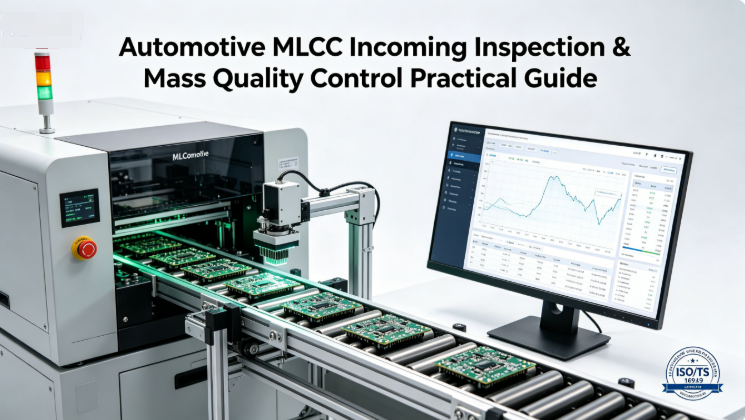
Automotive MLCC Incoming Inspection & Mass Quality Control Practical Guide
mu sen Introduction
As the core passive components of new energy vehicle electronic control systems, automotive MLCC quality consistency directly determines the reliability of the whole vehicle electronic system. Even 0.1% batch latent defects may cause massive after-sales issues, production line shutdown, certification rework and other heavy losses.
Many vehicle manufacturers and Tier1 suppliers have a misunderstanding in supply chain management: focusing too much on component selection while ignoring incoming inspection. They only conduct appearance inspection but neglect electrical parameters, latent defects such as internal delamination and terminal electrode poor connection, as well as reliability indicators. This leads to unqualified MLCC entering production lines and bringing hidden failure risks.
Automotive MLCC incoming inspection and batch control must comply with dual requirements of AEC-Q200 standard + automotive application adaptation, covering the whole process of incoming acceptance, process control and exception handling. Combined with mass production practical experience, this article sorts out inspection items, testing standards, batch quality control methods and latent defect screening skills, helping supply chain, quality and procurement teams build a standardized management system and block unqualified MLCC at the source.
1. Core Principles of Automotive MLCC Incoming Inspection
- Compliance Principle: Incoming MLCC must meet AEC-Q200 certification and fully match BOM specifications including capacitance, voltage, package size, dielectric material and reliability grade. Mixing or wrong parts are strictly prohibited.
- Full Coverage Principle: Inspection must cover four dimensions: appearance, electrical parameters, latent defects and reliability. No key indicators can be omitted, especially latent defects with high failure rate in automotive scenarios.
- Batch Adaptation Principle: Inspection standards shall adapt to automotive working conditions such as high temperature, vibration and high voltage, with enhanced testing on DC bias characteristics, vibration resistance and high temperature endurance.
- Traceability Principle: Each batch shall provide complete traceability information including batch number, production date, supplier and AEC-Q200 test report, ensuring traceability and recall availability for abnormal lots.
2. Full Incoming Inspection Items for Automotive MLCC
2.1 Appearance Inspection (100% Full Inspection)
Core Purpose: Screen obvious physical damage and avoid defective MLCC into production.
- Package & Marking: Dimension such as 0402/0603/1206 consistent with BOM; clear printing of capacitance, voltage and brand logo without blur or missing marks.
- Ceramic Body: No chipping, cracking, material missing, color difference, surface scratch or deformation.
- Terminal Electrode: No peeling, oxidation, blackening or poor adhesion; uniform plating without copper exposure or layer separation.
- Packaging: Anti-static and moisture-proof package with complete label information; no mixing or damaged packaging.
2.2 Electrical Parameter Inspection (Sampling Inspection)
Core Purpose: Verify parameter consistency and avoid drift or out-of-spec components.
- Capacitance & Tolerance: Tested by LCR meter at 1kHz/1MHz; within ±5%/±10% tolerance; batch deviation ≤3%.
- ESR / ESL Test: For high frequency, high voltage and SiC/GaN applications, ESR ≤10mΩ @1MHz, ESL ≤3nH for high frequency decoupling.
- Rated Voltage & Insulation Resistance: Insulation resistance ≥10¹⁰Ω; withstand 1.2 times rated voltage for 1 minute without breakdown or abnormal leakage current.
- DC Bias Decay Test: Under 70% rated bias, capacitance attenuation ≤30% to meet design margin.
- Temperature Drift: Within -40℃~125℃, X7R/X8R capacitance drift ≤±15% without abnormal fluctuation.
2.3 Latent Defect Inspection
Latent defects including internal layer cracking, electrode delamination and internal voids are main causes of later failure, which cannot be identified by visual check only.
- X-Ray Inspection: Sampling ratio ≥5%, key batch ≥10%; check internal structure without crack, delamination, void or foreign inclusion.
- Cross-section Microscopy: 3~5 pcs per batch; confirm tight bonding between terminal electrode and ceramic body without peeling or inner layer crack.
- Solderability Test: Simulate reflow soldering profile; no electrode peeling or ceramic cracking; solder wetting rate ≥95%.
2.4 Reliability Sampling Inspection
- High Temperature Aging: 1000 hours @85℃ rated voltage; capacitance decay ≤10%, no breakdown or leakage rise.
- Vibration Test: Comply with ISO 16750-3 random vibration 10~2000Hz 4g; no internal crack or electrode damage after test.
- Humidity Aging: 1000 hours @85℃/85%RH rated bias; no ion migration or leakage current increase.
- Temperature Cycling: 1000 cycles from -40℃ to 125℃; no parameter drift or structural damage.
3. Batch Quality Control Standard Process
3.1 Incoming Acceptance Process
- Supplier delivery with delivery note, COA and AEC-Q200 report.
- Warehouse pre-check: verify specification, quantity and package integrity.
- Full inspection: appearance, electrical parameters, latent defects and reliability sampling.
- Judgment & handling: qualified for stock-in; unqualified isolated and returned with supplier corrective action request.
- Data filing: archive inspection records and traceability documents.
3.2 Production Process Control
- Storage Control: Keep humidity ≤30% at 20~25℃; implement FIFO; bake at 125℃ for 4 hours if stored over 1 month.
- SMT Mounting Control: Follow standard reflow profile; control heating rate, peak temperature 240~245℃ and cooling rate to avoid thermal shock cracking.
- Online Sampling: 10~20 pcs per hour to check mounting accuracy and soldering quality.
- Final Inspection: Module sampling with X-Ray and electrical test to screen latent MLCC defects.
3.3 Supplier Quality Management
- Qualified supplier list: only approve manufacturers with AEC-Q200 production line, complete traceability and stable capacity.
- Supplier grading: classify by yield, delivery performance and technical support.
- Abnormal feedback: require root cause analysis and corrective report for non-conforming batches.
- Quarterly on-site audit: verify production process and quality system stability.
4. Common Quality Issues & Solutions
| Quality Issue | Inspection Method | Treatment Plan | Preventive Measure |
|---|---|---|---|
| Chipping & cracking | Visual full inspection | Isolate and return goods | Strengthen forming and package protection |
| Capacitance out of tolerance | LCR testing | Return unqualified batch | Optimize production consistency |
| Internal crack & delamination | X-Ray / Cross-section | Batch return & supplier audit | Optimize sintering and electrode process |
| Terminal oxidation & peeling | Visual / Solderability test | Return and request plating improvement | Enhance moisture-proof packaging |
| Mixing & wrong parts | Specification verification | Isolate and return | Optimize labeling and sorting process |
| Excessive DC bias decay | DC bias test | Return and re-select low decay MLCC | Reserve sufficient design margin |
5. Inspection Misunderstandings & Avoidance
- Only do visual inspection and ignore latent defects → Must add X-Ray sampling for key batches.
- Only test capacitance without ESR/ESL → High frequency & high voltage MLCC must test ESR/ESL.
- Reliability test as formalities only → Follow AEC-Q200 & ISO 16750-3 strictly.
- Supplier audit only focus on price → Prioritize AEC-Q200 certified automotive grade suppliers.
- Incomplete inspection records → Establish standardized inspection ledger for traceability and recall.
6. Automotive MLCC Incoming Inspection Checklist
mu sen Conclusion
Automotive MLCC incoming inspection and batch quality control are the core link to avoid risks and stabilize mass quality. It is not only simple pass/fail judgment, but builds a standardized system combining AEC-Q200 standard and automotive application characteristics with full-dimensional inspection, whole-process control and full traceability.
Strict incoming inspection on appearance, electrical parameters, latent defects and reliability, together with supplier and production process control, can effectively block unqualified MLCC, reduce batch failure, after-sales rework and production shutdown loss, and ensure long-term stable operation of automotive electronic control systems.
Dongguan Musen Leyton Electronic Technology Co., Ltd. supplies full series AEC-Q200 automotive grade MLCC. Each batch provides complete COA and AEC-Q200 test reports, supporting incoming inspection guidance and free sample testing, helping customers build standardized quality control systems and reduce supply chain risks.
Complete Guide to MLCC Selection Mistakes & Correct Engineering Practices
High-Voltage Automotive MLCC Selection Application Design 800V Platform Adaptation
Bài viết liên quan