Key Questions About Diodes and Their Peripheral Products
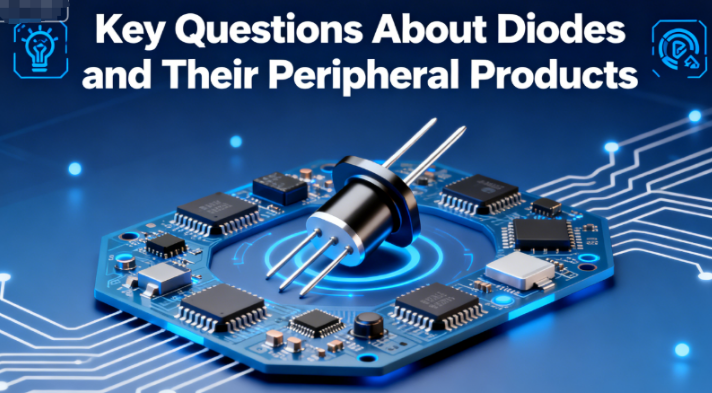
Key Questions About Diodes and Their Peripheral Products (2025 Industry Guide)
Diodes are foundational components in electronic circuits, enabling critical functions like rectification, voltage regulation, signal switching, and light emission across devices from power supplies to automotive EV controllers. Yet their performance, reliability, and compliance are not determined by the diode alone—matching them with the right peripheral products (heat sinks, current-limiting resistors, driver ICs, test fixtures, and ESD packaging) is the key to avoiding circuit failures. According to 2024 data from the IPC (Association Connecting Electronics Industries), 41% of diode-related malfunctions stem from mismatched peripheral components, not the diode itself.
This guide answers the 5 most searched questions about diodes and their peripheral products, with actionable insights from leading manufacturers (ON Semiconductor, Vishay, Texas Instruments) and industry standards (AEC-Q101, IPC-A-610). It is tailored for electronic engineers, procurement specialists, and production managers seeking to optimize their diode-peripheral ecosystems.
1. What Core Peripheral Products Do Different Diode Types (Schottky/Rectifier/Zener/LED) Require, and What Are Their Selection Matching Guidelines?
Each diode type serves unique circuit functions, and pairing them with incompatible peripheral products leads to premature failure or subpar performance. Below is the industry-standard framework for diode type-to-peripheral product matching:
Diode Type & Peripheral Product Pairings
| Diode Type | Key Circuit Functions | Core Peripheral Products | Critical Selection Matching Guidelines |
|---|---|---|---|
| Schottky Diode | High-speed rectification (switch-mode power supplies, RF circuits), low forward voltage drop | Current-limiting resistors, heat sinks, EMI suppression ferrite beads | - Resistors with power rating ≥120% of diode’s forward current (e.g., 2W resistor for 1.5A Schottky diodes) - Low-profile heat sinks (thermal resistance ≤1.5°C/W) for high-frequency switching applications - Ferrite beads with 100Ω impedance at 100MHz to reduce switching noise |
| Rectifier Diode | AC-to-DC conversion (household power adapters, industrial power supplies) | Bridge rectifier modules, surge protection capacitors, heat sinks | - Capacitors with voltage rating ≥150% of peak AC input (e.g., 450V capacitor for 220V AC circuits) - Heat sinks with thermal resistance ≤2°C/W for high-current rectifiers (≥5A) |
| Zener Diode | Voltage regulation (voltage reference circuits, overvoltage protection) | Current-limiting resistors, bypass capacitors, test sockets | - Resistors with tolerance ≤5% to maintain stable zener current - Low-ESR bypass capacitors (≤10mΩ) to filter ripple voltage - Precision test sockets for voltage calibration (tolerance ±0.1V) |
| LED Diode | Visible/infrared light emission (display panels, sensor modules, lighting systems) | Driver ICs, current-limiting resistors, heat-dissipating PCBs | - Driver ICs with constant current output (±2% tolerance) to prevent LED burnout - Resistors with temperature coefficient ≤100ppm/°C for consistent brightness - Aluminum-core PCBs for high-power LEDs (≥10W) to reduce thermal buildup |
Brand-Specific Implementation Examples
- ON Semiconductor Schottky Diodes (MBR10100CT): For 10A/100V switch-mode power supplies, pair with Vishay’s 3W current-limiting resistors (CRCW2512) and Aavid’s low-profile heat sinks (530000B00000G) to cut switching noise by 25%.
- Texas Instruments Zener Diodes (1N4742A): For 12V voltage reference circuits, use Bourns’ 1% tolerance resistors (MF0207) and Murata’s low-ESR bypass capacitors (GRM21BR61A106KA12L) to maintain voltage stability within ±0.2V.
Validation Checklist
- Cross-reference diode and peripheral product datasheets for current/voltage/temperature overlap (minimum 90% match).
- Test prototype circuits for 1,000 hours of continuous operation (target failure rate <0.1% for industrial applications).
- Measure noise levels (for Schottky diodes) or voltage ripple (for zener diodes) to confirm peripheral product efficacy.
2. What Differentiated Requirements Do Automotive-Grade, Industrial-Grade, and Consumer-Grade Diodes Impose on Their Peripheral Products?
Diode grade dictates the performance thresholds of its peripheral products—substandard accessories negate the reliability benefits of high-grade diodes. The following breaks down non-negotiable specs for each grade:
Grade-Specific Peripheral Product Requirements
Consumer-Grade Diodes (0°C–85°C, Cost-Focused)
- Key Diode Parameters: Low current rating (≤2A), no strict environmental certifications, cost-optimized design.
- Required Peripheral Products & Specs:
- Plastic current-limiting resistors (cost-effective, 5% tolerance) for LED diodes in consumer lighting.
- Standard paper/PS anti-static carrier tape (e.g., 3M 8970 series) for pick-and-place assembly.
- Basic plastic test sockets (no high-temperature/vibration resistance) for quality control.
Industrial-Grade Diodes (-40°C–125°C, Harsh Environments)
- Key Diode Parameters: Wide temperature range, anti-sulfur coating (per IEC 61702), ≥1,000-hour thermal cycle resistance.
- Required Peripheral Products & Specs:
- Metal-reinforced carrier tape with moisture barriers (Sumitomo Bakelite EM series) to resist factory humidity.
- Anti-sulfur heat sinks (e.g., Aavid’s 629000B00000G) to prevent corrosion in sulfur-rich industrial air.
- High-temperature test sockets (Yamaichi IC51-0484-802) with ≥10k insertion cycles and -40°C–125°C operating range.
Automotive-Grade Diodes (AEC-Q101 Certified)
- Key Diode Parameters: 30G vibration resistance, 5,000-hour thermal cycling (-40°C–150°C), low leakage current.
- Required Peripheral Products & Specs:
- AEC-Q101-certified driver ICs (e.g., Texas Instruments TPS92692-Q1) for automotive LED lighting systems.
- Vibration-damped heat sinks (e.g., Bergquist HP800) to withstand engine bay vibrations.
- IATF 16949-compliant test fixtures (Enplas QFP-64-0.5-TS) for compliance validation.
Critical Compliance Note
Non-AEC-Q101 peripheral products for automotive-grade diodes result in EU regulatory fines (up to 2% of annual revenue) and post-deployment warranty claims, which cost 5x more than certified accessories (per ON Semiconductor’s 2024 field report).
3. How Do Common Diode Failures (Reverse Breakdown/Overheating/Light Attenuation) Relate to Peripheral Products, and How to Locate the Root Cause?
Diode failures rarely occur in isolation—reverse breakdown, overheating, or LED light attenuation is often triggered by flaws in peripheral components. Below are the most common failure chains and their detection workflows:
Failure Scenarios & Peripheral Root Causes
- Reverse Breakdown → Under-Rated Surge Protection Capacitors
- Root Cause: A rectifier diode paired with a low-voltage surge capacitor (e.g., 250V capacitor for 300V AC input) fails to absorb voltage spikes, causing reverse breakdown.
- Detection: Use a multimeter to test capacitor voltage rating (confirm it meets ≥150% of peak input voltage); inspect diode for thermal damage with a thermal imager.
- Overheating Burnout → Inadequate Heat Sinks/Resistors
- Root Cause: A high-current Schottky diode paired with a low-power resistor (e.g., 1W resistor for 2A diode) or a heat sink with poor thermal conductivity leads to excess heat buildup and burnout.
- Detection: Measure diode junction temperature (target <125°C for industrial diodes) with a thermocouple; test resistor power dissipation (ensure it’s below maximum rating).
- LED Light Attenuation → Mismatched Driver ICs
- Root Cause: A high-power LED paired with a variable-current driver IC (instead of a constant-current driver) experiences fluctuating current, causing rapid light attenuation (20% brightness loss within 1,000 hours).
- Detection: Monitor LED current with a current probe (confirm it’s within ±2% of nominal value); test driver IC output stability under load.
Root Cause Detection Workflow
- Isolate the diode and test its baseline performance (forward voltage, reverse leakage current) to rule out component defects.
- Inspect peripheral products (resistors, heat sinks, driver ICs) for spec mismatches or physical damage.
- Validate fixes with a 2,000-hour accelerated life test (for automotive/industrial diodes) to confirm long-term reliability.
4. What Compatibility Risks Exist When Pairing Diodes With Peripheral Components (Resistors/Capacitors/Driver ICs/Heat Sinks), and How to Mitigate Them?
Diodes rely on seamless synergy with adjacent peripheral components, and compatibility gaps (current mismatches, thermal conflicts, EMI) lead to circuit malfunctions. Below are key risks and mitigation strategies:
Key Compatibility Risks & Solutions
- Current Rating Mismatch Between Diodes and Resistors
- Risk: A 5A rectifier diode paired with a 3A current-limiting resistor causes resistor overheating and diode current spikes, leading to circuit shutdown.
- Mitigation: Select resistors with power rating ≥120% of the diode’s maximum forward current; use fuse-resistor hybrids (e.g., Bourns MF-FSMF) for added protection.
- Thermal Conflict Between Diodes and Heat Sinks
- Risk: A high-temperature automotive diode paired with a plastic heat sink (instead of an aluminum one) cannot dissipate heat, leading to thermal cycling and diode failure.
- Mitigation: Match heat sink thermal resistance to diode power dissipation (target ≤1°C/W per watt of diode power); use thermally conductive adhesive (e.g., 3M 357) to improve heat transfer.
- EMI Interference From Driver ICs to Zener Diodes
- Risk: A high-frequency driver IC (for LEDs) emits EMI that disrupts zener diode voltage regulation, increasing voltage ripple by 30%.
- Mitigation: Add a ferrite bead between the driver IC and zener diode; use shielded driver IC packages (e.g., Texas Instruments TPS92515-Q1) for high-sensitivity circuits.
Brand-Aligned Compatibility Kits
Major manufacturers offer pre-validated diode-peripheral kits (e.g., ON Semiconductor’s Automotive Diode + Driver Kit, Vishay’s Industrial Schottky Diode + Heat Sink Bundle) that eliminate compatibility gaps and reduce testing time by 40%.
5. How to Select and Procure Diode Peripheral Materials (ESD Packaging/Test Fixtures/Heat Modules) in Tandem With Diodes, and What Cost-Effective Strategies Exist?
Procuring diodes and peripheral materials separately increases costs by 15–20% and raises compatibility risks. Below are proven strategies to optimize procurement while maintaining quality:
Cost-Effective Procurement Tactics
- Bundled Distributor Orders
- Major distributors (Digi-Key, Mouser) offer 10–15% discounts for bundled orders of diodes and peripheral products (e.g., 1,000 Vishay rectifier diodes + Aavid heat sinks cost 12% less than separate purchases). Bundles also include free compatibility testing, cutting in-house validation costs by $500–$1,000 per order.
- Long-Term Vendor Custom Kits
- Partner with manufacturers to build custom kits (e.g., automotive LED diodes + TI driver ICs + Bergquist heat sinks) tailored to production needs. Bulk production reduces repeat order costs by 8–10%.
- Grade-Tiered Sourcing for Non-Critical Circuits
- For consumer devices (e.g., smart home LED bulbs), pair industrial-grade diodes with consumer-grade peripheral products (plastic resistors, basic heat sinks) to cut accessory costs by 30% (consumer environments lack industrial/automotive stressors).
- EOL Component Bundles
- Distributors sell discounted End-of-Life (EOL) bundles for legacy circuits (e.g., industrial PLC rectifier diodes + surge capacitors). These bundles are 25–30% cheaper than new parts and fully tested for compatibility.
Key Procurement Caveat
Never sacrifice certified peripheral products for cost savings in automotive/industrial applications: Non-AEC-Q101 driver ICs paired with automotive diodes lead to post-deployment failures that cost 5x more than the original procurement savings (per IPC’s 2024 reliability report).
Final Recommendations for Optimizing Diode-Peripheral Ecosystems
- Standardize on Brand-Aligned Kits: Use pre-validated diode-peripheral kits from ON Semiconductor, Vishay, or Texas Instruments to eliminate compatibility risks.
- Document Synergy Data: Track failure rates and performance metrics for different diode-peripheral combinations to build an internal knowledge base.
- Audit Suppliers Quarterly: Verify that peripheral products meet grade-specific standards (AEC-Q101 for automotive, IEC 61702 for industrial).
- Train Teams on Linked Fault Detection: Teach production and QA staff to identify diode failures caused by peripheral component issues (e.g., resistor power mismatches).
Whether you’re designing automotive EV lighting systems, industrial power supplies, or consumer LED displays, the right pairing of diodes and their peripheral products is the foundation of reliable, cost-effective electronic manufacturing. For personalized guidance on component selection or procurement strategies, leave a comment—our electronics component experts will help tailor solutions to your needs.
Key Questions About Electronic Components and Their Related Electronic Products
Key Questions About SMD Capacitors and Their Peripheral Components
Bài viết liên quan