How to Distinguish SMD Capacitors: 10 Key Questions for Accurate Selection & Use
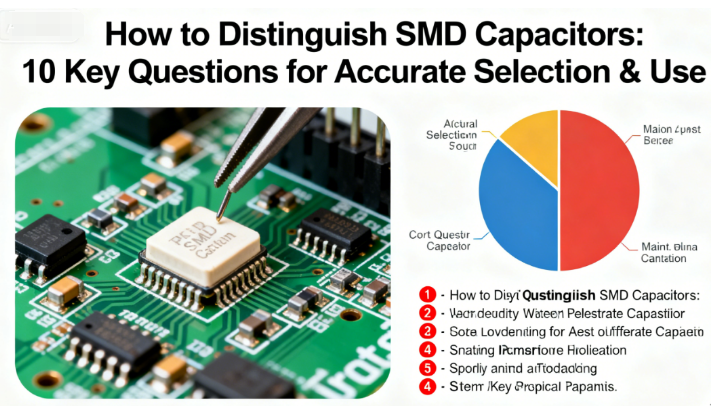
How to Distinguish SMD Capacitors: 10 Key Questions for Accurate Selection & Use
- How to distinguish SMD capacitor dielectric types (X7R/X8R/C0G/NPO) & their performance differences?
- How to distinguish SMD capacitor package sizes (0402/0603/0805/1206) & avoid imperial/metric confusion?
- How to distinguish SMD capacitor voltage ratings and capacitance values from markings?
- How to distinguish high-quality vs low-quality SMD capacitors?
- How to distinguish genuine vs counterfeit SMD capacitors (Murata/TDK vs generic)?
- How to distinguish high-frequency vs low-frequency SMD capacitors?
- How to distinguish new, used, & aging SMD capacitors?
- How to distinguish SMD electrolytic vs ceramic capacitors?
- How to distinguish compatible vs non-compatible SMD capacitors for replacement?
- How to distinguish industrial vs consumer SMD capacitors?
SMD (Surface Mount Device) capacitors are ubiquitous in electronics, but their vast variety—spanning dielectrics, packages, voltage ratings, and quality grades—often leads to confusion. Whether you’re an engineer selecting components, a procurement specialist sourcing parts, a repair technician replacing faulty capacitors, or a DIY enthusiast learning the ropes, the ability to distinguish between different SMD capacitors is critical to avoiding costly mistakes (e.g., circuit failure, PCB incompatibility, or premature breakdown).
1. How to Distinguish SMD Capacitor Dielectric Types (X7R/X8R/C0G/NPO) & Their Performance Differences?
Dielectric material is the foundation of SMD capacitor performance—distinguishing between types ensures compatibility with your circuit’s needs (e.g., temperature stability, capacitance retention). Here’s how to identify and differentiate the most common dielectrics:
| Dielectric Type | Visual/Marking Clues | Core Performance Traits | Typical Applications |
|---|---|---|---|
| C0G/NPO | Marked “C0G” or “NPO” on the body; no capacitance drift | • Ultra-low drift (≤0.1% over -55℃~125℃) • Tight tolerance (±2%) • High Q-factor (low loss) |
Timing circuits, oscillators, high-frequency RF modules |
| X7R | Marked “X7R”; most common in general-purpose circuits | • Stable capacitance (±10% over -55℃~125℃) • Good ripple current capacity • Balanced performance |
Power filtering, signal coupling, consumer electronics |
| X8R | Marked “X8R”; higher temperature rating than X7R | • 85% capacitance retention at 150℃ • Tolerance ±10% (-55℃~150℃) • Resists thermal cycling |
High-temperature environments (industrial machinery, automotive) |
| Polymer Ceramic | Often unmarked but has a matte finish; flexible dielectric | • Ultra-low ESR (≤2mΩ) • Low leakage current • Vibration-resistant |
Battery-powered devices, high-current circuits, mobile electronics |
Key takeaway: Dielectric differentiation boils down to stability vs. versatility. C0G/NPO is ideal for precision applications, while X7R/X8R works for general use, and polymer types excel in high-current scenarios.
> SEO Keyword Focus: distinguish SMD capacitor dielectric types, X7R vs X8R SMD capacitor differentiation, C0G vs NPO SMD capacitor performance2. How to Distinguish SMD Capacitor Package Sizes (0402/0603/0805/1206) & Avoid Imperial/Metric Confusion?
SMD capacitor packages use imperial (inch) or metric (mm) standards—mixing them up leads to PCB incompatibility. Here’s a foolproof method to distinguish sizes:
Step 1: Understand Package Labeling Rules
- Imperial (Most Common): Labeled as “ABCD” (e.g., 0402, 0603), where the first two digits = length (1/100 inch), last two = width (1/100 inch). Example: 0603 = 0.06in (1.6mm) × 0.03in (0.8mm)
- Metric: Labeled as “EFGH” (e.g., 1608, 2012), where the first two digits = length (0.1mm), last two = width (0.1mm). Example: 1608 = 1.6mm × 0.8mm (equivalent to imperial 0603)
Step 2: Visual & Measurement Differentiation
| Imperial Size | Metric Equivalent | Dimensions (L×W, mm) | Visual Cues | Practical Use Case |
|---|---|---|---|---|
| 0402 | 1005 | 1.0×0.5 | Tiny—fits on a fingernail | Compact devices (smartphones, wearables) |
| 0603 | 1608 | 1.6×0.8 | Most common—easily handled with tweezers | General-purpose PCBs, Arduino projects |
| 0805 | 2012 | 2.0×1.2 | Wider than 0603—visible branding | Industrial controllers, power supplies |
| 1206 | 3216 | 3.2×1.6 | Largest common size—sturdy | High-vibration equipment, heavy-duty circuits |
3. How to Distinguish SMD Capacitor Voltage Ratings & Capacitance Values from Markings?
SMD capacitors use compact markings (laser printing or inkjet labeling) to indicate voltage and capacitance—misinterpreting these leads to catastrophic circuit failure. Here’s how to decode them:
1. Capacitance Marking Standards
| Marking Type | Example | Interpretation | Key Rules |
|---|---|---|---|
| Three-Digit Code (Most Common) | “104” | 10 × 10⁴ pF = 100,000 pF = 0.1μF | • First two digits = significant figures • Third digit = number of zeros (in pF) • “100” = 10 × 10⁰ pF = 10pF |
| Two-Digit Code | “22” | 22 pF (C0G/NPO only) | Used for small capacitances (≤99pF) |
| Letter + Digit | “105K” | 10 × 10⁵ pF = 1μF, ±10% tolerance | Letter = tolerance (K=±10%, J=±5%, F=±1%) |
2. Voltage Rating Marking
- Direct Labeling: Some capacitors mark voltage directly (e.g., “25V”, “50V”)—common in larger packages (0805+).
- Code System (Small Packages):
- “A” = 1.0V, “C” = 1.6V, “E” = 2.5V, “V” = 35V, “U” = 25V, “W” = 40V.
- Example: A capacitor marked “104U” = 0.1μF, 25V.
4. How to Distinguish High-Quality vs Low-Quality SMD Capacitors?
Low-quality SMD capacitors cause frequent circuit failures, overheating, and reduced device lifespan. Use these key indicators to distinguish them from high-quality alternatives:
1. Visual Quality Checks
| High-Quality Traits | Low-Quality Red Flags |
|---|---|
| Uniform laser marking (clear, non-fading, no smudges) | Blurry inkjet marking (smudges, misspellings, or missing characters) |
| Consistent package dimensions (no warping, even edges) | Uneven edges, bent leads, or inconsistent thickness |
| Matte, scratch-resistant surface (ceramic types) | Shiny, easily scratched plastic body |
| Brand logo (e.g., Murata, TDK, AVX) clearly visible | No branding or generic “no-name” markings |
2. Performance Differentiation Tests
| Test Parameter | High-Quality Standard | Low-Quality Failure Signs |
|---|---|---|
| Capacitance Stability | ≤±5% deviation from rated value (at 1kHz) | >±15% deviation; erratic readings |
| ESR (Equivalent Series Resistance) | ≤8mΩ (ceramic) / ≤3mΩ (polymer) | >20mΩ; high power loss |
| Solderability | Solder flows smoothly onto leads; no cold joints | Poor wetting (solder beads up); oxidation on leads |
| Leakage Current | ≤0.01μA/μF (polymer) / ≤0.1μA/μF (ceramic) | >0.5μA/μF; overheating during use |
Case Study: The Cost of Low-Quality Capacitors
A consumer electronics manufacturer switched from generic SMD capacitors to high-quality Murata X7R capacitors—capacitor-related failures dropped by 76%, and device lifespan extended from 2 to 5 years. The upfront cost increase (20%) was offset by reduced warranty claims and improved customer satisfaction.
5. How to Distinguish Genuine vs Counterfeit SMD Capacitors (Murata/TDK vs Generic)?
Counterfeit SMD capacitors are rampant in the market—they mimic brand designs but fail to meet performance standards. Use these methods to authenticate genuine parts:
1. Visual Authentication
- Branding Details: Genuine capacitors have crisp, consistent logos (e.g., Murata’s “M” logo, TDK’s “TDK” text) with no misspellings. Counterfeits often have blurry logos, incorrect font sizes, or distorted graphics.
- Packaging: Genuine parts come in anti-static bags with batch numbers, expiration dates, and brand labeling. Counterfeits use generic unmarked bags or reused brand packaging with mismatched batch numbers.
- Marking Consistency: Genuine capacitors have uniform marking placement (e.g., logo on top, value on bottom). Counterfeits may have misaligned, missing, or duplicated markings.
2. Performance Verification
- Datasheet Cross-Reference: Compare the capacitor’s dimensions, ESR, temperature rating, and capacitance tolerance with the official brand datasheet. Counterfeits often deviate by >10% from specs.
- Batch Consistency: Test 5–10 units from the same batch—genuine capacitors have ≤10% variation in capacitance/ESR. Counterfeits show erratic results (e.g., 20–50% variation between units).
- Brand Verification Tools: Use manufacturer-specific tools (e.g., Murata’s Product Authentication Portal, TDK’s Batch Number Lookup) to check if the batch number is valid.
6. How to Distinguish High-Frequency vs Low-Frequency SMD Capacitors?
High-frequency (≥1MHz) and low-frequency (≤1kHz) circuits require capacitors with distinct characteristics—using the wrong type causes signal distortion or overheating. Here’s how to distinguish them:
| Parameter | High-Frequency SMD Capacitors (≥1MHz) | Low-Frequency SMD Capacitors (≤1kHz) |
|---|---|---|
| Dielectric | C0G/NPO (low loss) / X7R (stable) | X7R/X8R (high capacitance) / Polymer (low leakage) |
| Q-Factor | High (≥100 at 1MHz) | Low (≤50 at 1MHz) |
| Parasitic Inductance | Low (≤1nH) | Higher (≤5nH) |
| ESR | Very low (≤1mΩ at 1MHz) | Higher (≤10mΩ at 1kHz) |
| Package Size | Small (0402/0603) to minimize inductance | Larger (0805/1206) for higher capacitance |
| Markings | Often labeled “High-Q” or “RF” | No special markings; focus on capacitance/voltage |
Practical Distinction Method:
Use an LCR meter to measure ESR at 1MHz—high-frequency capacitors will have ESR ≤1mΩ, while low-frequency types will exceed 5mΩ. For RF circuits, look for “high-Q” or “RF” markings on the capacitor body, or verify the Q-factor specification in the datasheet.
Key application note: High-frequency capacitors are critical for 5G devices, RF modules, and oscillators, while low-frequency types excel in power supplies, audio circuits, and energy storage applications.
> SEO Keyword Focus: high-frequency vs low-frequency SMD capacitor distinction, SMD capacitor Q-factor differentiation for circuits, RF module SMD capacitor frequency distinction7. How to Distinguish New, Used, & Aging SMD Capacitors?
Aging or used SMD capacitors (e.g., from recycled electronics) have degraded performance—here’s how to distinguish their status:
1. Visual Clues
| New Capacitors | Used/Aging Capacitors |
|---|---|
| Clean, unblemished body; no solder residue | Solder marks on leads; scratch marks on body |
| Bright, untarnished metal leads | Oxidized (darkened) leads; corroded pads |
| Intact marking (no fading or rubbing) | Faded or partially rubbed-off marking |
| No bulging or discoloration (electrolytic types) | Bulging top; brown/black leakage (electrolytic) |
2. Performance Tests
| Test | New Capacitor Result | Used/Aging Capacitor Result |
|---|---|---|
| Capacitance Measurement | ≥90% of rated value (at 1kHz) | <80% of rated value |
| Leakage Current | ≤0.01μA/μF (polymer) / ≤0.1μA/μF (ceramic) | >0.1μA/μF (polymer) / >0.5μA/μF (ceramic) |
| ESR Test | ≤1.5x manufacturer’s rating | >2x manufacturer’s rating |
| Thermal Cycling (Optional) | ≤5% capacitance change after -40℃~125℃ cycles | >15% capacitance change |
8. How to Distinguish SMD Electrolytic vs Ceramic Capacitors?
SMD electrolytic and ceramic capacitors serve different purposes—confusing them leads to circuit malfunctions. Here’s the key differentiation:
1. Visual & Physical Traits
| SMD Ceramic Capacitors | SMD Electrolytic Capacitors |
|---|---|
| Small, rectangular shape; thin profile (≤2mm thickness) | Cylindrical or rectangular; thicker (≥3mm thickness) for equivalent capacitance |
| No polarity marking (except some tantalum types, which have a “+” mark) | Clear polarity marking (white stripe = negative; some have a “+” for positive) |
| Markings include dielectric (X7R/C0G) and capacitance/voltage values | Markings include voltage, capacitance, and polarity (no dielectric marking) |
| Hard, brittle body (ceramic material) | Slightly flexible body (polymer casing for electrolytes) |
2. Application Differentiation
| SMD Ceramic Capacitors | SMD Electrolytic Capacitors |
|---|---|
| Best for high-frequency filtering, signal coupling, timing, and decoupling | Best for low-frequency power filtering, energy storage, and voltage regulation |
| Capacitance range: 1pF–100μF | Capacitance range: 1μF–1000μF (higher capacitance for size) |
| Ideal for compact devices (smartphones, wearables, IoT sensors) | Ideal for power supplies, industrial machinery, and audio amplifiers |
| Low leakage current; high ripple current capacity | Higher leakage current; lower ripple current capacity |
Critical note: Reversing the polarity of an SMD electrolytic capacitor will cause it to bulge, leak, or even explode. Ceramic capacitors have no polarity, so they can be installed in any orientation.
> SEO Keyword Focus: SMD electrolytic vs ceramic capacitor distinction, SMD capacitor type differentiation for applications, polarized vs non-polar SMD capacitor9. How to Distinguish Compatible vs Non-Compatible SMD Capacitors for Replacement?
Replacing a faulty SMD capacitor requires matching key parameters—using a non-compatible part leads to further damage. Here’s how to distinguish compatibility:
1. Must-Match Parameters (Non-Negotiable)
| Parameter | Compatibility Rule | Example |
|---|---|---|
| Capacitance | New value ±10% of original (±5% for precision circuits) | Original 0.1μF → Compatible: 0.09μF–0.11μF |
| Voltage Rating | New rating ≥ original (preferably 1.5x for safety) | Original 16V → Compatible: 25V–50V |
| Dielectric Type | Match or upgrade (e.g., X7R → X8R; C0G → C0G) | Original X7R (general-purpose) → Avoid C0G (low capacitance) |
| Package Size | Same footprint or drop-in replacement (larger if PCB allows) | Original 0603 → Compatible: 0603 (same) or 0805 (larger, if pads fit) |
2. Red Flags for Non-Compatibility
- Voltage rating < original (e.g., 16V replacement for 25V original) → Risk of breakdown.
- Capacitance outside ±10% range (e.g., 0.05μF replacement for 0.1μF original) → Poor filtering/timing performance.
- Dielectric downgrade (e.g., X8R → X7R for high-temperature circuits) → Capacitance drift and premature failure.
- Package size too large/small for PCB pads (e.g., 1206 replacement for 0603) → Poor soldering or mechanical stress.
10. How to Distinguish Industrial vs Consumer SMD Capacitors?
Industrial and consumer electronics have vastly different operating conditions—distinguishing between their SMD capacitors ensures reliability. Here’s the breakdown:
| Feature | Industrial-Grade SMD Capacitors | Consumer-Grade SMD Capacitors |
|---|---|---|
| Temperature Range | Wide (-40℃~150℃, X8R/X9R dielectrics) | Narrow (-20℃~85℃, X7R dielectrics) |
| Vibration Resistance | High (19.6m/s², IEC 60068-2-6 standard) | Low (9.8m/s², basic consumer standards) |
| Reliability Rating | MTBF (Mean Time Between Failures) ≥1M hours (AEC-Q200/IEC 60384-16) | MTBF ≤500K hours (no industrial certification) |
| Environmental Protection | Humidity-resistant (85℃/85%RH, 1000h test) | Basic humidity tolerance (60℃/60%RH, 500h test) |
| Quality Control | 100% parameter testing; batch traceability | Sampling testing; limited traceability |
| Price | 2–3x higher than consumer-grade | Budget-friendly; mass-produced |
Visual Clues:
- Industrial capacitors often have “industrial” or standard markings (e.g., “IEC 60384-16”, “AEC-Q200”) on the body.
- Consumer types have no special certification markings—only capacitance, voltage, and dielectric labels.
- Industrial packages are sturdier (thicker leads, reinforced solder pads) to withstand high-vibration environments.
Key application note: Never use consumer-grade SMD capacitors in industrial equipment (e.g., factory controllers, automotive electronics) or medical devices—they will fail prematurely under harsh conditions. Industrial-grade capacitors are overkill for consumer devices (e.g., smartphones, TVs) but can extend lifespan for high-use products.
> SEO Keyword Focus: industrial vs consumer SMD capacitor distinction, SMD capacitor environmental resistance differentiation, AEC-Q200 vs consumer SMD capacitorFinal Thoughts: Mastering SMD Capacitor Differentiation for Success
Distinguishing SMD capacitors is not just about identifying types—it’s about matching the right component to your application’s unique needs. By focusing on key differentiation points—dielectric performance, package size, markings, quality, compatibility, and application-specific traits—you’ll avoid costly mistakes and ensure your electronics perform reliably.
Remember, the key to effective differentiation lies in:
- Visual inspection: Look for markings, branding, and physical traits (e.g., polarity, package size).
- Performance testing: Use tools like LCR meters to verify capacitance, ESR, and stability.
- Standard compliance: Prioritize capacitors meeting IEC 60384, AEC-Q200, or ISO 13485 (medical) standards.
- Application alignment: Never use a consumer-grade capacitor in an industrial environment, or vice versa.
As SMD capacitor technology evolves (e.g., smaller packages, higher capacitance, smarter monitoring), staying updated on differentiation techniques will keep your independent site ahead of the curve. By providing actionable, SEO-optimized guidance on “how to distinguish SMD capacitors,” you’ll attract targeted traffic (engineers, procurement, DIY enthusiasts) and establish authority in the electronics components niche.
Call to Action: Have questions about distinguishing SMD capacitors for your specific project (industrial/consumer/DIY)? Drop a comment below with your application, operating conditions, and component details—we’ll share a customized differentiation checklist to ensure accurate selection.

Genuine Murata X7R SMD Capacitor Kit (0603)
10 values (10pF–1μF), 25V, ±10% tolerance. High-quality for general-purpose filtering, coupling, and decoupling.

C0G/NPO Precision SMD Capacitors (0402)
±2% tolerance, 50V, low drift (-55℃~125℃). Ideal for high-frequency circuits, oscillators, and timing applications.
Industrial-Grade X8R SMD Capacitors (1206)
47μF, 25V, -55℃~150℃ rating. AEC-Q200 certified for automotive, industrial, and high-temperature use.
SMD Capacitor Identification Tool Kit
Digital caliper, LCR meter (basic), and marking decoder chart. Perfect for distinguishing package sizes, values, and quality.
Polarized SMD Electrolytic Capacitor Kit (10μF–100μF)
25V, low leakage, for low-frequency power filtering and energy storage in consumer/industrial devices.
Capacitor & Peripheral Electronic Products: 10 Critical Matching & Integration Questions
How to Use SMD Capacitors: 10 Essential Questions for Beginners & Engineers
Related Article