Awakening Mechanical Touch MLCC Neural Veins Behind Embodied AI and Humanoid Robots
Awakening Mechanical Touch: MLCC Neural Veins Behind Embodied AI and Humanoid Robots
In today's rapid advancement of Embodied AI, robots are no longer just "iron arms" in factories that mechanically repeat fixed actions. Walking into the cutting-edge technology exhibition hall of 2026, bipedal humanoid robots can flexibly pass eggs with both hands and autonomously shuttle through complex home environments to wash clothes; bionic dexterous hands with tactile feedback can even perceive the thickness and material of paper through the faint pressure of fingertips.
This revolution that gives machines "bodies and perception" is essentially an extreme challenge that is nearly stringent to hardware integration, miniaturization space, and sensor precision.
When hundreds of micro force, tactile, visual, and inertial sensors (IMU) cover the robot's entire body like human nerve endings, MLCCs (Multilayer Ceramic Capacitors), as the underlying signal stability source of all this, are becoming the silent key supporting the "neural veins" of embodied intelligence.
1Hardware Extreme Stress Test Brought by Humanoid Robots
The working environment and integrated architecture of humanoid robots and embodied AI hardware pose extremely disruptive and stringent requirements for passive components:
1. Palm-Sized Space and Extreme High-Density Integration
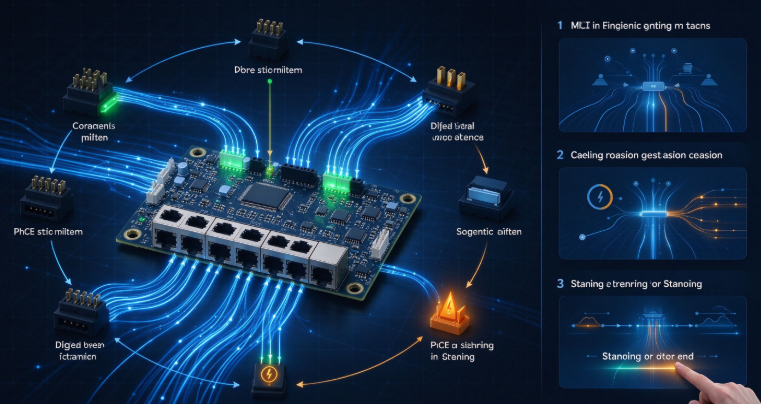
To maintain human-like agile posture, the internal space of the robot's torso, joints, and dexterous hands is extremely crowded. Sensors and control boards must achieve ultimate miniaturization — conventional-sized capacitors simply cannot fit.
2. Continuous Impact and Micro-Vibration Caused by High-Frequency Motion
When robots walk, jump, or grasp objects, joints throughout the body generate high-frequency mechanical impacts and continuous vibrations. If the capacitor's mechanical stress bearing capacity is insufficient, it is highly prone to body cracking and short circuits due to PCB micro-deformation, causing "local paralysis" of the robot.
3. Anti-Interference Challenge for Massive Weak Analog Signals
The robot's electronic skin and tactile sensors need to capture microamp-level electrical signal changes. Any electromagnetic interference (EMI) generated by joint motor operation may drown out precise tactile data. How to maintain signal purity under strong interference is the lifeline of system design.
2Barron Embodied AI Special Series: Injecting Robust "Neurons" into Robots
To empower next-generation humanoid robots and embodied AI hardware, Barron has carried out special upgrades in miniaturization, stress resistance, and high-precision decoupling series:
Nano-Scale Micro Packages and Large Capacity Achieved Simultaneously
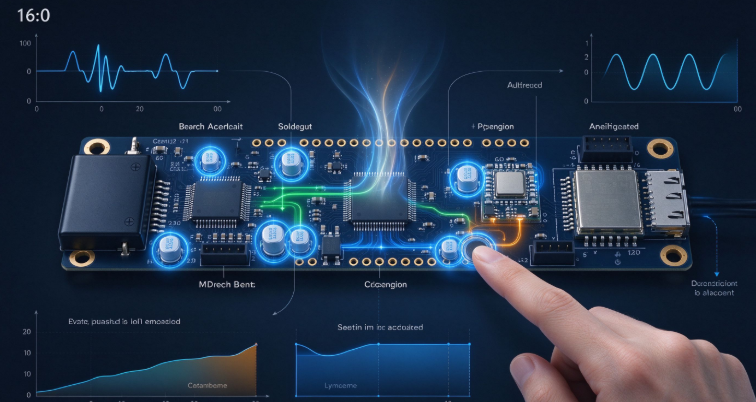
We provide ultra-micro high-capacity MLCCs covering 0201 and 01005, perfectly adapting to the extremely compact space of humanoid robot fingertip dexterous hands and micro joint control boards, providing the closest transient power supply for sensor chips.
Conductive Resin Soft Termination Technology Anti-Stress
Fully introducing anti-mechanical stress resin terminal electrode structures, which can easily absorb physical deformations caused by the robot's high-intensity motion and frequent collisions, completely eradicating hidden dangers of cracking due to mechanical stress, ensuring all-weather stable operation.
Ultra-High Anti-Interference and Low Temperature Drift C0G Material
For the analog frontends of tactile and inertial navigation (IMU) sensors, Barron provides high-precision low-temperature drift capacitors, ensuring that the acquisition accuracy of sensors remains steadfast when environmental temperature changes or motors start with large currents.
3Practical Exercise: Placement of MLCCs in the Core Architecture of Humanoid Robots
In the precise deployment of embodied AI hardware, Barron MLCCs are active at key positions that determine the robot's "agility and perception":
Tactile Acquisition Circuits for Bionic Dexterous Hands and Electronic Skin
Within the extremely limited space inside finger joints, micro pressure and tactile sensors are densely arranged. Using Barron's miniaturized, high-precision capacitors can effectively filter environmental stray noise, giving robots delicate and precise "touch."
Joint Servo Motor Drives and Position Encoders
Next to encoders and drive boards that control the precise positioning of robotic arms, deploy Barron's low-ESL, high-stability decoupling capacitor arrays, ensuring motors run smoothly even under transient high voltages during high-speed start-stop and sharp turns.
Embodied Brain (Edge AI Computing Motherboard) Power Integrity
Edge computing chips processing massive visual and tactile large models have extremely high requirements for transient current. Barron's high-performance decoupling capacitors provide them with a rock-solid low-impedance power network.
4Conclusion: With Tiny Foundations, Supporting the Robot's Sea of Stars
The ultimate goal of embodied intelligence is to让 machines truly understand and integrate into the human physical world. In this great journey of reshaping the future, it is precisely countless tiny yet outstanding MLCCs that silently guard every precise touch and agile turn of robots.
Is your robot, embodied AI hardware, or smart sensor project looking for a passive component partner that can withstand extreme space and strong vibration tests?
Welcome to visit www.barronmlcc.com to explore our embodied AI and robot special MLCC product line. Let Barron, with stringent craftsmanship, join hands to create a new era of robot intelligence!
Get Free Robotics MLCC Samples & Embodied AI Design ConsultationEmail: hyc2355937758@gmail.com WhatsApp: +86 15913754866 WhatsApp: +86 18824523083 Official Website: www.barronmlcc.com
Bridging the Sky-Earth Divide High-Frequency MLCC Breakthroughs Behind 5.5G and Direct Satellite Communication
The Hidden Force Behind Light Speed Transmission MLCC High-Frequency Survival Rules in 800G 1.6T Optical Module
Related Article