Great Wisdom in Microamps Low-Power MLCC Selection Secrets for IoT and Edge Computing
Great Wisdom in Microamps: Low-Power MLCC Selection Secrets for IoT and Edge Computing
In the grand picture of the "Internet of Everything," what often attracts the most attention are the massive algorithms in the cloud and the blinking cabinets of data centers. However, what truly determines the vitality of IoT systems are those edge sensing nodes scattered in streets and alleys, factory corners, and even deep mountains and wild forests — smart water meters, wireless temperature and humidity sensors, industrial vibration monitors, and asset tracking tags.
For designers of these IoT hardware devices, the core pain points they face are often extremely extreme: the battery is only the size of a button, yet it must support stable device operation for 3 to 5 years or even longer; in daily deep sleep at microamp (µA) levels, but at the moment of waking up to transmit wireless signals, the current surges by tens or even hundreds of milliamps.
In this relentless pursuit of "ultimate battery life," as the main force of circuit energy storage and decoupling, the physical characteristics of MLCCs (Multilayer Ceramic Capacitors) — such as leakage current magnitude — directly determine how long the battery can last.
1The Overlooked "Invisible Leakage": Battery Life Killer of IoT Hardware
In ordinary high-power devices (such as phones or computers), the leakage current of capacitors themselves is negligible. But in IoT devices focusing on ultra-low power, this parameter becomes a lifeline.
Insulation Resistance and Leakage Traps
When an IoT node is in deep sleep mode, the static current of the entire circuit is often reduced to a few microamps or even nanoamps. If a capacitor with insufficient insulation resistance (IR) or poor quality is selected at this time, the tiny leakage current continuously existing inside the capacitor may quietly "consume" the precious battery power, greatly reducing the designed lifespan.
Voltage Drop Under Pulse Transients
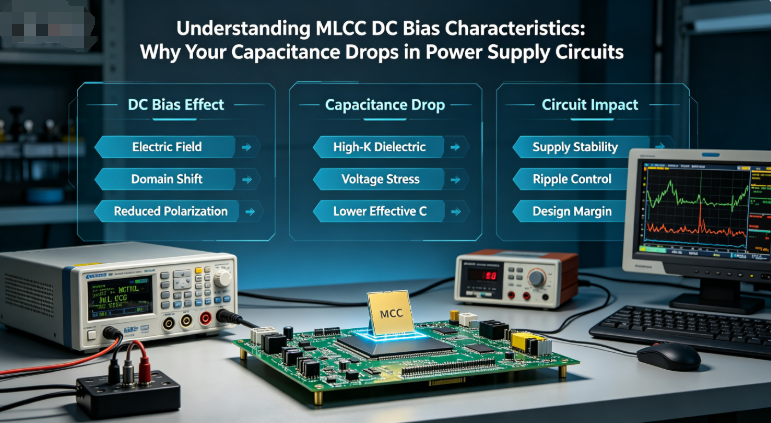
When IoT nodes send data through LoRa, NB-IoT, or BLE, the RF module instantaneously pulls up the current. If the local decoupling MLCC has insufficient capacity or its effective capacitance "shrinks" due to DC bias under high-frequency transients, it will cause an instantaneous drop in power supply voltage, leading to the microcontroller (MCU) accidentally triggering a Brown-out Reset (BOR), resulting in data transmission failure.
2Technical Breakthrough of Barron Low-Power Series MLCCs
To help IoT developers破解 "battery life anxiety," Barron has carried out special optimization of MLCC underlying materials and screening mechanisms for ultra-low-power edge computing scenarios:
Ultra-High Insulation Resistance (High IR) Formulation nA Level Leakage
By improving the sintering purity and grain boundary control technology of ceramic dielectrics, we have greatly enhanced the insulation resistance of capacitors at room temperature and in high-humidity environments, suppressing leakage current to extremely low levels, ensuring that during the deep sleep period of IoT devices, capacitors do not become "power thieves."
Optimized Dielectric Thickness and Energy Storage Efficiency
While ensuring micro packages (such as 0402 or 0201), stable charge reserves are provided through high-precision lamination technology, perfectly absorbing transient voltage drops caused by RF burst pulses, ensuring MCUs and wireless modules can still work stably under extreme low power conditions.
Excellent Environmental Adaptability
IoT devices often face outdoor sun exposure or humid environments. Barron industrial-grade low-power MLCCs have extremely strong resistance to damp-heat migration, completely eliminating leakage surges caused by electrochemical corrosion.
3Practical Exercise: Capacitor Placement Art for Low-Power IoT Circuits
In the hardware design of IoT nodes, to allow Barron MLCCs to release their best effectiveness, we recommend following these practical placement rules:
"Personal Bodyguards" for MCUs and Wireless Chips
Place low-power decoupling capacitors (such as 0.1µF ceramic capacitors配合 4.7µF/10µF energy storage capacitors) closely against the power pins of the main control MCU and RF transceiver chip. Traces should be short and thick, ensuring that the current during wireless transmission can be "sourced locally," avoiding voltage collapse caused by parasitic inductance of long traces.
Energy Storage Nodes for Energy Harvesting Circuits
For passive/micro-power self-powered systems using solar, piezoelectric, or thermoelectric power generation, at the energy storage terminal of the power management chip (PMIC), selecting Barron's low-leakage, high-stability capacitors can maximize the locking of weak environmental electrical energy, improving the energy conversion efficiency of the overall system.
4Conclusion: Defining Long-Lasting Companionship in the Tiny Details
The ultimate charm of the Internet of Things lies in making technology invisible yet long-lasting. Starting from tiny MLCCs, meticulously crafting every microamp of power consumption is precisely the confidence Barron has to help developers create "maintenance-free, ultra-long battery life" smart hardware.
Are your IoT sensors, smart home terminals, or edge computing nodes troubled by unstable battery life or high sleep power consumption?
Welcome to visit www.barronmlcc.com to explore our ultra-low leakage, high-reliability MLCC product line. Let Barron's professional quality escort your low-power hardware!
Get Free Low-Power Samples & IoT Design ConsultationEmail: hyc2355937758@gmail.com WhatsApp: +86 15913754866 WhatsApp: +86 18824523083 Official Website: www.barronmlcc.com
Precision Pulse Under Industrial Gears MLCC Reliability in Robotics and Automation Control
Driving Toward Digital Cockpits The Silent Guardians Behind Smart Cars and V2X Connectivity
Related Article