Top 5 Questions on the Latest Diode Technology Directions in 2026
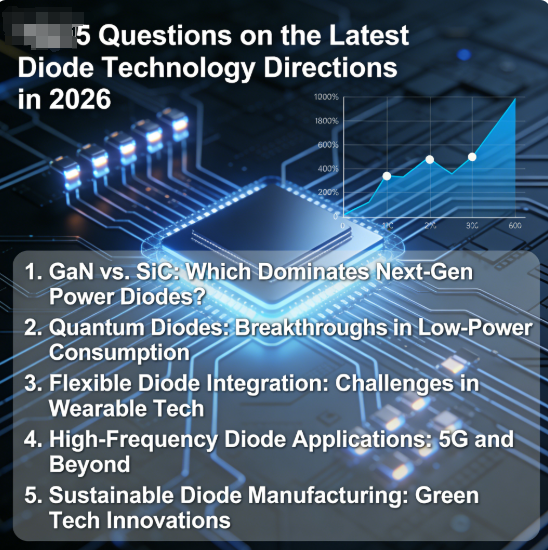
Top 5 Questions on the Latest Diode Technology Directions in 2026
Diodes are the most basic but critical semiconductor devices in power electronics, 5G-A, AI servers, electric vehicles, and wearables. As 2026 brings rapid advances in third‑ and fourth‑generation semiconductors, engineers, purchasers, and R&D teams are searching for clear answers to the newest diode trends and pain points.
1. Why Can’t SiC Diodes Fully Replace Silicon Fast Recovery Diodes in 2026 Despite Cost Drops?
Silicon Carbide (SiC) Schottky diodes have seen a 20–30% cost decrease in 2026, but they still cannot completely replace traditional silicon fast recovery diodes.
- Many low-cost, low-power systems (home appliances, small power adapters, legacy industrial controls) are built for silicon diodes and cannot benefit from SiC performance.
- SiC materials and packaging are still 1.5–2.5x more expensive at low voltage & low current ratings.
- Silicon diodes have stronger stability in high-humidity, unprotected environments.
Verdict: SiC = high-power, high-efficiency markets (EV, solar, industrial). Silicon = mass low-to-medium power markets.
2. Why Do AI Servers & Data Centers Prefer GaN Diodes Over SiC Diodes in 2026?
AI servers and data centers have extremely strict requirements for power density and efficiency — and GaN diodes fit perfectly.
- GaN diodes have near-zero reverse recovery charge (Qrr), supporting switching frequencies above 1MHz.
- Better performance in 48V/12V POL converters for GPUs and computing modules.
- Smaller size, lower heat, and higher power density for dense server racks.
SiC diodes are better for >1200V high-voltage systems, not the high-frequency, low-voltage architecture of AI servers.
3. What Are the Top Reliability Challenges for AEC-Q101 Automotive-Grade Diodes in 2026?
2026 is the year of 800V EV platforms and smarter automotive power systems, which bring new challenges to AEC-Q101 automotive diodes:
- Extreme temperature cycling (-40°C to 175°C) causing thermal fatigue
- Voltage spikes and overshoot from 800V fast charging
- High humidity and corrosion in under-hood environments
- Instability in bidirectional OBC and V2G systems
Advanced packaging (silver sintering), better passivation, and high-temperature wafers are the main solutions.
4. What New Design Pitfalls Exist for Miniaturized ESD/TVS Diodes in 5G-A & Wearables (2026)?
01005 and 0201 ultra‑mini ESD/TVS diodes are widely used in 5G-A and wearable devices, but they come with hidden design risks:
- Ultra-low capacitance (<0.3pF) required by 5G-A weakens ESD protection ability
- Higher parasitic inductance causes signal interference in 5G-A & Wi-Fi 7
- Tiny packages easily crack or suffer solder issues in flexible wearables
Successful design requires balancing size, capacitance, clamping voltage, and PCB layout.
5. Will Ga₂O₃ (Gallium Oxide) Diodes Disrupt SiC/GaN Markets in 2026 Commercialization?
Gallium oxide (Ga₂O₃) diodes officially entered mass production in 2026, but they will not replace SiC or GaN soon.
- Advantage: Ultra-high breakdown voltage, extremely low material cost potential
- Disadvantage: Very poor thermal conductivity, fragile material, limited packaging
- 2026 application: High-voltage, low-frequency static equipment (power grid, test instruments)
SiC and GaN still lead in automotive, AI, industrial, and high-frequency markets.
| Diode Type | 2026 Core Market | Strength |
|---|---|---|
| SiC Diode | EV, Solar, Industrial PSU | High voltage, high power |
| GaN Diode | AI Server, 5G-A, High-Freq PSU | Ultra-high freq, low loss |
| Automotive AEC-Q101 | EV, OBC, Motor Control | High temp, high reliability |
| ESD/TVS Mini | 5G-A, Wearable, Phone | Small size, ESD protection |
| Ga₂O₃ Diode | Power Grid, Test Equipment | Ultra-high voltage, low cost |
Conclusion
2026 is a year of coexistence and differentiation for diode technologies: SiC and GaN lead high-end power electronics, automotive diodes focus on 800V reliability, miniaturized ESD/TVS faces new design challenges, and Ga₂O₃ enters the market as a complementary solution.
Understanding these directions helps engineers select the right components, purchasers plan supply chains, and brands stay competitive in the semiconductor market.
We provide SiC, GaN, automotive AEC-Q101, and miniaturized ESD/TVS diodes optimized for AI, 5G-A, EV, and wearable applications.
📩 Email: hyc2355937758@gmail.com
📱+86-18824523083 WhatsApp: +86-15913754866
2026 में डायोड के शीर्ष 5 नवीनतम प्रश्न | प्रवृत्तियां और समाधान
5 New Doubts Puzzles About Chip Ceramic Capacitors MLCC in 2026 | Expert Answers
संबंधित लेख