How Does an SMD Capacitor Work Principle Structure and Practical Use
How Does an SMD Capacitor Work? Principle, Structure, and Practical Use
How does an SMD capacitor work?
An SMD capacitor works by storing electrical energy in an electric field formed between two conductive electrodes separated by a dielectric material, then releasing that energy when needed to stabilize voltage, filter noise, or support transient current demands in electronic circuits.
This article explains how SMD capacitors work internally, how their structure affects performance, and how engineers apply them in real designs.
What Is an SMD Capacitor?
An SMD capacitor (Surface Mount Device capacitor) is a capacitor designed to be mounted directly onto the surface of a printed circuit board (PCB) using surface-mount technology (SMT).
Compared with through-hole capacitors, SMD capacitors are:
-
Smaller and lighter
-
Better suited for automated assembly
-
Optimized for high-frequency operation
These characteristics influence how SMD capacitors function in modern circuits.
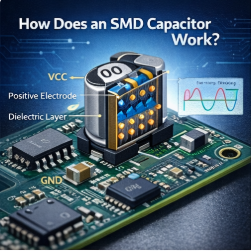 Basic Working Principle of an SMD Capacitor
At a fundamental level, an SMD capacitor operates based on electrostatic energy storage.
When a voltage is applied:
-
Electrons accumulate on one electrode
-
An equal and opposite charge forms on the other electrode
-
An electric field develops across the dielectric
The stored energy is given by the formula:
E = ½ · C · V²
Where:
-
E = stored energy
-
C = capacitance
-
V = applied voltage
This principle is the same for all capacitors, but SMD construction enhances performance.
Internal Structure of an SMD Capacitor
1. Electrodes
SMD capacitors contain metal electrodes that collect and release electrical charge.
In ceramic capacitors (MLCCs), multiple electrode layers are stacked to increase capacitance.
2. Dielectric Material
The dielectric determines:
-
Capacitance value
-
Voltage rating
-
Temperature stability
Common dielectric types:
-
C0G (NP0): Very stable, low loss
-
X7R: Balanced stability and capacitance
-
X5R: Higher capacitance, less stability
3. Terminations
Metal terminations on both ends allow the capacitor to be soldered onto the PCB and connected electrically.
How SMD Capacitors Work in Real Circuits
1. Decoupling and Bypassing
SMD capacitors provide a local energy reservoir near ICs, supplying instantaneous current and reducing voltage fluctuations.
This is why small ceramic capacitors are placed close to power pins.
2. Filtering and Noise Suppression
By presenting low impedance to high-frequency signals, SMD capacitors shunt noise to ground, improving signal integrity and EMC performance.
3. Energy Storage in Power Circuits
In power supplies, SMD capacitors store and release energy to smooth DC outputs and handle load transients.
Tantalum, aluminum electrolytic, or polymer SMD capacitors are often used here.
Why SMD Capacitors Perform Better at High Frequencies
SMD capacitors have:
-
Shorter current paths
-
Lower parasitic inductance
-
Reduced ESR
These factors allow them to respond quickly to fast-changing signals, making them ideal for high-speed digital and RF circuits.
Common SMD Capacitor Types and How They Work
| Type | How It Works Best | Typical Use |
|---|---|---|
| Ceramic (MLCC) | Low ESR, fast response | Decoupling, RF |
| Tantalum | Stable bulk capacitance | Power rails |
| Aluminum Electrolytic | High capacitance | Filtering |
| Polymer | Very low ESR | High current |
How Engineers Optimize SMD Capacitor Performance
To ensure proper operation, engineers consider:
-
Voltage derating
-
Package size (0402, 0603, 0805)
-
Placement close to load
-
Parallel capacitor combinations
Improper design or placement can reduce effectiveness or cause premature failure.
How Understanding SMD Capacitor Operation Helps Sourcing
For purchasing teams, understanding how SMD capacitors work helps in:
-
Evaluating suitable alternatives
-
Avoiding mismatched dielectric types
-
Reducing reliability risks
Suppliers offering engineering support and cross-reference services add significant value.
Conclusion
So, how does an SMD capacitor work?
It works by storing energy in an electric field and releasing it rapidly to stabilize voltage, filter noise, and support reliable circuit operation.
Understanding the working principle of SMD capacitors enables engineers to design better circuits and helps purchasing teams source components with confidence.
What Are the Types of SMD Capacitors? A Complete Guide for Engineers
What Is an SMD Capacitor?
Related Article