MLCC Incoming Inspection Quality Control Practical Guide Automotive / Industrial Grade
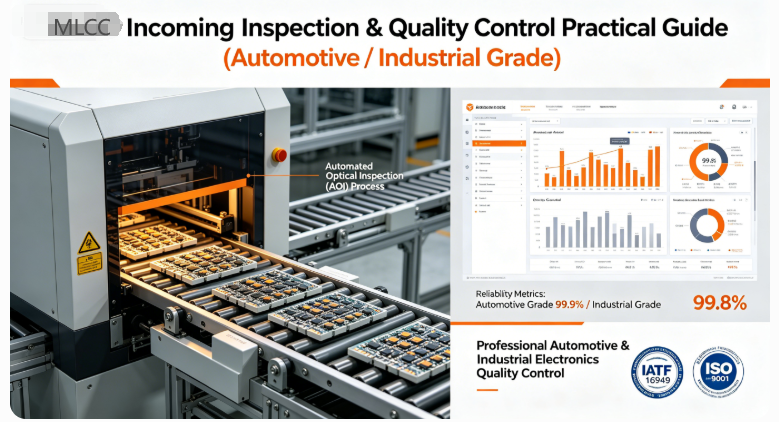
MLCC Incoming Inspection & Quality Control Practical Guide (Automotive / Industrial Grade)
mu sen Introduction
Incoming quality of MLCCs is the first defense line for system reliability. In automotive, industrial, and PV applications, more than 80% of mass MLCC failures result from non-compliant incoming materials, incomplete inspection, and poor quality control. Many companies focus only on component selection and neglect inspection, leading to soldering failures, field failures, mass rework, increased costs, and warranty risks.
MLCC incoming inspection is not just visual check. It requires comprehensive testing of electrical parameters, appearance, reliability, and consistency based on application scenarios. A closed-loop quality control system must be established, covering supplier approval, incoming inspection, defect handling, and batch traceability.
This article provides practical inspection standards, test methods, and quality control procedures for automotive and industrial-grade MLCCs to help engineers control incoming quality and avoid mass risks.
1. Core Principles of MLCC Incoming Inspection
- Differentiated inspection by application: Automotive/industrial MLCCs inspected to highest standards; consumer grade to corresponding levels.
- Batch management first: Each lot inspected and labeled separately; mixing lots is prohibited.
- Mandatory key indicators: Capacitance, ESR/ESL, voltage withstand, appearance, and reliability are required.
- Zero tolerance for non-conformity: Critical automotive/industrial lots are rejected if any key parameter fails.
- Standardized environment: Temperature 25±5℃, humidity 45%~65% to ensure accurate test results.

2. Complete MLCC Incoming Inspection Process
1. Pre-Warehouse Verification
- Verify part number, capacitance, voltage, package, dielectric against PO.
- Check supplier, batch number, production date, shelf life.
- Automotive MLCCs require AEC-Q200 certification; industrial grade requires reliability reports.
- Check packaging integrity, no damage, moisture, or mixed parts.
2. Sampling Rules (GB/T 2828.1)
- Automotive / industrial critical circuits: ≥5% sampling, min 50 pcs; full inspection if <1000 pcs.
- Industrial auxiliary / high-end consumer: 3%~5%, min 30 pcs.
- Low-end consumer: 1%~3%, min 20 pcs.
- Abnormal batches: ≥10% or full inspection.
3. Visual Inspection (10–20× magnifier)
| Item | Acceptance Standard | Rejection Standard |
|---|---|---|
| Ceramic Body | No crack, chip, damage, or stain; uniform color | Cracks, chips, damage, obvious stains |
| Termination | No oxidation, peeling, or exposed copper; uniform plating | Oxidation, peeling, exposed copper, severe scratches |
| Dimension | Within ±0.05mm tolerance | Out of tolerance |
| Packaging | Intact, clear label, no mixed parts | Damaged, mixed parts, missing info |
4. Electrical Parameter Test (Core Items)
- Capacitance: LCR meter at 1kHz/1MHz; tolerance ≤±10% (precision ≤±5%). DC bias attenuation ≤30% (X8R), ≤35% (X7R) at 70% rated voltage.
- ESR/ESL: High-frequency LCR at 1MHz; ≤ datasheet typical value. Consistency ≤10%.
- Withstanding Voltage: 1.2× rated voltage for 60s; no breakdown/arcing; leakage ≤1μA (≤5μA for high voltage).
- Leakage Current: At rated voltage; ≤1μA. High-temperature (85℃) test required for automotive/industrial.
- SRF: ≥2× operating frequency for high-frequency applications.
5. Reliability Test (Harsh Environments)
- Automotive: Temperature cycle (-40℃~125℃, 1000 cycles), vibration (10~2000Hz, 10g).
- Industrial high temp: Aging at 125℃ for 1000h; capacitance decay ≤10% (X7R), ≤5% (X8R).
- PV outdoor: Damp heat (85℃/85%RH, 1000h); no leakage or oxidation.
6. Judgment & Disposition
- Accepted: All items pass; labeled and stored.
- Rejected: Key parameters fail; batch returned to supplier.
- Concession: Minor non-critical defects only; NOT allowed for critical circuits.
3. Inspection Focus by Application
1. Automotive Grade (AEC-Q200)
- Mandatory: Visual, capacitance (bias), ESR/ESL, Hi-Pot, leakage, temp cycle, vibration
- Key: AEC-Q200 validity, batch consistency, termination adhesion
- Prohibit: Non-certified, failed reliability
2. Industrial Grade
- Mandatory: Visual, capacitance, ESR/ESL, Hi-Pot, leakage, high-temp aging
- Key: Temperature drift, bias attenuation, humidity resistance
3. PV & Energy Storage
- Mandatory: Visual, capacitance (bias), Hi-Pot, leakage, damp heat, SRF
- Key: High voltage withstand, low bias decay, humidity resistance
4. Consumer Grade
- Mandatory: Visual, capacitance, Hi-Pot, leakage

4. MLCC Quality Control System
1. Supplier Approval
- Approved vendor list; automotive/industrial suppliers need AEC-Q200 & ISO9001.
- New suppliers require sample test and pilot run.
- Regular performance evaluation.
2. Storage & Process Control
- Store in dry cabinet (RH ≤30%, 20~25℃).
- FIFO management; bake 125℃/4h if stored >1 month.
- Optimize reflow profile; avoid manual soldering damage.
3. Defect Traceability & Handling
- Establish defect records with batch, supplier, and issue.
- Immediate hold for mass defects; trace and rework.
- Supplier corrective action required.
4. Continuous Improvement
- Analyze defect rate and optimize inspection items.
- Upgrade test items for high-frequency/high-voltage applications.
5. Common Inspection Mistakes
- Mistake 1: Only visual inspection → Must include electrical and reliability tests.
- Mistake 2: Insufficient sampling → Strict sampling for automotive/industrial.
- Mistake 3: No certification check → Automotive MLCCs need AEC-Q200.
- Mistake 4: Using defective parts in critical circuits → Zero tolerance required.
- Mistake 5: Poor storage → Moisture damage; use dry cabinet.
- Mistake 6: Mixed batch inspection → Each lot separate for traceability.
6. Incoming Inspection & QC Checklist
- Verify part number, specs, supplier, certification, packaging before receiving
- Follow sampling rules; ≥5% for critical applications; full inspection for abnormal lots
- Visual: No cracks, chips, oxidation, mixed parts; intact packaging
- Electrical test: Capacitance, ESR/ESL, Hi-Pot, leakage, SRF (high-frequency)
- Reliability test: Temp cycle, vibration, aging, damp heat for automotive/industrial/PV
- Disposition: Reject failed lots; concession only for non-critical use
- Storage: Dry cabinet, FIFO; bake and re-test if moist
- Traceability: Defect records, batch tracking, supplier evaluation
mu sen Conclusion
MLCC incoming inspection and quality control are critical to avoid mass failures, reduce costs, and improve system reliability. Overlooking inspection leads to rework, failures, and reputation loss.
For automotive, industrial, and PV applications, inspection must be comprehensive, scenario-based, and traceable. A closed-loop quality system ensures long-term stability.
Following this guide helps improve incoming quality, reduce risks, and enhance production efficiency.
Dongguan Musen Leyton Electronic Technology Co., Ltd. provides fully tested MLCCs with complete certifications and COA reports. We support customized incoming inspection plans, free samples, and technical support to ensure reliable quality control.
Contact Us
MLCC Failure Analysis Troubleshooting Practical Manual With Case Studies
MLCC ESR/ESL Parasitic Analysis - High-Frequency Optimization Practical Guide
Related Article