MLCC Selection Pitfall Guide Why Does Your PCB Board Always Restart Unexpectedly
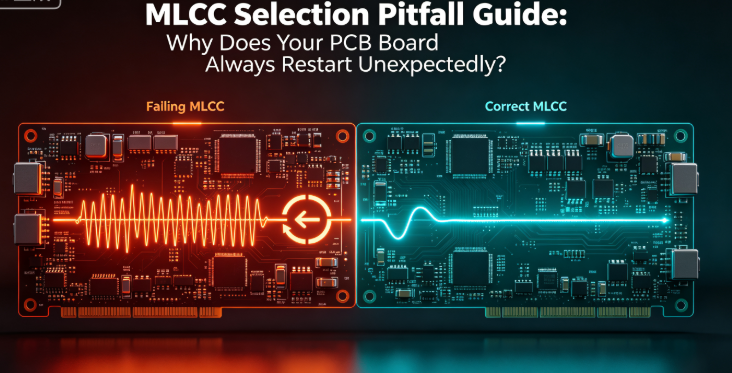
MLCC Selection Pitfall Guide: Why Does Your PCB Board Always Restart Unexpectedly?
In the field of electronic design and manufacturing, multilayer ceramic capacitors (MLCCs), despite their tiny size, are often jokingly called "the heart of the circuit" by engineers. However, many startups and procurement departments often make selection mistakes, leading to serious stability problems of products under high temperature, high voltage or complex electromagnetic environments.
If your products often suffer from unexplained restarts, excessive ripple noise, or high repair rates after delivery, it is time to re-examine your MLCC selection strategy.
1. Don't Be Fooled by "Capacitance": The DC Bias Effect of MLCC
Many purchasers only look at the rated capacitance on the specification sheet when selecting components. But do you know that when operating voltage is applied across the capacitor, its effective capacitance often suffers from severe attenuation?
Phenomenon to Watch Out For:
A capacitor marked as 10μF may shrink to only 3μF-4μF in actual effective capacitance when the operating voltage reaches 50% of the rated voltage.
How to Avoid This Pitfall:
When selecting MLCCs, you must check the DC Bias characteristic curve provided by the manufacturer. Do not blindly pursue small packages (such as 0201). For critical power paths, appropriately increasing the package size or selecting series with more stable high dielectric constant materials (X7R/X5R) is the key to ensuring system stability.
2. Why Do Your Capacitors Always "Fail"? (Stress and Service Life)
The number one killer of capacitor failure is often not voltage breakdown, but mechanical stress. PCB bending, thermal expansion and contraction, or thermal shock during soldering can easily cause microcracks in MLCCs.
Expert Recommendations:
- Avoid Stress Zones: Try not to place capacitors on the edges of PCB or in bending-sensitive areas.
- Consider Soft Termination: If your products need to face frequent vibration or drastic temperature changes, it is recommended to upgrade to series with soft termination electrodes, which can effectively absorb mechanical deformation.
3. Procurement Perspective: How to Balance Price and Performance?
In the current market environment, supply chain stability directly determines the time-to-market of products.
| Dimension | High-Performance Capacitors (Industrial/Automotive Grade) | General-Purpose Capacitors (Consumer Grade) |
|---|---|---|
| Application Scenarios | Medical, industrial control, automotive | Household small appliances, toys |
| Temperature Coefficient | X7R, C0G (Excellent) | Y5V, Z5U (Poor) |
| Supply Stability | High, suitable for long-life cycle products | Highly volatile with market conditions |
Our Suggestions:
For core circuits (such as decoupling of power management ICs), be sure to stick to high-specification products. For non-critical paths, optimizing BOM cost through reasonable cross-reference is the core of reflecting procurement professionalism.
Consumer Electronics Design Pitfall Guide How to Properly Balance MLCC Size and Power Supply Noise
High-Reliability Selection and Application of MLCC for PV Energy Storage - Failure Mechanism Scenario-Based Selection
Related Article