The Art of Balance in Millimeters Precision MLCC Guardians in Humanoid Robot IMU and Sensor Systems
The Art of Balance in Millimeters: Precision MLCC Guardians in Humanoid Robot IMU and Sensor Systems
If powerful servo motors and precision reduction gears endow humanoid robots with the "bones and muscles" for walking, then the inertial measurement units (IMUs), torque sensors, and high-precision encoders distributed throughout the body are their "inner ears and nerves" for perceiving their own posture and maintaining balance.
When a bipedal humanoid robot lands on one foot and gracefully turns on uneven ground, the IMU chip inside its chest is calculating three-axis acceleration and angular velocity at a frequency of thousands of times per second. At this moment, any tiny sensor data drift or noise interference may be misjudged by the algorithm as severe tilt loss of control,进而 causing the robot to stumble or even fall.
In this grand project pursuing ultimate balance and agility, MLCCs (Multilayer Ceramic Capacitors), as the cornerstone of analog frontends and signal conditioning circuits, are playing an irreplaceable role with their pure guardianship of microvolt-level signals.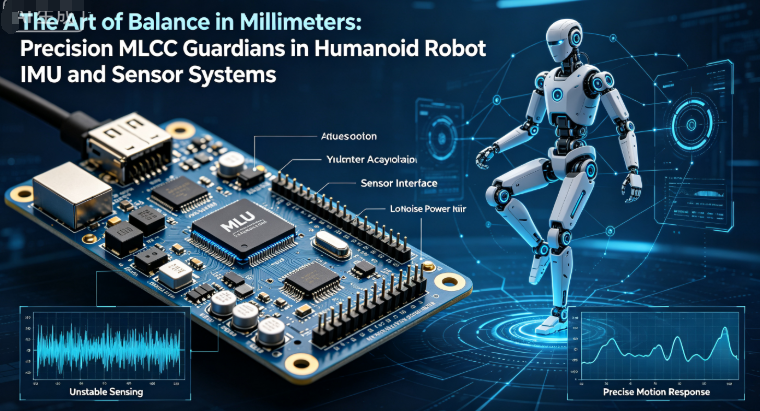
1The "Micro Electromagnetic Battlefield" Faced by Sensors
The interior of a humanoid robot's body is a highly integrated "melting pot of electromagnetic noise." Dozens of high-power servo motors, driven by high-frequency PWM chopping, generate massive amounts of conducted interference and spatial radiation magnetic fields inside the fuselage. For IMUs and tactile sensors, they face extremely severe challenges:
High-Precision Challenges Under Extremely Low Signal-to-Noise Ratio (SNR)
Inertial navigation systems and micro force sensors often collect analog signals at the millivolt or even microvolt level. Once electromagnetic noise侵入 the signal link, it will directly cause errors in attitude calculation, making the robot's "dynamic balance algorithm" produce misactions.
Zero Bias Error Caused by Temperature Drift
Long-term high-intensity movement of the robot causes the internal temperature of the fuselage to rise sharply. If the bypass and filter capacitors around the sensor undergo severe capacitance drift with temperature, it will cause "zero drift" in the sensor output, making the robot "unable to distinguish east, west, south, and north."
Physical Interference of High-Frequency Micro-Vibrations on Sensitive Devices
Plantar tactile and joint sensors directly bear mechanical shocks when landing. Capacitors must not only have stable electrical performance but also cannot产生 stray voltage glitches caused by the piezoelectric effect under long-term micro-vibrations.
2Barron High-Precision C0G and Anti-Interference Special Series: Empowering Ultimate Perception
To keep the robot's "inner ears and nerves" absolutely清醒 in harsh electromagnetic and mechanical environments, Barron has launched a series of special MLCC solutions for high-precision sensors and IMUs:
Ultra-Low Temperature Drift C0G/NP0 Dielectric Technology ±30 ppm/°C
We adopt specially made ultra-high purity ceramic formulations, ensuring that the capacitance change rate of capacitors approaches zero (within ±30 ppm/°C) over a wide temperature range from -55°C to +125°C, completely eradicating sensor zero bias errors caused by temperature changes.
Optimized Anti-Piezoelectric Effect and Low-Noise Design
In response to the extreme demand of inertial navigation systems for signal purity, Barron has optimized the microscopic lattice structure of capacitors, effectively suppressing piezoelectric noise common in Class II ceramics, ensuring that no artificial glitches are introduced into sensitive analog circuits in mechanical vibration environments.
Excellent High-Frequency Filtering and Shielding Effectiveness
At the power supply input terminal and reference voltage terminal of the IMU chip, closely配合 Barron's low-ESR, high-frequency decoupling capacitor array builds a tight "electromagnetic firewall," keeping motor switching noise out.
3Practical Exercise: Placement of MLCCs in Robot Perception Neurons
In the precision sensor architecture of humanoid robots, Barron MLCCs are active at several golden positions that determine balance ability:
Power and Reference Decoupling for Inertial Measurement Units (IMU)
At the core power supply and reference voltage terminals of six-axis/nine-axis gyroscopes and accelerometers, using Barron's high-precision C0G capacitors ensures absolute purity and high repeatability of attitude sampling data.
Joint Micro Force and Torque Sensor (F/T Sensor) Amplification Circuits
At the frontend of instrumentation amplifiers that collect weak deformation signals, using Barron's low-leakage, low-temperature drift capacitors for precision filtering allows the robot to distinguish the subtle differences between "gentle touch" and "firm grip."
Synchronous Clock Signal Filtering for Vision and Depth Camera Modules
Around the image sensors (CIS) of binocular vision and 3D depth cameras, deploy micro high-frequency filter capacitors to ensure no screen tearing or noise during dynamic capture.
4Conclusion: With Millimeter Stability, Building the Beauty of Robot Balance
Every perfect turn and smooth landing of a humanoid robot is a symphonic praise for modern electronic manufacturing craftsmanship. Barron is always committed to providing the most reliable and purest passive component support for the cutting-edge exploration of embodied intelligence.
Is your robot IMU, high-precision sensor, or embodied AI perception module project looking for a passive component partner that can break through temperature drift and electromagnetic interference bottlenecks?
Welcome to visit www.barronmlcc.com to explore our high-precision, low-temperature drift MLCC special series. Let Barron, with ultimate craftsmanship, help your intelligent robots travel steadily and perceive without boundaries!
Get Free High-Precision C0G Samples & Sensor Design ConsultationEmail: hyc2355937758@gmail.com WhatsApp: +86 15913754866 WhatsApp: +86 18824523083 Official Website: www.barronmlcc.com
Winning the 800V Era MLCC Breakthroughs Behind Silicon Carbide SiC and High Voltage Fast Charging
Flying Through Low-Altitude Realms High-Reliability Capacitor Secrets Behind Drone and eVTOL Hardware
Related Article