Top 5 Latest Questions About Tantalum Capacitors in 2026
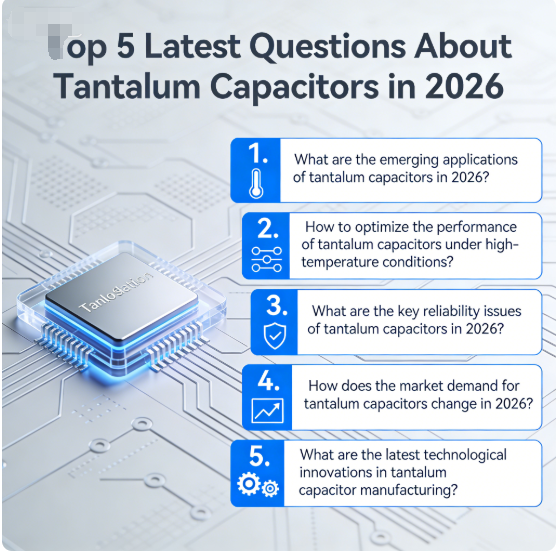
Top 5 Latest Questions About Tantalum Capacitors in 2026
Tantalum capacitors are critical components in automotive, AI, consumer electronics, and industrial applications, and 2026 has brought significant changes to the tantalum capacitor industry—driven by the popularization of 800V automotive platforms, the explosion of AI server demand, rising tantalum prices, and the commercialization of alternative materials.
Engineers, purchasers, and R&D professionals are increasingly searching for clear, data-backed answers to the latest tantalum capacitor challenges.
1. How Can Tantalum Capacitors Meet AEC-Q200 Certification and High Reliability Requirements for 800V Automotive Platforms in 2026?
2026 is the year of 800V automotive platform popularization, with major EV manufacturers (Tesla, BYD, Volkswagen) launching models equipped with 800V power systems. This shift has increased tantalum capacitor usage in EVs by 20-25%, as they are essential for power conversion, voltage regulation, and motor control.
However, 800V automotive environments impose strict requirements on tantalum capacitors, starting with AEC-Q200 certification—the industry standard for passive components in automotive applications. Beyond certification, tantalum capacitors must overcome three key reliability challenges:
- Wide Temperature Range: Under-hood temperatures in EVs range from -40℃ to 150℃, requiring tantalum capacitors to maintain stable capacitance and low leakage current across this range.
- Vibration and Shock Resistance: Vehicle operation generates constant vibration, which can damage the tantalum core or cause solder joint failure.
- Corrosion Resistance: Automotive fluids (coolants, oils) and humidity can corrode capacitor packaging, leading to performance degradation or failure.
Practical Solutions: To meet these requirements, manufacturers are using high-purity tantalum powder (99.99% purity) to improve thermal stability and voltage resistance. Hermetic packaging (such as metal cans) prevents moisture and corrosion, while optimized dielectric layers reduce leakage current. Additionally, all automotive-grade tantalum capacitors must pass strict AEC-Q200 testing, including 1,000 thermal cycles, vibration tests, and humidity tests, ensuring long-term reliability in 800V EV systems.
2. With the Boom in AI Server Demand, What Are the Selection Differences and Application Boundaries Between Tantalum Capacitors and MLCCs?
The AI server market has exploded in 2026, with global shipments expected to grow by 45% year-on-year. A single AI server requires more than 10 times the number of tantalum capacitors of a traditional server, as AI GPUs and power modules demand ultra-stable voltage output and fast transient response.
This has led to a common question: how to choose between tantalum capacitors and MLCCs (chip ceramic capacitors) for AI server applications? The key differences and application boundaries are clear:
- Tantalum Capacitors: Excel in low ESR (≤5mΩ), stable capacitance at high frequencies (up to 1MHz), and strong transient current response. They are ideal for high-reliability, high-current components such as AI server PSUs, GPU power modules, and voltage regulation circuits. Tantalum capacitors also have better long-term stability, reducing the risk of AI server downtime.
- MLCCs: Offer advantages in miniaturization and cost, making them suitable for low-power, non-critical auxiliary circuits (such as signal filtering). However, MLCCs have higher ESR at high frequencies and are more prone to capacitance degradation, making them less suitable for core AI power components.
Key Takeaway: Tantalum capacitors are the preferred choice for core AI server power components, while MLCCs are used for auxiliary circuits. This selection strategy optimizes performance, reduces costs, and ensures AI server stability.
3. What Design and Mass Production Challenges Do 01005 Package Tantalum Capacitors Face in 2026, and How to Solve Them?
As electronic devices become increasingly miniaturized—especially 5G-A terminals, wearable AI devices, and slim smartphones—the 01005 package tantalum capacitor (0.4mm × 0.2mm) has become a mainstream choice in 2026. However, its ultra-small size brings significant design and mass production challenges that many manufacturers struggle with.
The three most pressing challenges are:
- Feeding Jams: During SMT (Surface Mount Technology) assembly, the 01005 package is prone to jamming in feeding equipment, reducing production efficiency and increasing labor costs.
- Material Damage: The fragile tantalum core is easily cracked during packaging, soldering, or handling, leading to low yield rates.
- Polarity Orientation Errors: The ultra-small size makes it difficult to distinguish polarity, leading to wrong installation and component failure.
Solutions to Overcome These Challenges:
- Optimize packaging design to enhance the structural strength of the tantalum core, reducing the risk of cracking.
- Use precision feeding equipment with anti-jam technology, such as vacuum suction feeding, to improve assembly efficiency.
- Adopt automated optical inspection (AOI) systems to detect polarity errors in real time, ensuring correct installation.
- Select high-quality tantalum powder and dielectric materials to improve the overall durability of the capacitor.
These measures can increase the yield rate of 01005 tantalum capacitors from the current 82-88% to over 92%, making mass production feasible for manufacturers.
4. With Tantalum Prices Continuing to Rise (Matching Historical Peaks) in 2026, How to Control Tantalum Capacitor Procurement and Cost Risks?
Tantalum prices have been on a steady rise in 2026, with tantalum ore prices reaching $140 per pound—matching historical peaks. This is driven by two key factors: supply disruptions from Congolese mines (which account for 60% of global tantalum production) and surging demand from AI and automotive industries.
For enterprises that rely on tantalum capacitors, this price surge poses significant procurement and cost risks. Here are three practical strategies to mitigate these risks:
- Sign Long-Term Supply Contracts: Partner with reliable tantalum capacitor suppliers to sign long-term contracts, locking in prices and ensuring stable supply. This avoids the impact of short-term price fluctuations and supply shortages.
- Optimize Product Design
- Implement Smart Inventory Management
By adopting these strategies, enterprises can effectively control procurement costs and reduce the impact of tantalum price fluctuations in 2026.
5. With the Commercialization of Tantalum Capacitor Alternative Materials (Niobium, High-Dielectric Ceramics) in 2026, Can Large-Scale Replacement Be Achieved?
In 2026, alternative materials for tantalum capacitors—including niobium capacitors and high-dielectric ceramics—have entered commercial mass production, raising questions about whether they can replace tantalum capacitors on a large scale. The short answer is: no, not in 2026.
While alternative materials offer cost advantages, they have significant limitations that prevent large-scale replacement:
- Niobium Capacitors: Similar in performance to tantalum capacitors but lower in cost, but they lack the high-voltage and high-temperature resistance required for 800V automotive and AI server applications. They are only suitable for low-power, non-critical circuits.
- High-Dielectric Ceramics: Excel in miniaturization and cost but have higher ESR at high frequencies and poor long-term stability, making them unsuitable for core power components.
- Supply Chain Immaturity: Alternative materials are still in the early stages of mass production, with inconsistent product quality and an immature supply chain. Domestic high-end tantalum capacitor materials also still rely on imports, limiting the widespread adoption of alternatives.
2026 Outlook: Alternative materials will only replace tantalum capacitors in low-power, non-critical applications (such as consumer electronics auxiliary circuits). Tantalum capacitors will remain irreplaceable in high-reliability, high-performance scenarios like 800V automotive, AI servers, and industrial equipment.
| Tantalum Capacitor Application | 2026 Core Challenge | Key Solution |
|---|---|---|
| 800V Automotive | AEC-Q200 certification & high reliability | High-purity tantalum powder + hermetic packaging + AEC-Q200 testing |
| AI Server | Selection vs MLCCs | Tantalum for core power; MLCCs for auxiliary circuits |
| 01005 Miniaturization | Production yield & installation errors | Precision feeding + AOI inspection + optimized packaging |
| Procurement & Cost | Rising tantalum prices | Long-term contracts + design optimization + smart inventory |
| Alternative Materials | Large-scale replacement feasibility | Use alternatives for non-critical circuits; retain tantalum for high-performance |
Conclusion
2026 is a pivotal year for the tantalum capacitor industry, with 800V automotive platforms, AI server demand, miniaturization, rising prices, and alternative materials shaping the market. The top 5 questions addressed in this blog are the most searched by industry professionals, and understanding their answers is key to optimizing design, reducing costs, and ensuring reliability.
Tantalum capacitors remain irreplaceable in high-reliability, high-performance applications, while alternative materials and cost-control strategies offer solutions for non-critical scenarios. By staying informed about these trends, you can stay competitive in the global semiconductor market.
Top 5 Most Common Diode Peripheral Usage Questions Practical Guide 2026
Top 5 Latest Questions About Diodes in 2026
Related Article