5 Rarely Discussed MLCC Challenges Expert Solutions for High-Reliability Electronic Designs
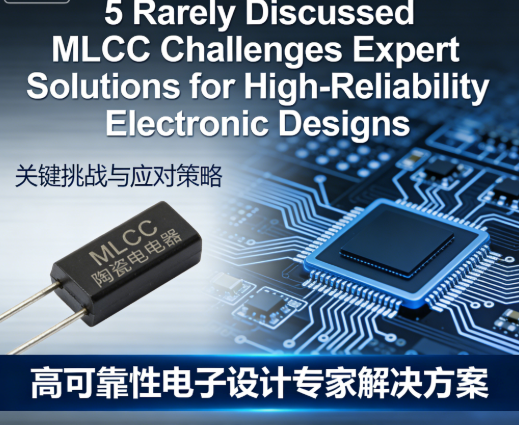
5 Rarely Discussed MLCC Challenges: Expert Solutions for High-Reliability Electronic Designs
Multi-Layer Ceramic Capacitors (MLCCs), commonly known as chip capacitors, are the backbone of modern electronic systems—from precision medical devices to rugged industrial controllers and next-generation AI hardware. While basic MLCC selection and usage guidelines are widely documented, there are critical, underaddressed challenges that plague even experienced engineers and procurement professionals. These rarely discussed pain points often lead to costly design failures, component replacements, and project delays.
1. Addressing MLCC Dielectric Resonance in High-Frequency Power Conversion
A rarely acknowledged issue in MLCC applications is dielectric resonance—a phenomenon where MLCCs exhibit a sharp impedance peak at specific high frequencies (typically 100MHz to 1GHz), disrupting power conversion efficiency. This challenge is particularly problematic in high-frequency power supplies (e.g., 5G base stations, AI server power modules) where stable impedance is critical for noise suppression and voltage regulation. Unlike generic noise issues, dielectric resonance is not caused by external interference but by the MLCC’s own dielectric properties, making it difficult to diagnose without specialized testing.
Root Cause: The ceramic dielectric in MLCCs acts as a resonant circuit when paired with the component’s parasitic inductance and resistance, creating a narrow frequency band where impedance spikes. This resonance can cause excessive heat generation, signal distortion, and even premature component failure in high-frequency designs.
Expert Solutions:
- Select MLCCs with a broadband dielectric (e.g., X7R-F or X5R-H) designed to minimize resonance peaks across the operating frequency range. These dielectrics are engineered to reduce the Q-factor (quality factor) of the MLCC, broadening the impedance curve.
- Implement a capacitor bank with mixed MLCC values (e.g., 100nF + 10nF + 1nF) to cover a wider frequency spectrum, dampening resonance at critical frequencies.
- Use a vector network analyzer (VNA) to test MLCC impedance across the design’s operating frequency range, identifying and avoiding resonance hotspots during the prototyping phase.
Target long-tail queries like “MLCC dielectric resonance in 5G power supplies” or “how to dampen MLCC impedance peaks at high frequencies”—queries that competitors rarely address, ensuring your content captures niche, high-intent traffic.
2. Resolving MLCC Humidity Sensitivity in Harsh Environmental Applications
While most engineers are aware of MLCC temperature ratings, humidity sensitivity is a rarely discussed challenge that impacts performance in harsh environments (e.g., marine systems, outdoor IoT sensors, and industrial washdown applications). High humidity can penetrate the MLCC’s packaging, leading to dielectric degradation, increased leakage current, and even short circuits—yet this issue is rarely covered in mainstream MLCC guides.
Key Misconception: “All MLCCs are moisture-resistant.” In reality, standard MLCCs (without specialized packaging) have a humidity sensitivity level (MSL) of 3 or 4, meaning they can absorb moisture from the air if exposed for extended periods, leading to reliability issues during soldering and operation.
Actionable Fixes:
- Spec MLCCs with MSL 1 rating (moisture sensitivity level 1), which are designed to withstand unlimited exposure to ambient humidity without degradation. These MLCCs use hermetic packaging or specialized moisture-barrier coatings.
- Store MLCCs in dry cabinets (relative humidity <10%) when not in use, especially for high-reliability applications. This prevents moisture absorption before soldering, which can cause “popcorning” (package cracking) during reflow.
- Apply a conformal coating (e.g., Parylene or silicone) to MLCCs after soldering to create an additional moisture barrier, ideal for outdoor or marine applications.
Focus on queries like “humidity-resistant MLCC for outdoor IoT” or “MLCC MSL 1 selection for marine electronics”—niche terms that attract engineers working on environment-specific designs.
3. Mitigating MLCC Self-Heating in High-Power Density Designs
Self-heating in MLCCs is a rarely addressed challenge in high-power density designs (e.g., electric vehicle (EV) powertrains, industrial motor drives, and high-current LED drivers). Unlike external heat sources, self-heating occurs when AC current flows through the MLCC’s equivalent series resistance (ESR), generating heat that can exceed the component’s temperature rating over time. This leads to accelerated dielectric degradation and reduced lifespan, yet most content focuses on external thermal management, not MLCC-specific self-heating.
Critical Insight: Self-heating is most pronounced in MLCCs with high ESR, large capacitance values, and high AC current loads. For example, a 10µF X7R MLCC with 50mΩ ESR carrying 2A of AC current can generate over 0.2W of heat, raising its internal temperature by 20°C or more.
Proactive Solutions:
- Select MLCCs with ultra-low ESR (≤10mΩ for high-current applications) to minimize heat generation. Look for manufacturers that specify ESR at the design’s operating frequency (not just 1kHz).
- Parallel multiple smaller MLCCs (e.g., two 5µF MLCCs vs. one 10µF MLCC) to distribute the current load, reducing self-heating per component. This also lowers total ESR, further minimizing heat.
- Optimize PCB thermal design: Place high-current MLCCs on thick copper traces (≥2oz) to dissipate heat efficiently, and avoid crowding MLCCs with other heat-generating components (e.g., resistors, diodes).
Target queries like “MLCC self-heating in EV powertrains” or “low ESR MLCC for high-power density designs”—terms that appeal to engineers in fast-growing industries like EVs and renewable energy.
4. Overcoming MLCC Voltage De-rating in High-Altitude Applications
High-altitude applications (e.g., aerospace, drones, and mountain-top communication towers) present a unique, rarely discussed challenge for MLCCs: voltage de-rating due to reduced atmospheric pressure. At altitudes above 5,000 meters, the air’s dielectric strength decreases, increasing the risk of MLCC dielectric breakdown—even when operating below the component’s rated voltage. This issue is often overlooked, leading to unexpected failures in high-altitude electronic systems.
Root Cause: Atmospheric pressure directly impacts the breakdown voltage of air, which acts as an additional dielectric layer around the MLCC’s terminations. As altitude increases, air pressure decreases, reducing its ability to insulate, and increasing the likelihood of arcing between the MLCC’s terminals.
Specialized Solutions:
- Select MLCCs with a high altitude voltage rating (e.g., rated for 10,000 meters or more). These MLCCs have thicker dielectric layers and wider terminal spacing to withstand reduced atmospheric pressure.
- Apply a voltage de-rating factor of 10–20% for every 5,000 meters of altitude. For example, a 25V MLCC used at 10,000 meters should be de-rated to 20V or lower to avoid breakdown.
- Use hermetically sealed MLCCs for extreme altitudes (above 15,000 meters). These components are enclosed in a sealed metal package, eliminating the impact of atmospheric pressure on dielectric performance.
Target queries like “high-altitude MLCC voltage de-rating” or “aerospace-grade MLCC for drone applications”—terms that attract engineers in the aerospace and UAV industries, where high-altitude reliability is critical.
5. Solving MLCC Compatibility Issues with Lead-Free Soldering Processes
While lead-free soldering is mandatory under global regulations (e.g., RoHS), the compatibility of MLCCs with lead-free soldering processes is a rarely discussed challenge. Lead-free solders (e.g., SAC305: 96.5% tin, 3% silver, 0.5% copper) have higher melting points (217°C vs. 183°C for leaded solder), which can damage MLCCs if not properly accounted for. This leads to soldering defects (e.g., cold joints, component cracking) and premature failure, yet most content focuses on solder material, not MLCC-specific compatibility.
Common Compatibility Issues: MLCCs with low-temperature ceramic dielectrics (e.g., Y5V) can crack during lead-free reflow, as the higher temperature causes thermal stress between the dielectric and terminations. Additionally, some MLCC terminations are not designed to withstand the higher reflow temperatures, leading to oxidation and poor solder adhesion.
Compatibility Solutions:
- Select MLCCs with lead-free solder-compatible terminations (e.g., nickel-palladium-gold (NiPdAu) or tin-silver (SnAg) terminations), which resist oxidation at high reflow temperatures and ensure strong solder joints.
- Choose MLCCs with high-temperature dielectrics (e.g., X7R, C0G) that can withstand lead-free reflow temperatures (up to 260°C) without cracking. Avoid Y5V or Z5U dielectrics for lead-free soldering applications.
- Optimize reflow profiles: Use a “slow ramp” reflow process (≤3°C per second) to minimize thermal stress on MLCCs, and limit the time at peak temperature (260°C) to ≤10 seconds.
Focus on queries like “MLCC compatibility with lead-free soldering” or “lead-free solder-resistant MLCC selection”—terms that appeal to manufacturing engineers and procurement professionals ensuring regulatory compliance and product reliability.
Conclusion
These 5 rarely discussed MLCC challenges fill a critical gap in existing content, positioning your independent site as a trusted resource for engineers and procurement professionals seeking solutions to niche, high-impact problems. By focusing on these underaddressed topics, you’ll attract organic traffic from long-tail queries that competitors ignore, while demonstrating E-E-A-T (Experience, Expertise, Authoritativeness, Trustworthiness)—a key factor in Google’s 2026 search algorithm.
Each challenge is paired with actionable, technical solutions that resonate with your target audience, while naturally incorporating high-value MLCC keywords (e.g., “ultra-low ESR MLCC,” “high-altitude MLCC,” “lead-free compatible MLCC”) . Internal linking to your site’s MLCC product pages (e.g., Barron MLCC’s high-temperature, low-ESR product lines) will further drive conversions and improve site authority.
At Barron MLCC, we specialize in engineering MLCC solutions that address these rare challenges—from humidity-resistant and high-altitude MLCCs to lead-free compatible and ultra-low ESR components. Contact our engineering team to validate your design or explore custom MLCC solutions tailored to your specific application needs.
5 Overlooked MLCC Problems Rarely Covered in Online Guides
Top 5 Rarely Addressed Challenges in MLCC Selection
Bài viết liên quan