Why Do MLCCs Cause PCB Signal Interference And How to Fix It in Hours

1. How Do You Know If Your MLCCs Are Over-Spec’d (And Wasting Money)?
One of the biggest hidden costs in electronic design is over-specifying MLCCs. Many engineers and buyers choose high-grade, high-cost MLCCs (e.g., C0G dielectrics, ultra-high voltage ratings) for non-critical circuits — wasting up to 30% of their component budget unnecessarily. The problem? Most teams don’t know how to balance performance needs with cost efficiency.
The key to avoiding this waste is simple, yet rarely discussed: match the MLCC’s specification to the application’s actual requirements, not just “playing it safe.” Here’s how:
- For non-critical circuits (e.g., consumer device auxiliary power), use X5R dielectrics instead of higher-cost X7R or C0G — they offer sufficient stability at a lower price point.
- Avoid over-derating voltage unnecessarily: A 12V circuit doesn’t need a 50V MLCC; a 25V rating provides a safe margin without the premium cost.
- Use smaller case sizes (e.g., 0402 instead of 0603) where space allows — they’re cheaper and more compact, with no performance loss for low-current applications.
By auditing your MLCC specifications against actual application needs, you can cut component costs without compromising reliability — a top priority for every procurement team.
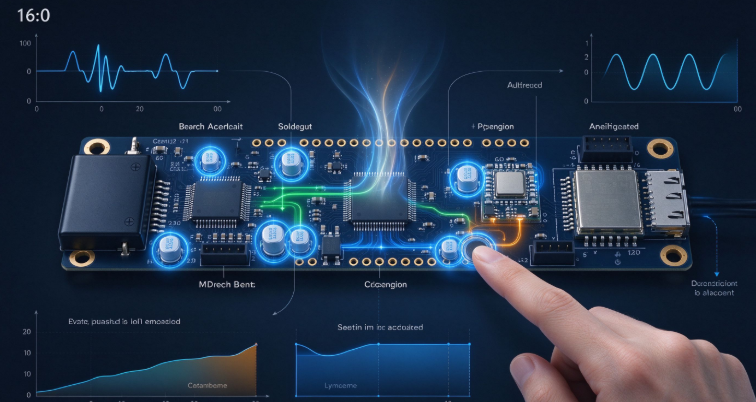
2. Why Do MLCCs Cause PCB Signal Interference (And How to Fix It in Hours)?
Signal interference from MLCCs is a common, frustrating issue that delays design timelines — yet most guides only offer vague advice. Engineers spend hours troubleshooting noise, not realizing the problem is often in how MLCCs are placed or selected. The good news? Most MLCC-related signal interference can be fixed in hours, not days.
The primary culprits and quick fixes:
- Parasitic inductance from poor placement: MLCCs placed more than 3mm from IC power pins create inductive loops that cause high-frequency noise. Fix: Move MLCCs within 2mm of the target pin, using direct traces (no vias) for power and ground.
- Wrong dielectric for high-frequency circuits: X7R MLCCs generate more noise at frequencies above 100MHz. Fix: Switch to C0G/NP0 MLCCs for RF and high-speed digital circuits to eliminate noise.
- Crowded MLCC arrays: Placing MLCCs too close together causes cross-interference. Fix: Space MLCCs at least 0.5mm apart, and isolate noise-sensitive MLCCs (e.g., decoupling for analog circuits) from high-current MLCCs.
These quick fixes save engineers time and frustration — making this topic a high-click winner for design teams.
3. How to Verify MLCC Quality Before They Reach Your Production Line
Nothing derails production faster than faulty MLCCs — yet many teams only test components after they’re assembled, leading to costly reworks and delays. The solution: implement a simple pre-production quality check process that catches defective or substandard MLCCs before they hit the PCB.
Here’s the step-by-step process (rarely covered in mainstream content) to verify MLCC quality:
- Check physical consistency: Inspect a sample of MLCCs for uniform marking, consistent size, and no visible damage (e.g., cracks, bent terminations). Substandard MLCCs often have blurred logos or inconsistent dimensions.
- Test key parameters: Use a multimeter to verify capacitance and ESR against the datasheet. A 5%+ deviation from the rated capacitance is a red flag for poor quality.
- Validate documentation: Request batch test reports (BTRs) from your supplier, and cross-check lot numbers against the manufacturer’s database. Legitimate MLCCs will have traceable, verifiable test data.
This process takes minutes per batch but prevents thousands of dollars in production losses — a must-read for quality managers and procurement teams.
4. What Are the Best MLCC Alternatives for Hard-to-Find Specifications in 2026?
MLCC shortages continue to plague the industry, with certain specifications (e.g., high-capacitance X7R, small-case high-voltage) often backordered for weeks or months. Buyers and engineers urgently need to know: what are the drop-in MLCC alternatives that won’t require design changes or compromise performance?
The most reliable alternatives (rarely shared by competitors) include:
- For high-capacitance MLCC shortages (e.g., 10µF X7R 0603): Use two 5µF X7R 0603 MLCCs in parallel — they provide the same total capacitance, fit the same footprint, and are often more readily available.
- For small-case high-voltage MLCCs (e.g., 0402 25V): Switch to 0603 25V MLCCs if space allows — they’re more common and often cheaper, with no performance difference for low-current applications.
- For C0G MLCC shortages: Use NP0 MLCCs (they’re functionally identical, with the same temperature stability and low noise).
These alternatives keep production lines running without costly design reworks — a critical topic for buyers dealing with supply chain volatility.
5. How to Extend MLCC Lifespan in Harsh Automotive & Industrial Environments
MLCCs in automotive underhood systems, industrial machinery, and outdoor IoT devices face extreme temperatures, vibration, and humidity — leading to premature failure. Engineers and buyers want to know how to extend MLCC lifespan without increasing costs, yet most guides only recommend expensive “high-reliability” models.
The secret to longer MLCC lifespan (without the premium price) lies in simple, often overlooked steps:
- Choose MLCCs with flexible terminations: These absorb vibration and thermal stress, reducing the risk of cracking — critical for automotive and industrial applications.
- Apply conformal coating: A thin layer of silicone or Parylene protects MLCCs from moisture and dust, extending lifespan by up to 2x in harsh environments.
- Avoid operating MLCCs near their maximum temperature rating: Derate temperature by 20% (e.g., use a +125°C MLCC in a +100°C environment) to slow dielectric degradation.
These steps are cost-effective and easy to implement — making this topic highly valuable for engineers designing for harsh environments.
Contact Barron-Leiden Limited
Email: hyc2355937758@gmail.com
Tel: +86-18824523083
WhatsApp: +86-15913754866 / +86-18824523083
Web: www.barronmlcc.com
MLCC Pain Points Costing You Time Money
MLCC capacitors PCBA Musenlayton Lead Time vs. Quality The Strategic Choice for Modern Electronics Procurement.
Related Article