Are MLCC Capacitors Polarized What Engineers Need to Know
Are MLCC Capacitors Polarized? What Engineers Need to Know
When working with electronic components, one common question is whether an MLCC capacitor has a positive and negative terminal. This matters during PCB design, component placement, assembly, and troubleshooting.
The short answer is that most standard multilayer ceramic capacitors (MLCCs) are non-polarized. However, there are important details to understand before using them in a circuit.
1. Are MLCC Capacitors Polarized?
Unlike electrolytic capacitors, standard MLCCs generally do not have designated positive and negative terminals. Either terminal can usually connect to the higher or lower potential in a circuit.
This makes MLCCs convenient for surface-mount assembly because pick-and-place machines do not normally need to align them according to electrical polarity.
For example, a standard 100nF X7R ceramic capacitor used for power supply decoupling can typically be placed in either orientation, provided its electrical and physical specifications meet the application requirements.
However, always confirm the exact component's datasheet rather than assuming every capacitor type follows the same rules.
2. Why Don't Standard MLCCs Have Positive and Negative Terminals?
An MLCC contains alternating internal metal electrodes separated by ceramic dielectric layers. The electrodes connect to opposite external terminals, creating the capacitor's electrical structure.
In a standard ceramic capacitor, this structure does not require a fixed positive or negative connection. The component can therefore operate with either polarity under its specified conditions.
This differs from many aluminum electrolytic and tantalum capacitors, whose internal construction generally requires correct polarity.
For engineers and purchasing teams, understanding this difference helps prevent incorrect assumptions when reviewing a bill of materials (BOM).
3. Can an MLCC Be Connected in Reverse?
In ordinary circuits, reversing the terminal connections of a standard MLCC does not cause the same polarity-related problem associated with a polarized electrolytic capacitor.
But non-polarized does not mean immune to electrical damage.
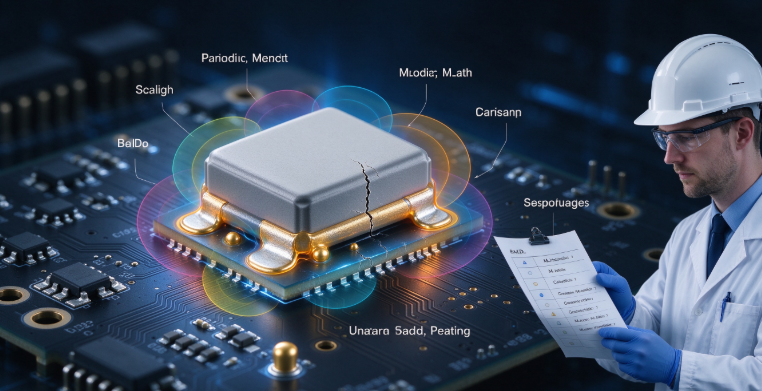
An MLCC can still fail if the applied voltage exceeds its rating, if transient conditions exceed its capability, or if the application introduces excessive electrical or mechanical stress.
Alternating-voltage applications also require careful evaluation. The peak voltage, waveform, frequency, temperature, and dielectric type all matter. Do not assume that a capacitor's rated DC voltage automatically establishes its suitability for every AC application.
The correct approach is to check the manufacturer's specified operating conditions for the intended circuit.
4. Does MLCC Orientation Matter During PCB Assembly?
For most standard MLCCs, electrical polarity does not determine their placement direction. This simplifies automated SMT assembly.
Nevertheless, orientation can still matter for practical reasons:
- PCB layout: The component must match the footprint and available space.
- Assembly quality: Pad geometry and solder-paste printing affect solder-joint formation.
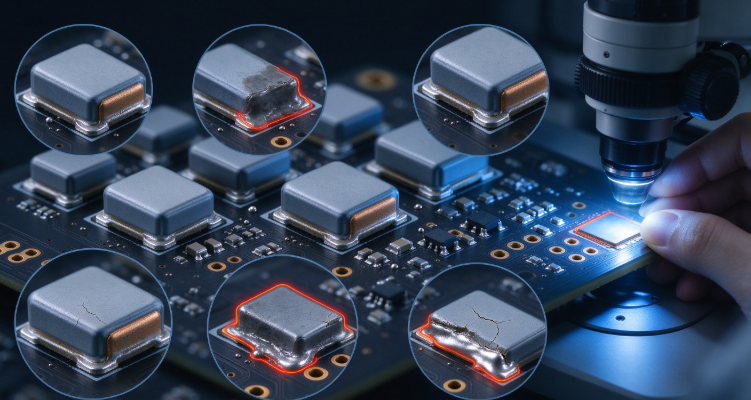
- Mechanical stress: Board bending and depanelization can damage ceramic capacitors, regardless of their electrical orientation.
- Inspection and traceability: Consistent component placement can help with manufacturing documentation and troubleshooting.
For this reason, an assembly drawing may specify a preferred orientation even when the capacitor itself has no positive or negative terminal.
5. How Can You Identify the Terminals of an MLCC?
On many small MLCC packages, the body has no visible polarity marking. This is normal.
Unlike polarized capacitors, a standard MLCC generally does not need a positive or negative marking on the casing. Both end metallizations serve as equivalent terminals.
Special customized MLCC types are rare exceptions. If you see special marks on the MLCC body, refer to the datasheet to verify whether the marking is for polarity, batch code or other identification purposes.
Conclusion
Nearly all conventional MLCC capacitors are non-polarized, so you don’t need to worry about positive or negative polarity during PCB placement. Even so, non-polarized MLCCs still have voltage, temperature and mechanical limits. Always validate specs against your circuit requirements before mass production.
If you are sourcing MLCC capacitors for your PCB projects, share your capacitance, voltage, dielectric and package requirements with our team for technical support and quotation.
Contact Us
Email: hyc2355937758@gmail.com
WhatsApp: +86 15913754866
Tel: +86 18824523083
Website: barronmlcc.com
MLCC Capacitor Soldering 6 Common Problems and How to AvoidThem

Related Article