How to Choose an MLCC Capacitor for Automotive Electronics A Practical Selection Guide
How to Choose an MLCC Capacitor for Automotive Electronics: A Practical Selection Guide
As automotive electronics become more complex, capacitors have to perform reliably in environments that are very different from those found in ordinary consumer devices. Electric vehicles, advanced driver assistance systems, battery management systems, onboard chargers, infotainment units, and body control modules all place different demands on passive components.
For engineers and purchasing teams, choosing an MLCC capacitor for automotive applications is therefore more than selecting a capacitance value and package size. The component must match the circuit's electrical requirements, operating temperature, mechanical environment, reliability expectations, and production conditions.
This guide explains the main factors to consider when selecting an MLCC capacitor for automotive electronics and how to avoid common selection mistakes.
1. Why Automotive Electronics Require Careful MLCC Selection
An MLCC, or multilayer ceramic capacitor, can perform several important functions in an automotive circuit, including power supply decoupling, voltage stabilization, noise suppression, filtering, and signal conditioning.
However, automotive electronics can experience temperature changes, vibration, mechanical stress, electrical transients, and long operating periods. Components installed in different parts of a vehicle may also face very different conditions.
For example, an MLCC used inside an infotainment system may have different requirements from one installed near a power conversion circuit or another high‑temperature location.
This means there is no single automotive MLCC capacitor that is suitable for every automotive application.
The first step is always to understand the actual electrical and environmental conditions of the circuit.
2. Start With the Application, Not the Capacitor
One common mistake in component selection is choosing an MLCC first and checking the application afterward.
A better approach is to begin with the circuit.
Ask the following questions:
- What function does the capacitor perform?
- What is the normal operating voltage?
- Are there voltage spikes or transient conditions?
- What is the expected operating temperature?
- Is the PCB exposed to continuous vibration?
- Is capacitance stability important?
- Is the capacitor located close to a power device?
- What package size can the PCB accommodate?
- What reliability qualification is required?
The answers determine which type of MLCC should be considered.
For example, a capacitor used for high‑frequency noise suppression may have different priorities from one used in a power conversion circuit. Similarly, a precision signal circuit may require better capacitance stability than a general‑purpose filtering circuit.
3. Check the Rated Voltage Carefully
Rated voltage is one of the most important parameters when selecting an MLCC capacitor for automotive electronics.
A capacitor should not simply be selected because its rated voltage is slightly higher than the circuit's nominal voltage.
The actual operating voltage, transient voltage, temperature, and dielectric characteristics should all be considered.
Class 2 ceramic dielectrics such as X5R and X7R can experience capacitance reduction under DC bias. Therefore, the nominal capacitance printed in a catalog does not necessarily represent the capacitance available under the circuit's actual operating conditions.
For automotive power electronics, engineers should evaluate the capacitor's capacitance under real voltage conditions rather than relying only on the nominal specification.
This becomes particularly important in circuits where stable capacitance is necessary for filtering, timing, control, or power conversion.
4. Choose the Dielectric According to the Circuit
Different ceramic dielectric materials provide different electrical characteristics.
X5R and X7R are widely used where relatively high capacitance is required in a compact package. They are commonly considered for decoupling, filtering, and power‑related applications.
C0G/NP0 dielectric offers excellent stability against temperature and voltage changes and is often considered when low loss and capacitance stability are important. Automotive component manufacturers also offer C0G MLCC products qualified for automotive applications.
The correct question is therefore not:
“Which dielectric is the best?”
Instead, engineers should ask:
“Which dielectric provides the characteristics required by this particular circuit?”
That distinction can prevent unnecessary over‑specification while maintaining the required electrical performance.
5. Temperature Rating Matters More Than Package Size
Automotive electronics can operate across a much wider temperature range than many consumer products.
The temperature requirement depends heavily on where the component is installed.
An MLCC used in an interior electronic module may experience a different environment from a component installed close to an engine, motor, inverter, battery system, or other heat‑generating equipment.
Automotive‑grade MLCC product families are available for different temperature requirements. For example, manufacturer product lines include automotive MLCCs qualified for applications reaching 125°C and products designed for higher‑temperature environments.
When selecting an MLCC capacitor for automotive use, engineers should therefore check:
- Operating temperature range
- Temperature characteristic of the dielectric
- Capacitance change with temperature
- Rated voltage at the required temperature
- Reliability test conditions
Temperature should be considered together with voltage rather than treated as an independent specification.
6. AEC‑Q200 Is Important, But It Is Not the Whole Selection Process
AEC‑Q200 is an important qualification reference for automotive passive components. Automotive MLCC product families from major manufacturers are offered with AEC‑Q200 qualification.
However, an engineer should not select a capacitor simply because the product description contains the words “AEC‑Q200.”
The actual application still needs to be evaluated.
Important questions include:
- Does the component meet the required capacitance?
- Is the voltage rating sufficient?
- Does the temperature range match the application?
- Is the package suitable for the PCB?
- Is the component appropriate for the mechanical environment?
- Are the required reliability documents available?
- Can the supplier provide stable production and traceability?
AEC‑Q200 qualification provides an important reliability reference, but component selection remains an engineering process.
7. Package Size Can Affect Mechanical Reliability
Smaller MLCC packages are attractive because they help engineers save PCB space.
However, package size should not be considered only from a miniaturization perspective.
MLCCs are ceramic components, and ceramic materials are mechanically rigid. PCB bending, board assembly stress, thermal expansion, and mechanical vibration can create stress on the component.
This is particularly important for larger MLCC packages.
Automotive applications may therefore require attention to PCB layout, soldering conditions, component placement, and mechanical stress. Some automotive MLCC product families specifically incorporate anti‑cracking or soft‑termination technologies to improve resistance to mechanical and soldering stresses.
For this reason, selecting the smallest possible capacitor is not always the appropriate strategy.
The package should provide a balance between electrical performance, PCB space, thermal behavior, and mechanical reliability.
8. Consider Where the MLCC Will Be Installed
The same vehicle can contain many different electronic environments.
An MLCC capacitor for automotive applications may be used in:
Battery Management Systems
BMS circuits require capacitors for filtering, decoupling, signal processing, and power management. Stability and reliability are important because the electronic system monitors and controls battery operation.
Onboard Chargers
OBC systems contain power conversion circuits with demanding electrical conditions. MLCCs may be used in filtering, control, and high‑frequency portions of the circuit. High‑voltage and low‑loss characteristics may become important depending on the topology.
ADAS and Radar Systems
Advanced driver assistance systems rely on increasingly sophisticated electronic circuits. Capacitors used in these systems may require stable electrical characteristics and appropriate high‑frequency performance.
Automotive Infotainment
Infotainment systems generally include processors, communication circuits, displays, audio systems, and wireless functions. MLCCs are commonly used for decoupling and noise filtering.
Body Electronics
Body control modules, lighting systems, door modules, seat controls, and other electronic units can contain large numbers of passive components. In these applications, stable supply, consistent quality, and long‑term availability can be important purchasing considerations.
9. Do Not Ignore DC Bias
One of the most overlooked issues when selecting an MLCC is DC bias.
For many Class 2 ceramic capacitors, applying DC voltage can reduce the effective capacitance. The amount of reduction depends on factors such as dielectric type, capacitance value, rated voltage, package construction, and applied voltage.
Consider a simple example.
An engineer may specify a capacitor with a nominal capacitance of 10 µF. If the component is operated under significant DC voltage, the effective capacitance may be considerably lower than the nominal value.
Therefore, the question should not simply be:
“Is the capacitor 10 µF?”
It should be:
“How much effective capacitance remains under the actual operating voltage?”
This is especially important in automotive power and filtering circuits.
10. Evaluate the Supplier, Not Just the Datasheet
Selecting the correct MLCC capacitor for automotive applications also involves evaluating the supplier.
A datasheet provides important technical information, but automotive projects often require more than a specification sheet.
Purchasing and engineering teams may need to consider:
- Production consistency
- Quality control procedures
- Traceability
- Reliability test documentation
- Sample availability
- Production capacity
- Lead time
- Packaging requirements
- Change notification procedures
- Long‑term supply capability
This becomes particularly important when a component moves from engineering samples to mass production.
A capacitor that performs well during laboratory testing still needs consistent manufacturing performance throughout the production lifecycle.
11. Common Mistakes When Selecting Automotive MLCCs
Mistake 1: Selecting by capacitance only
Capacitance is only one parameter. Voltage, dielectric, temperature, tolerance, package, and reliability requirements must also be evaluated.
Mistake 2: Using consumer‑grade components in automotive applications without qualification
A component designed for consumer electronics should not automatically be treated as an automotive component simply because its electrical specifications appear similar.
Mistake 3: Ignoring DC bias
The nominal capacitance printed on the part number may not equal the effective capacitance under operating voltage.
Mistake 4: Choosing the smallest package automatically
Miniaturization is important, but mechanical reliability and assembly conditions also need to be considered.
Mistake 5: Treating AEC‑Q200 as the only selection criterion
Qualification is important, but the component must still match the electrical and environmental requirements of the specific circuit.
12. A Practical Checklist for Choosing an MLCC Capacitor for Automotive Applications
Before approving an automotive MLCC for a new design, engineers and procurement teams can review the following checklist:
| Parameter | What to Check |
|---|---|
| Capacitance | Required nominal and effective capacitance |
| Voltage | Rated voltage and actual operating voltage |
| Dielectric | X5R, X7R, C0G/NP0, or other required type |
| Temperature | Required operating temperature range |
| Tolerance | Acceptable capacitance tolerance |
| Package | PCB space and mechanical requirements |
| DC Bias | Capacitance loss under operating voltage |
| Reliability | Required automotive qualification |
| Mechanical Stress | PCB bending, vibration, and assembly conditions |
| Supply | Production capacity and long‑term availability |
| Documentation | Datasheet, qualification and reliability information |
Using this checklist before purchasing can reduce the risk of selecting a component that looks suitable on paper but does not fully match the real application.
Conclusion
Choosing an MLCC capacitor for automotive electronics requires more than comparing capacitance and price.
The right component depends on the complete application environment: voltage, temperature, dielectric characteristics, DC bias, package size, mechanical stress, circuit function, qualification requirements, and supply capability.
For automotive engineers and procurement teams, the most practical approach is to start with the application requirements and then select the MLCC based on measurable electrical and reliability conditions.
As automotive electronics continue to become smaller, more powerful, and more integrated, careful passive‑component selection will remain an important part of reliable vehicle electronics design.
If you are sourcing automotive‑grade MLCC capacitors for a new project, provide the required capacitance, voltage, dielectric, package size, operating temperature, and application information. A qualified MLCC supplier can then help match the component to the actual circuit requirements rather than simply recommending a general‑purpose capacitor.
Contact Barron‑Leiden for Automotive‑Grade MLCC
Email: hyc2355937758@gmail.com
WhatsApp: +86 15913754866
Tel: +86 18824523083
Website: www.barronmlcc.com
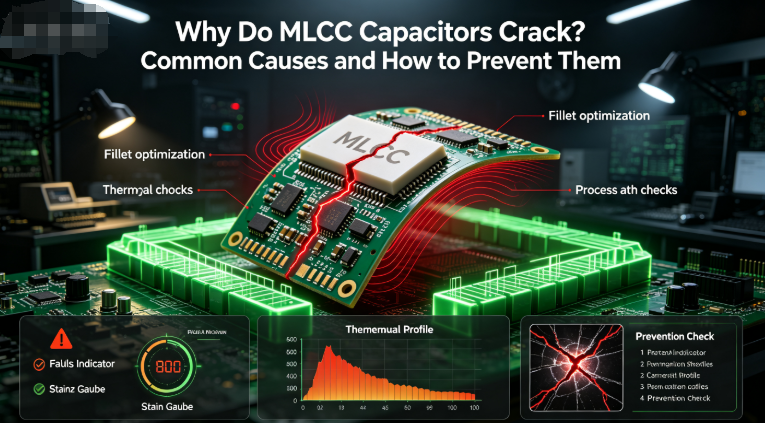
Why Do MLCC Capacitors Crack Common Causes and How to Prevent Them
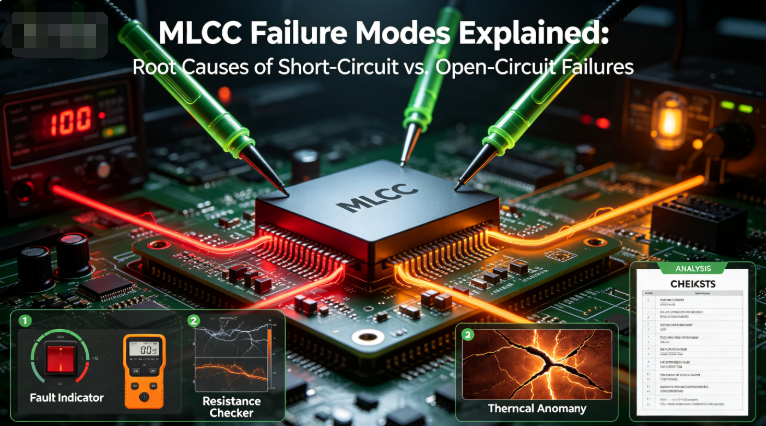
MLCC Failure Modes Explained Root Causes of Short Circuit vs Open Circuit Failures
Related Article