How to Read and Interpret MLCC Datasheets A Practical Guide for Component Procurement
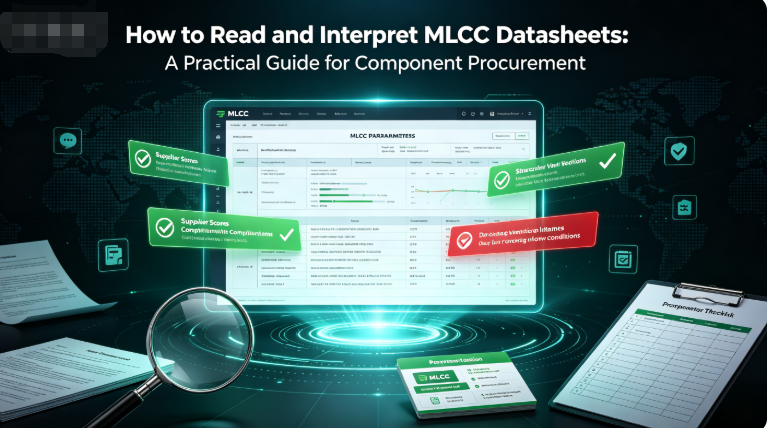
How to Read and Interpret MLCC Datasheets: A Practical Guide for Component Procurement
For electronic component buyers, supply chain managers, and hardware engineers, reviewing a manufacturer's datasheet is a daily routine. However, Multi-Layer Ceramic Capacitor (MLCC) datasheets contain subtle parameters, shorthand nomenclature, and performance curves that are frequently misunderstood. Misinterpreting these specifications can lead to purchasing incorrect parts, experiencing unexpected circuit failures, or running into compliance issues during mass production.
This guide breaks down the essential sections of an MLCC datasheet and provides actionable tips on how to evaluate components accurately for commercial and industrial applications.
1. Decoding the Part Number (Ordering Code)
Most major MLCC manufacturers use a structured alphanumeric part number system. While formats vary slightly between brands, a standard part number typically encodes:
- Dimensions / Case Size: EIA standard codes such as 0402, 0603, 0805, or 1210.
- Dielectric Material: Codes representing temperature characteristics (e.g., C0G/NP0, X7R, X5R).
- Capacitance Value: Represented in picofarads (pF), often using a three-digit multiplier code (e.g., 105 equals 10 × 10⁵ pF = 1μF).
- Capacitance Tolerance: Letters indicating allowable variance (e.g., ±5% for J, ±10% for K, ±20% for M).
- Rated Voltage: Working DC voltage designation (e.g., 16V, 25V, 50V, 100V).
- Termination Finish: Information regarding plating materials, such as pure Tin (Sn) over Nickel (Ni) barrier layers, or specialized flexible termination codes.
2. Understanding Temperature Characteristics and Codes
The dielectric code on a datasheet dictates how the component behaves under varying thermal conditions. Procurement teams must match these codes to the operating environment of the end product:
- NP0 (C0G): Temperature coefficient of 0 ± 30 ppm/°C over -55°C to +125°C. Essential for high-precision or high-frequency applications.
- X7R: Capacitance change limited to ±15% over -55°C to +125°C. Suitable for standard industrial electronics.
- X5R: Similar to X7R, but with a restricted lower temperature range down to -55°C and an upper limit of +85°C. Perfect for consumer electronics and standard indoor commercial devices.
3. Evaluating Frequency Response, ESR, and Impedance
A common misconception is that a capacitor acts purely as a capacitance storage device across all frequencies. In reality, every MLCC possesses internal equivalent series resistance (ESR) and equivalent series inductance (ESL).
- Self-Resonant Frequency (SRF): As frequency increases, an MLCC's capacitive reactance decreases until it reaches its resonant point, where capacitive and inductive reactances cancel each other out. Beyond the SRF, the component begins to act like an inductor, rendering it ineffective for high-frequency noise filtering.
- Impedance Curves: Datasheets often include frequency-versus-impedance graphs. When sourcing decoupling capacitors for high-speed microcontrollers or FPGAs, engineering teams should review these charts to ensure low impedance at the target noise frequencies.
4. Packaging and Delivery Specifications
For automated surface-mount technology (SMT) production lines, physical packaging details are just as critical as electrical parameters:
- Tape and Reel Standards: Verify whether the parts are packaged in 7-inch or 13-inch reels, and confirm the pitch width to ensure compatibility with high-speed pick-and-place feeders.
- Environmental Compliance: Ensure the datasheet explicitly lists compliance certifications such as RoHS (Restriction of Hazardous Substances) and REACH declarations to meet international market regulations.


Secure Verified, High-Quality MLCC Sourcing
Avoid specification mismatches and supply chain delays by partnering with a trusted provider. Explore our comprehensive inventory and technical documentation at barronmlcc.com. Whether you need standard commercial parts or specialized technical assistance, our sales engineering team is ready to support your Bill of Materials (BOM).
Direct Email: hyc2355937758@gmail.com
WhatsApp & Mobile: +86 15913754866
Telephone Support: +86 18824523083
Official Web Portal: //www.barronmlcc.com
Understanding the MLCC Piezoelectric Effect Why Do Ceramic Capacitors Sing and How to Stop It
Understanding MLCC Dielectric Aging Why Class II Capacitors Lose Capacitance Over Time
Related Article