MLCC Common Failure Modes and Effective Protection Solutions
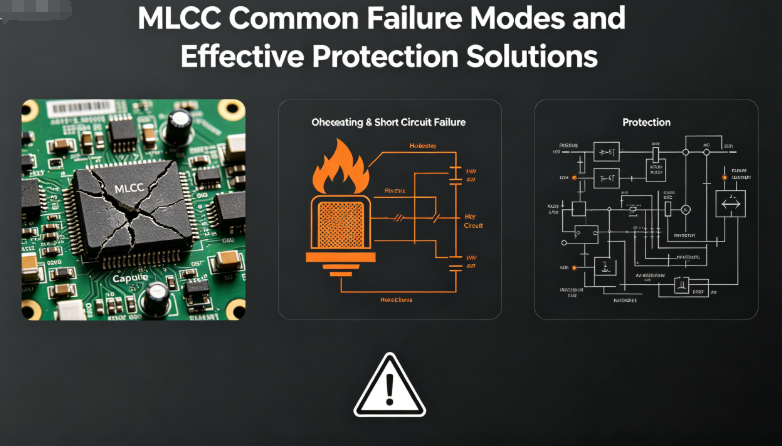
MLCC Common Failure Modes and Effective Protection Solutions
In electronic design and mass production, MLCC is one of the most widely used passive components. However, various hidden failures often occur during production, soldering and long-term operation. Most MLCC malfunctions are not caused by raw material defects, but by mechanical stress, thermal shock, improper design and irregular processing.
As an electronic engineer or procurement buyer, understanding typical MLCC failure modes and targeted protection methods can greatly reduce product rework, after-sales risks and batch quality problems. Today, we will sort out four most common MLCC failure types and practical prevention measures in simple and easy-to-understand language.
1. Delamination & Dielectric Damage
Cause
Internal layer cracking and dielectric breakage are mainly triggered by mechanical external stress and sudden soldering thermal shock.
Excessive bending of the PCB board, improper cutting, mounting pressure, or rapid temperature rise and drop during reflow soldering will lead to internal structural separation and dielectric damage of multi-layer ceramic capacitors. This kind of failure is latent and easy to cause intermittent short circuit or functional abnormality in the later stage.
Protection Solutions
- Adopt flexible termination electrode MLCC to absorb mechanical stress effectively
- Optimize reflow soldering temperature curve to avoid rapid heating and cooling
- Prefer stress-relief package design for high-bending and high-vibration products
- Standardize PCB routing and board bending control to reduce physical extrusion
2. Capacitance Degradation (Aging & DC Bias Influence)
Cause
Many engineers will encounter the problem of gradual capacitance attenuation in long-term use.
On the one hand, the inherent aging characteristics of dielectric materials will lead to slow capacity loss; on the other hand, long-term DC bias working environment will further reduce the actual effective capacitance, resulting in insufficient power filtering and unstable circuit operation.
Protection Solutions
- Reserve sufficient design margin for capacitance and voltage in the early stage of schematic design
- Prefer low aging, high stability material systems such as X7R and X8R
- Avoid long-term over-bias working conditions and reasonably derate component specifications
- For automotive and industrial high-reliability projects, select high anti-bias automotive-grade MLCC
3. Thermal Failure & Dielectric Breakdown
Cause
Thermal failure, overheating burnout and insulation breakdown are common in power modules, high-voltage circuits and high-density equipment.
Insufficient voltage margin, poor local heat dissipation, and the use of components that do not match the temperature grade will cause the MLCC to overheat, breakdown and even burn out under continuous high load.
Protection Solutions
- Ensure reasonable voltage derating and leave enough voltage margin
- Optimize PCB heat dissipation layout, increase copper area and heat dissipation vias
- Strictly select MLCCs that meet the actual operating temperature grade
- Avoid concentrated layout of high-power heating components to reduce ambient temperature rise
4. Soldering Cracks & Terminal Electrode Peeling
Cause
Unreasonable reflow temperature, excessive welding temperature, too fast temperature change, and poor terminal electrode craftsmanship will directly lead to edge cracks of the capacitor and peeling of the outer electrode. Once the terminal falls off or cracks, the component will be open-circuited and completely fail.
Protection Solutions
- Follow standard reflow soldering curve to control heating rate, constant temperature and cooling rate
- Choose MLCC with enhanced terminal electrode process and high bonding strength
- Avoid manual high-temperature iron welding for patch capacitors
- Strengthen incoming inspection to eliminate unqualified electrodes and defective products
Final Summary
MLCC failure is often cumulative and hidden. Mechanical stress, thermal shock, material aging, DC bias and non-standard welding are the four major root causes.
By standardized component selection, reasonable circuit design, optimized welding process and targeted structural protection, manufacturers can effectively avoid most quality risks and greatly improve the long-term reliability of electronic products.
About Us
Dongguan Musen Leyton Electronic Technology Co., Ltd.
With more than 20 years of professional experience in SMD MLCC and resistor manufacturing, we provide high-stability industrial-grade, automotive-grade AEC-Q200 MLCCs.
We adopt optimized dielectric materials, flexible terminal technology and strict quality control to effectively avoid common failure problems.
We support free sample testing, one-stop model selection and customized solutions for new energy, automotive electronics, industrial control and consumer electronics industries.
If you are looking for reliable MLCC suppliers to reduce failure rate and after-sales cost, welcome to contact us for professional technical support and quotation.
WhatsApp / WeChat: +86 15913754866 / +86 18824523083
Email: hyc2355937758@gmail.com
MLCC Design Selection Recommendations Shorten Certification Cycle Improve Product Reliability
Why Automotive Projects Demand Automotive-Grade MLCCs
Related Article