MLCC Failure Analysis Ultimate Troubleshooting Manual Complete Solutions for Cracking Breakdown Leakage Whistling Heating
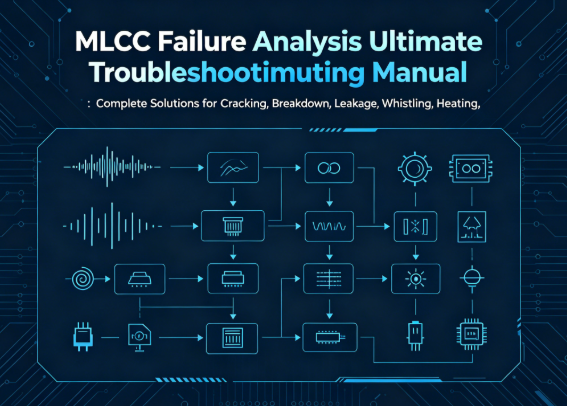
MLCC Failure Analysis Ultimate Troubleshooting Manual: Complete Solutions for Cracking, Breakdown, Leakage, Whistling, Heating
mu sen Introduction
As the most widely used passive component in electronics, MLCC failures are highly concentrated and follow clear patterns. Most engineers only replace components without identifying root causes, leading to repeated failures, mass rework, and customer complaints. All MLCC failures fall into 5 categories: Design & Selection Failure, Dielectric Material Failure, PCB Process Failure, Environmental Stress Failure, and Supply Chain Incoming Failure.
This manual covers 99% of industry MLCC failures: cracking, voltage breakdown, leakage, heating, whistling, capacitance drift, high-frequency oscillation, moisture failure, vibration detachment, and aging failure. Each fault includes symptoms, mechanism, troubleshooting, corrective actions, and prevention standards to form a closed-loop troubleshooting system.
1. Complete MLCC Failure Classification System
- Parameter Selection Failure: Insufficient voltage rating, bias decay, derating, mismatched capacitance/frequency, excessive ripple
- Dielectric Material Failure: Wrong dielectric, high-temperature capacitance drop, HV aging, high-frequency loss, poor powder quality
- Mechanical Process Failure: PCB bending crack, soldering thermal stress, mounting stress, vibration shock, uneven pad stress
- Environmental Reliability Failure: High-temp aging, moisture leakage, thermal cycle cracking, overheating, outdoor corrosion
- Supply Chain Incoming Failure: Refurbished parts, micro-cracks from used units, expired aging, mixed batches, false voltage rating, inferior powder
2. 10 High-Frequency Failures: Deep Troubleshooting & Solutions
2.1 MLCC Ceramic Body Cracking (Most Common)
Symptoms: Intermittent shutdown, short circuit, leakage, zero capacitance, micro-cracks
Root Cause: Brittle ceramic cracks under mechanical stress
- PCB Bending Stress: Avoid MLCC at board edges, screw holes; use routing instead of breaking
- Soldering Thermal Stress: Heating rate ≤3℃/s, iron ≤350℃, ≤3s per side
- Wrong Pad Design: Use standard symmetrical pads; add teardrop for automotive
- Vibration Shock: Replace 0402 with 0805/1206; use flexible termination MLCC
Prevention: No MLCC within 5mm of board edges; flexible terminals for stress areas
2.2 HV Breakdown & Short Circuit
Symptoms: Power short, burnout, blackened/perforated body
Root Cause: Over-voltage or spike breakdown
- Insufficient Derating: Consumer ≥1.5x, Industrial ≥2x, Automotive ≥2.5x
- Spike Breakdown: Use X8R for HV bus; no X7R in HV
- False Rating Parts: 1.5x voltage incoming test
Rule: HV only uses X8R/C0G
2.3 Excessive Leakage Current & High Power Consumption
Symptoms: High standby current, battery drain, unstable low-voltage operation
Root Cause: Dielectric aging, moisture, bias degradation, poor powder
Solution: Use C0G for standby/signal circuits; bake stock >1 year; no general X7R in HV
2.4 Capacitance Attenuation & Drift
Symptoms: Poor filtering, large ripple, frequency offset
Causes: Temperature drift (X5R >85℃), voltage drift (X5R/X7R), frequency drift, aging drift
Solution: Upgrade to X8R for long-term HV/HT; X8R/C0G for HF; C0G for precision signals
2.5 MLCC Whistling & Noise
Mechanism: Class II dielectrics (X5R/X7R) have piezoelectric effect
Solution: Ban X5R/X7R in audio/noise-sensitive circuits; replace with C0G/X8R; use MLCC + electrolytic combo
2.6 Severe Heating & Excessive Temperature Rise
Root Cause: High ESR, high-frequency loss, excessive ripple current
Solution: Low ESR X8R/C0G for HF; larger package; strict incoming ESR control
2.7 High-Frequency Oscillation & EMI Failure
Root Cause: High ESL, SRF in working band
Solution: 0402/0603 small packages; working frequency < 1/2 SRF; multi-stage filtering
2.8 Moisture Leakage & Tracking
Symptoms: Flashover, increased leakage in humid environments
Solution: Increase pad gap 0.2~0.3mm; thick solder mask; cover exposed copper
2.9 Vibration Detachment & Poor Solder
Root Cause: Small package, weak pad, insufficient solder
Solution: Remove 0402; wider pads + teardrop; AEC-Q200 automotive grade
2.10 Long-Term Aging Failure
Symptoms: Mass failure after 6–12 months
Solution: X8R for long-life devices; higher derating; ban low-cost X5R
3. MLCC Fault Quick Location Table
| Failure Symptom | Most Likely Root Cause | Quick Solution |
|---|---|---|
| Ceramic Crack, Intermittent Short | PCB Stress, Soldering Shock, Edge Layout | Relocate, Flexible Terminals, Optimize Pad |
| Power Breakdown, Burnout | Low Voltage Rating, Spike, False Parts | Upgrade Voltage, X8R, Incoming Test |
| Standby Leakage, High Power | Moisture, Aging, Bias Degradation | Bake Stock, Replace C0G |
| Large Ripple, Insufficient Cap | Bias Decay, Temperature Drift | Upgrade X8R, Increase Derating |
| Whistling Noise | Piezoelectric Effect | Replace C0G/X8R |
| Heating, Low Efficiency | High ESR, Wrong Dielectric | Low ESR X8R/C0G |
| EMI Failure, Unstable Loop | High ESL, Wrong SRF | Small Package, Multi-Stage Filter |
| Vibration Detachment | Small Package, Weak Pad | 0805/1206, Teardrop Pads |
4. Ultimate MLCC Failure Avoidance Summary
All failures come from 5 mismatches:
- Parameter Mismatch: Voltage, capacitance, frequency, derating
- Dielectric Mismatch: X5R in HT, X7R in HV, general dielectric in HF
- Process Mismatch: Wrong pad, layout, soldering temp, stress
- Environment Mismatch: Consumer parts in automotive/industrial
- Supply Mismatch: Refurbished, expired, false parts
True reliability comes from front-end standardization: Selection, Dielectric, PCB, Test, Supply Chain.
5. Complete MLCC Technical Whitepaper Series
- MLCC Parameter Selection Practical Manual
- MLCC Dielectric Selection Special Manual
- MLCC Test & Reliability Verification Manual
- MLCC Package & PCB Pad Design Manual
- MLCC Supply Chain & Purchasing Avoidance Manual
- Final: MLCC Failure Analysis Ultimate Troubleshooting Manual
mu sen Conclusion
MLCC failures seem complex but follow one logic: all failures are mismatches. By mastering the 5 standard systems (Selection, Dielectric, Test, PCB, Supply Chain), 99% of mass failures can be eliminated.
This complete series forms a full closed loop from design to quality control, suitable for consumer, industrial, automotive, new energy, and high-frequency power industries.
Dongguan Musen Leyton Electronic Technology Co., Ltd. focuses on high-reliability MLCCs for consumer, industrial, automotive, high-voltage, and high-frequency applications. We provide full technical support, selection solutions, reliability testing, failure analysis, and mass production risk control.
Contact Us
MLCC for High-Frequency Power Supplies SiC/GaN Adaptation High-Frequency Filtering Low-Loss Selection
MLCC Package Selection PCB Pad Design Manual Pad Specification Soldering Process Layout Avoidance
Related Article