MLCC Inventory and Humidity Sensitivity Management MSL humidity sensitivity rating storage standards moisture analysis of expired materials and standardized baking process
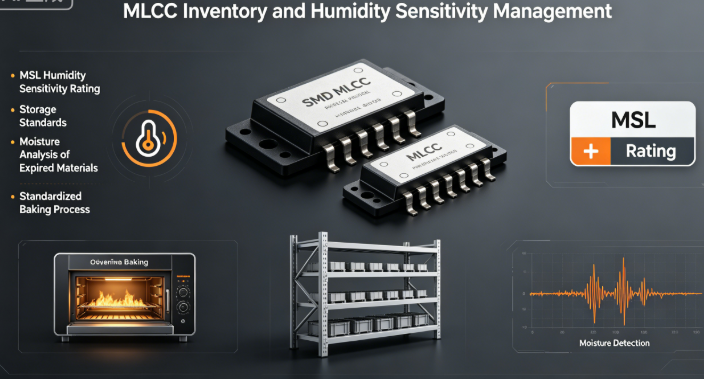
MLCC Inventory and Humidity Sensitivity Management: MSL humidity sensitivity rating, storage standards, moisture analysis of expired materials, and standardized baking process.
Company: Dongguan Musen Laidun Electronic Technology Co., Ltd.
MLCC Storage Management, MSL Moisture Sensitivity Level, Capacitor Moisture Failure, Expired Material Baking, Reflow Popcorn, Moisture Control Standard
mu sen Introduction
Most electronic enterprises only focus on MLCC selection, voltage rating, and dielectric grade, but long-term ignore storage and moisture control. According to industry failure statistics: about 15% of MLCC batch defects are NOT caused by poor incoming quality, but by moisture absorption, expiration, improper storage, or wrong baking processes.
MLCC ceramic body has a porous microstructure with strong hygroscopicity. After opening, water molecules continuously penetrate into the ceramic and electrode layers. If used directly in reflow soldering, it will cause popping, delamination, end crack, or hidden micro-cracks. Even without immediate failure, massive cracking and open circuit will occur under vibration or temperature cycling later, bringing huge after-sales risks.
This article systematically explains MLCC moisture principle, MSL classification, warehouse temperature & humidity control, floor life, expiration judgment, non-bakeable materials, standard baking parameters, revival process, and common mistakes. It is a mandatory standard for IQC, Warehouse, SMT, and R&D teams.
1. Root Cause of MLCC Moisture Failure
1.1 Ceramic Moisture Absorption Mechanism
MLCC ceramic dielectric contains numerous micro-pores and internal gaps. Compared with resistors and inductors, MLCC has the strongest moisture absorption ability. Water molecules stay in dielectric pores and internal electrode interfaces.
1.2 Reflow Soldering Popcorn Mechanism
Peak reflow temperature reaches 230℃~260℃. Internal liquid water vaporizes rapidly, expanding over 1600 times. Trapped vapor bursts ceramic internally:
- Visible failure: Ceramic pop, delamination, end drop, body crack
- Hidden failure: Internal micro-cracks (normal appearance, open circuit after 1~3 months)
- Electrical failure: Leakage surge, insulation drop, high-voltage breakdown
Key conclusion: Hidden micro-cracks are far more harmful than direct popping, and are the top cause of after-sales failure.
2. Complete MLCC MSL Moisture Sensitivity Standard (IPC/JEDEC J-STD-033)
| Moisture Level | Floor Life (After Opening) | Application | Storage Condition |
|---|---|---|---|
| MSL 1 | Unlimited | 0402 & smaller packages | ≤30℃ / 60%RH |
| MSL 2 | 1 Year | 0603 general MLCC | ≤30℃ / 60%RH |
| MSL 2a | 4 Weeks | 0805 standard high-voltage types | ≤30℃ / 60%RH |
| MSL 3 | 168h (7 days) | 1206+, high-voltage, automotive grade | ≤30℃ / 60%RH |
| MSL 4 | 72h (3 days) | Ultra-large, ultra-thin high-frequency MLCC | ≤25℃ / 50%RH |
2.1 High-Risk Moisture Materials
- 1206/1210/1812/2220 large package MLCC
- 250V~1500V high voltage series
- AEC-Q200 automotive grade, industrial long-life MLCC
- Ultra-thin low ESL high-frequency capacitors
3. Standard Warehouse Storage Specifications
3.1 Unopened Original Package
- Temperature: 18℃~28℃ (optimal 22℃~25℃)
- Humidity: 40%RH~60%RH, never exceed 65%RH
- Placement: 10cm above floor & wall, no direct stacking
- Shelf life: 12 months (vacuum sealed)
3.2 Opened Material Control Rules
- Label opening date immediately after opening
- Transfer to dry cabinet if exceeding floor life
- Short-term idle: dry cabinet ≤10%RH
- Long-term idle: re-vacuum pack + desiccant
- Strict FIFO for all opened materials
3.3 Dry Cabinet Classification
| Dry Cabinet Level | Humidity Range | Usage |
|---|---|---|
| Standard Dry Cabinet | 20%~40%RH | MSL1 / MSL2 small packages |
| Low Humidity Cabinet | 5%~10%RH | MSL2a / MSL3 high-voltage & large packages |
| Ultra-low Humidity N2 Cabinet | ≤5%RH | MSL4 high-precision & ultra-thin MLCC |
4. Expired & Moisture Judgment Standard
4.1 Expiration Conditions (Any one = expired)
- Broken / leaking vacuum bag, failed desiccant
- Exceeded MSL floor life after opening
- Unopened package over 12 months
- Long-term storage humidity >70%RH
- Exposed in open workshop >24 hours
4.2 Expired Material Handling Rules
- 0402/0603: safe for baking revival
- 0805/1206: allow ONE baking only
- 1210+: NO repeated baking (high stress risk)
- Damaged / oxidized parts: direct scrap
5. Standard MLCC Baking Process (Industry Official)
| Package Size | Baking Temp | Baking Time | Max Bake Times |
|---|---|---|---|
| 0402 / 0603 | 105℃ | 8~12h | 3 |
| 0805 | 105℃ | 12~16h | 2 |
| 1206 / 1210 | 105℃ | 16~24h | 1 |
| 1812+ | 85℃ (Low Temp) | 24~36h | NO re-bake |
5.2 Mandatory Baking Constraints
- Heating rate ≤5℃/min, no direct high temp
- Cool naturally inside oven to below 50℃ before take out
- Single layer placement, no stacking blocking vapor
- NEVER bake X7R/X8R at 125℃ (accelerated aging)


6. Strictly NON-BAKEABLE Material List (Red Line)
- Flexible termination MLCC (thermal stress failure)
- Ni-Pd-Au anti-sulfur MLCC (plating oxidation)
- Ultra-thin low-profile high-frequency MLCC
- Used reflow boards / second-hand components
- Damaged, chipped, scratched parts
7. Industry Common Misconceptions
- Misconception 1: Small packages are safe from moisture → Truth: 0603/0805 also pop under long-term high humidity
- Misconception 2: Higher temp = faster dry → Truth: Over 105℃ causes thermal stress micro-cracks
- Misconception 3: Unlimited use after baking → Truth: Baking damages dielectric layer cumulatively
- Misconception 4: N2 cabinet removes internal moisture → Truth: N2 only prevents oxidation, cannot extract absorbed water
- Misconception 5: Vacuum pack = safe within 1 year → Truth: Desiccant fails early if warehouse humidity is too high
8. Full Control Implementation SOP
Warehouse Incoming → IQC Check Humidity & Package → Vacuum Storage → Open Timing → Overdue → Dry Cabinet → Expiration Judgment → Baking / Scrap → Cool Down → SMT Production → Record Log
Three logs recommended: Opening Time Log, Baking Count Log, Expired Scrap Log.
mu sen Conclusion
MLCC moisture failure is highly concealed but the leading cause of hidden cracks, open circuit, and batch rework. Moisture control, storage, floor life, and standard baking are equally important as dielectric selection and voltage derating.
To reduce failure rate and after-sales cost, enterprises must unify MSL standard, enforce opening timing, standardize baking, and clarify non-bakeable materials. Full implementation across Warehouse, IQC, SMT, and R&D forms a complete reliability closed loop.
Musen Leyton provides free full set documents: MLCC Storage SOP, Baking Parameter Sheet, Expired Material Judgment Sheet to help factories build standardized moisture control systems.
MLCC 9 Failure Modes Troubleshooting Manual Full Symptoms Root Cause Analysis Permanent Solutions Quick Reference
MLCC Sulfuration Failure Prevention Corrosion Mechanism Failure Characteristics High/Low Resistance Sulfuration Material Selection All-Round Protection Solutions
Related Article