MLCCs for Digital Multimeters and Portable Test Instruments
MLCCs for Digital Multimeters and Portable Test Instruments: Supporting Stable and Accurate Electronic Measurements
MLCC capacitors for test instruments, ceramic capacitors for measuring equipment, MLCC selection for precision electronics, capacitors for portable test equipment
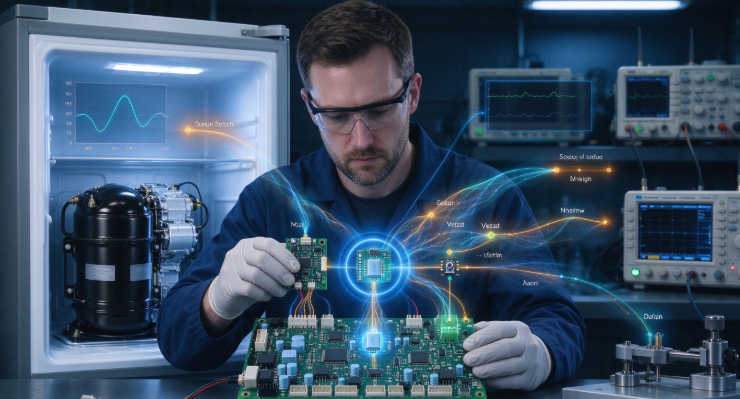
Digital multimeters and portable test instruments are widely used in electronics manufacturing, equipment maintenance, laboratories, and field troubleshooting. These devices measure electrical parameters such as voltage, current, resistance, and frequency.
Although they may look simple from the outside, their internal circuits require careful electronic design. Measurement accuracy depends on several factors, including signal conditioning, reference voltage stability, power supply quality, and noise control.
Multilayer ceramic capacitors (MLCCs) are commonly used in these circuits. They help filter power supply noise, stabilize local voltage rails, and support signal conditioning networks.
This article explains where MLCCs are used in digital multimeters and portable test instruments and what engineers should consider when selecting them.
1. Power Supply Filtering in Portable Test Instruments
Many portable measuring devices operate using batteries or external power adapters. Their internal circuits may include voltage regulators, DC-DC converters, microcontrollers, displays, and analog measurement components.
These circuits can generate or experience electrical noise during operation.
MLCCs are often placed near power management ICs to provide local decoupling and high-frequency noise filtering.
Common applications include:
- Input and output filtering around voltage regulators.
- Local decoupling for microcontrollers.
- Filtering for analog and digital power rails.
- Supporting stable voltage delivery during changing circuit loads.
Engineers commonly consider X7R or X5R MLCCs for general power filtering. The selected capacitance should be evaluated under actual operating voltage, temperature, and frequency conditions.
2. Supporting Precision Analog Front-End Circuits
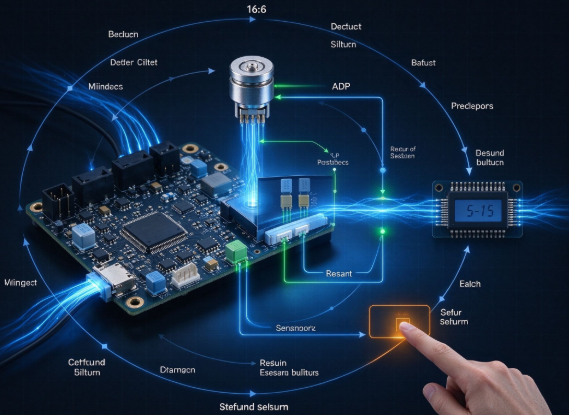
The analog front end is one of the most important sections of a digital multimeter.
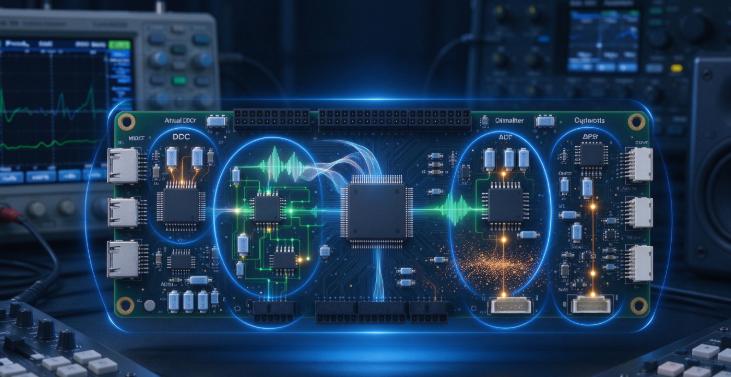
Before an analog-to-digital converter (ADC) processes a signal, the input may pass through protection circuits, voltage dividers, amplifiers, and filtering networks.
Capacitors in these circuits can influence bandwidth, settling behavior, and noise performance.
Depending on the circuit design, MLCCs may be used for:
- Signal filtering.
- Amplifier power supply decoupling.
- Noise reduction in selected frequency ranges.
- Timing and filtering networks.
For precision measurement circuits, engineers should pay close attention to capacitor tolerance, temperature characteristics, dielectric type, and voltage coefficient.
C0G/NP0 capacitors may be appropriate for certain precision or low-loss applications, while other dielectric types may be suitable for general filtering. The final choice should follow the measurement IC manufacturer's reference design and circuit requirements.
3. Filtering Noise from Switching Power Supplies
Portable instruments increasingly use compact switching regulators to improve power conversion efficiency and reduce circuit size.
However, switching regulators can introduce ripple and high-frequency noise.
If this noise couples into sensitive analog circuits, it may affect the instrument's measurement performance.
MLCCs can be used in input and output filtering networks to help manage this noise.
When selecting capacitors, engineers should consider:
- Required capacitance under DC bias.
- Equivalent series resistance (ESR).
- Equivalent series inductance (ESL).
- Operating frequency.
- Ripple current and temperature conditions.
- PCB layout and capacitor placement.
A capacitor's nominal capacitance alone does not determine its filtering performance. The complete power circuit and PCB layout must be evaluated together.
4. Supporting ADC and Reference Voltage Circuits
The ADC converts analog signals into digital values. Its performance depends on the surrounding circuit, including the reference voltage source and power supply.
Some ADC designs require external capacitors for reference pin filtering, supply decoupling, or input signal conditioning.
MLCCs may be used in these positions when permitted by the IC datasheet.
Important selection factors include:
Capacitance tolerance: Helps meet the requirements of specific filtering or timing networks.
Temperature stability: Reduces unwanted capacitance changes caused by environmental temperature variations.
Dielectric characteristics: C0G/NP0 may be suitable for selected stable signal circuits, while X7R may be used for general decoupling.
Settling behavior: The capacitor and surrounding circuit should meet the ADC manufacturer's requirements.
Engineers should avoid changing reference circuit capacitor values without checking the IC datasheet. An incorrect capacitor can affect settling time or circuit stability.
5. MLCCs in Display and Digital Control Circuits
Modern digital multimeters often include LCD screens, microcontrollers, memory, buttons, and communication interfaces.
These digital components can produce fast switching currents and electrical noise.
MLCCs are commonly used for local power decoupling near:
- Microcontrollers.
- Display driver ICs.
- Memory devices.
- Wireless communication modules.
- Interface and control circuits.
Small package sizes such as 0402, 0603, and 0805 may be considered depending on PCB space, voltage rating, capacitance, and assembly requirements.
The actual package should be selected according to the electrical and mechanical design rather than size alone.
6. Choosing the Right MLCC for Portable Measuring Equipment
Different circuit positions require different capacitor characteristics. Engineers should evaluate each application separately.
Here are several important selection factors.
Capacitance
Choose capacitance based on the circuit's filtering, decoupling, or timing requirements. Do not assume the printed nominal value equals the capacitance available during operation.
Rated Voltage
Select a voltage rating with appropriate design margin. For Class II ceramic capacitors, applied DC voltage can reduce effective capacitance.
Dielectric Type
- C0G/NP0: Suitable for circuits requiring high capacitance stability and low dielectric loss, within available capacitance ranges.
- X7R: Commonly used for general-purpose decoupling and filtering.
- X5R: Often used in compact power circuits where its temperature range and DC-bias performance meet the design requirements.
Package Size
Smaller packages help save PCB space, but engineers should also consider voltage capability, capacitance availability, soldering conditions, and mechanical stress.
Tolerance
Precision circuits may require tighter capacitance tolerance. General power decoupling circuits may allow wider tolerances.
7. Common MLCC Selection Mistakes
Several mistakes can affect the reliability or performance of portable measuring equipment.
Mistake 1: Selecting capacitors only by nominal capacitance.
The effective capacitance of Class II MLCCs may decrease under DC bias. Always check manufacturer curves.
Mistake 2: Using the same dielectric for every circuit.
Power filtering and precision analog circuits may have different requirements. Select dielectric types according to their functions.
Mistake 3: Ignoring PCB layout.
Long traces and poor grounding can reduce filtering effectiveness. Place decoupling capacitors close to the relevant IC power pins when recommended.
Mistake 4: Replacing components without checking circuit compatibility.
A substitute capacitor should match the required capacitance, voltage, tolerance, dielectric, package, and other relevant electrical characteristics.
Mistake 5: Overlooking mechanical stress.
Portable instruments may experience vibration, drops, and handling stress. PCB design, component placement, and suitable termination options should be considered where mechanical stress is a concern.
8. MLCC Selection Checklist for Engineers and Buyers
Before sourcing MLCCs for digital multimeters or portable test instruments, review the following information:
- Required capacitance and tolerance.
- Rated voltage and actual operating voltage.
- Dielectric type.
- Package size and termination.
- Operating temperature range.
- DC-bias characteristics.
- Manufacturer part number.
- Required quantity and target delivery schedule.
Providing complete specifications can make component sourcing and cross-reference evaluation more efficient.
Frequently Asked Questions
Q1: Why are MLCCs used in digital multimeters?
MLCCs are commonly used for power supply decoupling, noise filtering, signal conditioning, and supporting reference or ADC circuits.
Q2: Which dielectric is suitable for precision measurement circuits?
C0G/NP0 may be suitable for selected circuits requiring stable capacitance and low dielectric loss. However, the correct type depends on the circuit design and IC manufacturer's recommendations.
Q3: Can X7R capacitors be used in digital multimeters?
Yes. X7R MLCCs are commonly used in general power filtering and decoupling circuits. Their effective capacitance under DC bias and temperature conditions should be checked.
Q4: Does using a higher-capacitance MLCC always improve measurement accuracy?
No. Measurement accuracy depends on the complete circuit design. Capacitor value, dielectric characteristics, placement, and interactions with other components all matter.
Q5: What information should buyers provide when sourcing MLCCs?
Buyers should provide the part number or detailed specifications, required quantity, package size, voltage rating, dielectric type, and any acceptable alternative requirements.
Conclusion
MLCCs are important supporting components in digital multimeters and portable electronic test instruments. They are used in power supply filtering, analog signal conditioning, ADC circuits, and digital control systems.
Choosing the right capacitor requires more than matching nominal capacitance. Engineers and buyers should also consider voltage rating, dielectric type, tolerance, DC-bias behavior, package size, and operating conditions.
For more information about MLCC products and component sourcing options, visit Barron MLCC at //www.barronmlcc.com/. You can also submit your required specifications and target quantity to discuss suitable sourcing options for your project.
Barron MLCC
Email: hyc2355937758@gmail.com
WhatsApp:8615913754866
Tel: 86+18824523083
Website: www.barronmlcc.com
MLCCs for Smart Irrigation Controllers Supporting Valve Control Outdoor Electronics and Low Power Design
MLCCs for Industrial Barcode Scanners Supporting Image Sensors and Reliable Data Processing
Related Article