Smart water meters are becoming increasingly important in residential buildings, commercial facilities, and municipal water management systems. Compared with traditional mechanical meters, smart water meters can provide digital measurement, remote data transmission, and more efficient water usage monitoring.

Some modern designs use ultrasonic technology to measure water flow without relying on traditional moving mechanical parts.

Behind these functions are electronic circuits that must process sensor signals, calculate flow information, monitor battery conditions, and communicate data over long periods.

Multilayer ceramic capacitors (MLCCs) are important components in these circuits. They help stabilize power supplies, filter electrical noise, and support the operation of sensing ICs, microcontrollers, and wireless communication modules.

For electronics manufacturers and component buyers, understanding MLCC applications in smart water meters can help improve component selection and sourcing efficiency.

1. Why Do Smart Water Meters Need MLCCs?

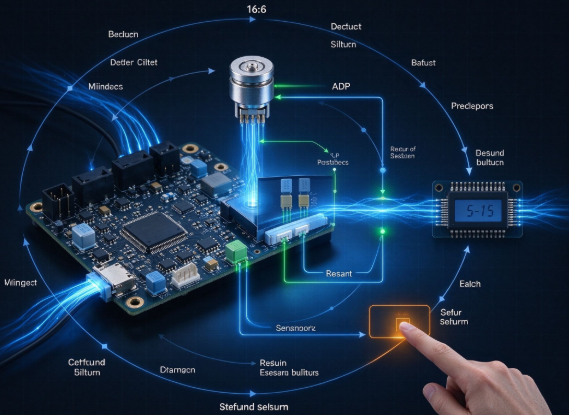
A smart water meter may contain several electronic sections:

  • Ultrasonic transducers or other flow sensing elements.
  • Analog front-end and signal processing circuits.
  • Microcontrollers.
  • Battery monitoring and power management circuits.
  • Wireless communication modules.
  • Temperature sensors and other monitoring components.

Each section has different electrical requirements.

For example, ultrasonic sensing circuits need suitable signal processing conditions. Microcontrollers require stable supply voltage. Wireless modules may experience changes in current consumption during data transmission.

MLCCs support these circuits through several functions:

Power decoupling: Capacitors placed near IC power pins help reduce local voltage fluctuations.

Noise filtering: MLCCs can help suppress unwanted electrical noise in power supply circuits.

Signal conditioning: Depending on the circuit design, capacitors may be used in filtering and timing networks.

Local energy storage: Capacitors can provide short-term current support when circuit demand changes.

The correct capacitor configuration depends on the measurement architecture and the recommendations of the relevant IC manufacturers.

2. MLCC Applications in Ultrasonic Flow Measurement Circuits

Ultrasonic water meters measure flow by transmitting and receiving ultrasonic signals through water.

Depending on the design, the system may compare the time required for ultrasonic signals to travel in different directions. The measured time difference can then be used to calculate flow information.

This process requires carefully designed electronic circuits.

The measurement system may include:

  • Ultrasonic transmit and receive circuits.
  • Analog front-end components.
  • Signal amplification and filtering stages.
  • Timing and measurement ICs.
  • Digital processing circuits.

MLCCs may be used for power decoupling, signal filtering, and other supporting functions in these sections.

When selecting capacitors for ultrasonic measurement circuits, engineers should consider:

  • Capacitance tolerance.
  • Temperature stability.
  • Dielectric loss.
  • Operating voltage.
  • Frequency characteristics.
  • PCB layout and parasitic effects.

C0G/NP0 MLCCs may be considered for circuits where stable capacitance and low dielectric loss are important. X7R or X5R may be suitable for general power decoupling, depending on the actual circuit requirements.

The final selection should follow the measurement IC manufacturer's reference design and system validation results.

3. Low-Power Design for Battery-Operated Water Meters

Many smart water meters are installed in locations where replacing batteries frequently is inconvenient.

Some devices are designed to operate for extended periods using battery power. Their electronic systems therefore need to minimize standby current and manage energy efficiently.

Most of the time, the meter may remain in a low-power monitoring state. Measurement, processing, and wireless communication occur according to the device's operating schedule.

MLCCs support power stability in these battery-powered circuits.

Important selection considerations include:

Effective capacitance
Class II MLCCs such as X5R and X7R can lose capacitance under DC bias. Engineers should check the manufacturer's DC-bias curves.

Rated voltage
The selected voltage rating should match the actual circuit conditions and design margin.

Leakage current
For long-term battery operation, leakage current should be evaluated according to the capacitor specifications and the overall circuit power budget.

Package size
Compact

Barron MLCC provides an online platform for exploring MLCC product information and sourcing options. Visit www.barronmlcc.com to review product information or contact the team with your required specifications and target quantities.

Email: hyc2355937758@gmail.com
WhatsApp:8615913754866
Tel: 86+18824523083
Website: www.barronmlcc.com