Silent Guardians in the Deep Blue Extreme Survival Rules of Ceramic Chip Capacitors in Deep-Sea Engineering and Marine Equipment
Silent Guardians in the Deep Blue: Extreme Survival Rules of Ceramic Chip Capacitors in Deep-Sea Engineering and Marine Equipment
When human footsteps not only stride toward the stars and seas but also dive downward into the 10,000-meter abyss, our conquest of extreme physical environments reaches another dimension of peak.
In marine engineering equipment such as deep-sea exploration vessels, underwater unmanned vehicles (UUVs), deep-sea seismic monitoring networks, and submarine optical cable repeaters, electronic systems face cruel tests unimaginable on land: hundreds of megapascals (MPa) of hydrostatic pressure brought by thousands of meters of water depth, intense high-salt spray corrosion permeating the air, and extreme environments of 7×24 hours of long-term immersion in dampness, darkness, and inability to perform manual maintenance.
In this long tug-of-war with water pressure, salt spray, and time, ceramic chip capacitors (MLCC), as indispensable cornerstones in underwater control cabins, sonar detection arrays, and deep-sea power management systems, must possess extraordinary pressure resistance, moisture resistance, and long-term anti-aging capabilities.
1The "Water Pressure and Corrosion Purgatory" Brought by Deep-Sea and Marine Engineering
Underwater marine environments can be called "invisible killers" for electronic components, with core pain points concentrated in three aspects:
Extremely High Hydrostatic Pressure and Periodic Mechanical Stress
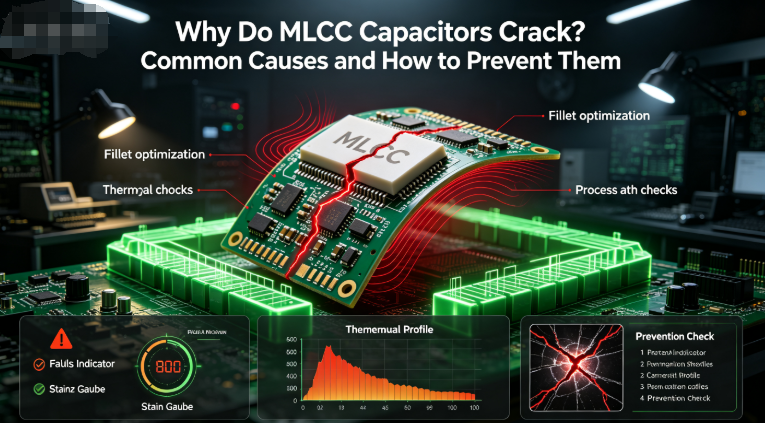
Although deep-sea electronic cabins are usually sealed with titanium alloy or special pressure-resistant shells, during long-term cycles of diving, surfacing, and submerging, slight elastic deformation of the shell is still transmitted to the internal PCB motherboard through structural components. If the mechanical pressure resistance and bending resistance of capacitor devices are insufficient, it is highly prone to invisible cracks in the ceramic body due to stress accumulation,进而 leading to catastrophic short circuits after seawater leakage.
Electrochemical Migration (Silver Migration) Under High Salt Spray and High Humidity Environments
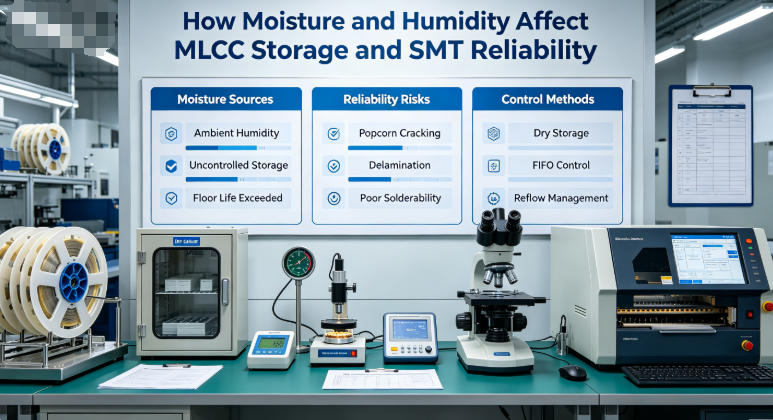
Marine atmospheres and humid cabin microenvironments are rich in chloride ions. When capacitor terminal electrodes containing precious metals such as silver are under the dual action of DC bias and moisture, electrochemical migration of metal ions is highly prone to occur, forming fine metal dendrites, ultimately leading to insulation failure.
"Absolute Zero Failure" Demand for Long-Term Unmanned Maintenance
Once deep-sea equipment is deployed on the seabed, its designed service life is often as long as 5 to 10 years or more. During this period, failure of any underlying capacitor may paralyze the entire underwater observation network, with extremely high salvage and maintenance costs.
2Barron Marine-Grade Special Series: Building a "Watertight Defense Line" for Deep-Sea Equipment
To empower deep-sea exploration and marine engineering equipment manufacturers to build rock-solid underwater electrical systems, Barron has launched a series of high-reliability ceramic chip capacitor solutions specifically built for high-pressure sealed cabins and marine environments:
Full-Series Upgraded Resin Soft Termination and Pressure-Resistant Reinforced Structure Marine Grade
In response to mechanical stress caused by deep-sea periodic water pressure deformation, Barron marine-grade MLCCs fully adopt conductive resin soft terminal technology, perfectly absorbing and buffering external force deformation, completely eradicating hidden dangers of micro-cracks, ensuring stability as solid as a rock in deep-sea high-pressure environments.
Special Passivation and Precious Metal Packaging Technology Resistant to Electrochemical Migration
Through unique multi-layer anti-corrosion barrier coatings on terminal electrodes and high-purity sealing processes, it completely blocks chloride ion intrusion and metal ion migration paths, maintaining eternal stability of insulation resistance in extreme high-humidity, high-salt spray environments.
Stringent Water Pressure Simulation and Long-Term Accelerated Life Screening
Every batch of products delivered to marine engineering customers must pass Highly Accelerated Stress Testing (HAST) and pressure resistance screening, using the highest standard quality red line to escort the silent坚守 at 10,000 meters deep in the sea.
3Practical Exercise: Core Positions of MLCCs in Deep-Sea Engineering Hardware
In the precision hardware architecture of underwater unmanned vehicles (UUVs) and deep-sea observation networks, Barron ceramic chip capacitors are active at key points that determine mission success or failure:
Underwater Sonar Arrays and Signal Acquisition Frontends
In analog frontends and filters that receive weak seabed echo sonar signals, use Barron's high-precision, low-temperature drift C0G material capacitors to ensure absolute purity and high fidelity of underwater acoustic signals.
Deep-Sea Thruster Brushless Motor Drive and Power Management (PMIC)
On high-power variable frequency drive boards that drive submersibles through the deep sea, deploy Barron's high-voltage, large-capacity X7R soft-termination capacitors to precisely absorb voltage surges at the moment of motor commutation.
Submarine Optical Cable Repeater Photoelectric Conversion and Power Supply Loops
On high-voltage DC buses powered by thousands of kilometers of submarine optical cable series connection, use Barron's medium-high voltage, high-reliability capacitors to build stable decoupling and filtering networks, ensuring uninterrupted transoceanic communication.
4Conclusion: With Rock-Solid Ceramics, Exploring the Infinite Mysteries of the Deep Blue Abyss
Human exploration of the ocean is an endless journey to the stars and seas. In this abyss challenge full of unknowns, Barron always guards the power and signal lifelines of every piece of marine equipment with industrial and military-grade stringent quality.
Is your deep-sea exploration equipment, underwater unmanned vehicle (UUV), or marine IoT project looking for a ceramic chip capacitor partner that can withstand extreme water pressure and high-salt spray corrosion tests?
Welcome to visit www.barronmlcc.com to explore our marine-grade high-reliability MLCC series products. Let Barron, with rock-solid quality, help your deep-sea equipment travel steadily and explore without boundaries in the 10,000-meter abyss!
Get Free Marine-Grade MLCC Samples & Deep-Sea Design ConsultationEmail: hyc2355937758@gmail.com WhatsApp: +86 15913754866 WhatsApp: +86 18824523083 Official Website: www.barronmlcc.com
Chasing the Stars and Seas Extreme Survival Rules of Ceramic Chip Capacitors Behind Commercial Aerospace and Satellite Constellations
Voltage Stabilizing Anchor of Giant Power Ceramic Chip Capacitors in Humanoid Robot High-Power Motors and Energy Storage Buses
Related Article