The Silent Support Behind Computing Power MLCC Selection Strategies in AI Data Centers and Servers
The Silent Support Behind Computing Power: MLCC Selection Strategies in AI Data Centers and Servers
When global attention focuses on the constantly刷新 parameter counts of large models and the surging performance of computing chips (GPU/ASIC), few people notice that behind this AI wave, there is a category of tiny yet crucial components enduring extremely harsh tests — these are Multilayer Ceramic Capacitors (MLCCs).
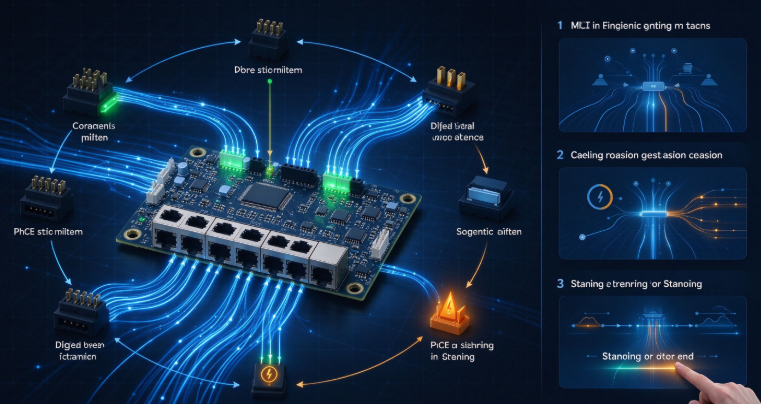
In high-performance servers of AI data centers, when processors (CPU/GPU) perform massive parallel computing, their operating current transiently jumps between several amps to hundreds of amps at extremely high speeds. Such drastic dynamic load changes pose devastating challenges to server Power Integrity (PI). How to maintain stable supply voltage within millisecond or even nanosecond timeframes? The answer is hidden in the dense MLCC arrays surrounding the core of the motherboard.
1Three Extreme Challenges of AI Servers for MLCCs
Compared with traditional consumer-grade or general-purpose servers, hardware architectures oriented toward AI computing power impose more disruptive technical specification requirements on MLCCs:
Extreme Transient Response and Low Impedance Requirements
When a GPU switches from idle to full-load operation instantly, the motherboard power supply must deliver enormous current instantaneously. If the impedance of the Power Distribution Network (PDN) is too high, it will产生致命的电压跌落 (Voltage Droop),进而导致芯片发生时序错乱甚至系统宕机。Therefore, AI servers require massive, ultra-low ESR/ESL MLCCs to work collaboratively across extremely high frequency bands, suppressing PDN impedance to the limit.
Dual Pressure of High Capacitance and Miniaturization
To be placed close to the core chip and shorten the current loop, MLCCs must be as compact as possible (such as 0402 or 0603 packages); but to provide sufficient transient charge reserve, extremely high single capacitance values (such as 22µF, 47µF, or even 100µF) are needed. This balance of achieving "ultra-large capacity" within tiny packages is the pinnacle challenge of materials science.
Long-Term Reliability Under High Temperature and Large Ripple Current
AI data centers operate 24/7 without interruption, with extremely high local temperatures inside racks. High-frequency large currents continuously flowing through capacitors generate significant internal Joule heating. If the temperature resistance and thermal stability of capacitors are inadequate, thermal breakdown or rapid capacity attenuation can easily occur.
2Barron's Technical Support for AI High-Computing Scenarios
To meet the stringent demands of modern AI data centers and HPC hardware, Barron has made key布局 in high-performance power decoupling series products:
Perfect Balance of Large Capacity and Miniaturization
Through continuously optimized dielectric layer thinning technology, we have achieved stable output of large capacitance values in mainstream packages (such as 0603, 0805), providing sufficient charge reserves for the backside and surroundings of AI core boards.
Low ESL/ESR Array Optimization Design
For high-frequency switching power supplies (such as VCore core power supply modules), Barron provides dedicated series with low equivalent series resistance and inductance, ensuring that during high-frequency transient switching, capacitors can respond "instantly," completely smoothing out voltage spikes.
Stringent Lifespan and Thermal Aging Testing 7×24 Reliability
Every batch of MLCCs destined for data centers undergoes high-temperature accelerated aging screening, ensuring that in data center environments with long-term full loads and high ambient temperatures, extremely low failure rates are still maintained.
3Practical Exercise: Key Placement of MLCCs on AI Motherboards
In AI server motherboard design, the placement and application of MLCCs are highly sophisticated:
Under Processor Core (Cavity / Backside Decoupling)
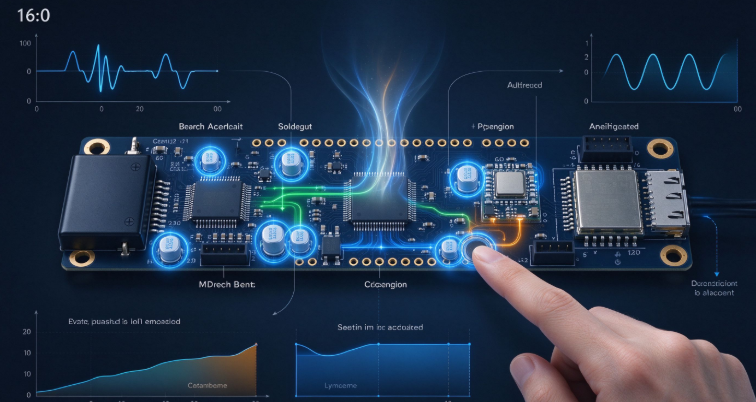
Modern AI computing cards often place hundreds of small-sized MLCCs densely on the backside of the GPU chip (the other side of the PCB). This leverages the "closest distance decoupling" principle, minimizing parasitic inductance — it is the lifeline for ensuring high-frequency transient response.
POL (Point of Load) Power Output Terminals
At the output terminals of VRM (Voltage Regulation Modules), a hybrid parallel architecture of "large-capacity electrolytic/polymer capacitors + multiple Barron medium-high capacitance MLCCs" is adopted, which can both satisfy large-capacity energy storage and perfectly absorb high-frequency switching noise.
4Conclusion: Computing Power Has No Limits, Stability Is the Cornerstone
The vast ocean of artificial intelligence is built upon the solid stability of every tiny electronic component. In this computing power race, Barron is always committed to providing the most reliable and highest-performance passive component support for global server manufacturers and AI hardware developers.
Is your AI server, GPU accelerator card, or high-computing power module facing severe power integrity challenges?
Welcome to visit www.barronmlcc.com to explore our high-performance decoupling capacitor series, or directly contact our application engineering team to obtain professional matching and simulation support for your project's Power Distribution Network (PDN)!
Email: hyc2355937758@gmail.com WhatsApp: +86 15913754866 WhatsApp: +86 18824523083 Official Website: www.barronmlcc.com
Breaking Through Miniaturization MLCC Solutions for Consumer Electronics and Wearables
The Key Role of MLCCs in 5G Communications and RF Frontends
Related Article