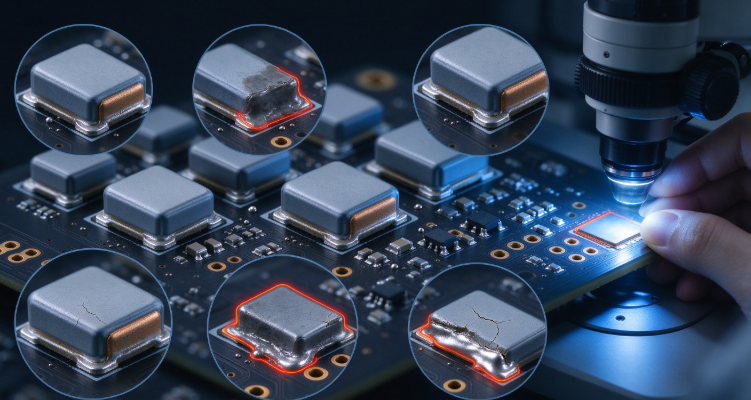
Why Do MLCC Capacitors Have No Markings How to Identify Them
Why Do MLCC Capacitors Have No Markings? How to Identify Them
Have you ever looked at a tiny ceramic capacitor on a PCB and wondered why there is no number, logo, or specification printed on its surface?
This is completely normal for many multilayer ceramic capacitors (MLCCs). Their small size makes direct identification difficult, so engineers and purchasing teams often need to rely on part numbers, packaging labels, and technical documentation instead.
Understanding how to identify unmarked MLCCs can help prevent component mix-ups during purchasing, inventory management, and PCB assembly.
1. Why Do Most MLCC Capacitors Have No Markings?
The main reason is their compact size. Common MLCC packages, such as 0201, 0402, and 0603, provide very little surface area for readable text.
An MLCC may need to be identified by its capacitance, rated voltage, dielectric type, tolerance, and manufacturer part number. Printing all this information directly on such a small body would be impractical.
Manufacturers therefore commonly supply small MLCCs without visible markings. This also makes it easier to use automated surface-mount technology (SMT) equipment without relying on printed text for component identification.
The absence of markings does not automatically indicate poor quality or a counterfeit component.
2. Can You Identify an MLCC by Its Appearance?
Not reliably.
Two ceramic capacitors may look almost identical while having very different electrical specifications. For example, they might share the same package size but differ in capacitance, rated voltage, dielectric material, or tolerance.
Body color is also not a dependable identification method. Different manufacturers and product series may use similar colors, and appearance alone cannot confirm a component's specifications.
Even when a capacitor's dimensions can be measured accurately, those measurements usually reveal only its approximate package size—not its complete electrical identity.
Important: Never select a replacement solely because it looks the same as the original component.
3. How Can You Identify an Unmarked MLCC?
If you need to identify an unmarked capacitor, start with traceable records rather than guessing from its appearance.
- Check the original packaging. The label on the reel, tray, or bag may provide the manufacturer part number, capacitance, voltage rating, package size, lot number, and other relevant information.
- Review the BOM. If the capacitor came from an assembled PCB, the bill of materials may identify the exact component assigned to that board location.
- Check purchasing records. Purchase orders, invoices, and supplier records may help establish which part was delivered.
- Consult the manufacturer's datasheet. Once you have a reliable part number, use the official documentation to verify its electrical and physical specifications.
- Use electrical testing when appropriate. An LCR meter can measure capacitance, while other instruments can check additional properties. However, measurements alone generally cannot establish the exact manufacturer or complete part number.
If the component's identity remains uncertain, do not treat an estimated identification as confirmed.
4. What If You Need to Identify an MLCC on an Existing PCB?
Identifying a capacitor already soldered to a circuit board can be more difficult because its original packaging may no longer be available.
A practical investigation can include the following steps:
- Find the PCB reference designator, such as C15 or C28.
- Check the schematic and BOM for the corresponding component.
- Review the board revision and any engineering change records.
- If documentation is unavailable, inspect the circuit and use suitable electrical measurements.
- Confirm the candidate part's specifications before installing a replacement.
Be careful with in-circuit measurements. Other components connected to the same electrical nodes can affect the readings.
If the board is safety-critical or the capacitor operates under demanding electrical conditions, guessing its value or voltage rating can create unnecessary risk. Obtain reliable design information or perform a proper engineering evaluation before replacement.
5. How Can Manufacturers and Buyers Prevent Component Mix-Ups?
Because many MLCCs have no visible identification, inventory control is especially important.
A few simple practices can reduce mistakes:
- Keep the original reel or packaging label until the material has been fully identified and accepted.
- Store different part numbers in clearly labeled, separate locations.
- Use barcode scanning or an electronic inventory system where practical.
- Match incoming material against the purchase order and approved BOM.
- Record manufacturer part numbers and lot information for traceability.
- Avoid mixing loose, unidentified capacitors with verified production stock.
For SMT production, accurate feeder setup and material verification are also essential. A component can be physically compatible with a footprint while still having the wrong electrical characteristics.
6. Does No Marking Mean an MLCC Is Counterfeit?
No. Many genuine MLCCs are intentionally supplied without markings, especially in smaller package sizes.
However, the absence of markings also means that visual inspection alone cannot establish authenticity.
When evaluating a new supplier, pay attention to the traceability of the supplied material. Check part numbers, packaging labels, lot information, documentation, and any verification requirements relevant to your application.
For critical products, consider additional inspection or testing based on the risks involved.
A reliable verification process should use several pieces of evidence rather than relying on a single visual characteristic.
7. What Information Should You Provide When Ordering MLCCs?
Since the component body may not display its specifications, accurate purchasing information is essential.
When requesting a quotation, provide as many of the following details as possible:
- Manufacturer part number, if available
- Capacitance value
- Rated voltage
- Dielectric type, such as X7R, X5R, or C0G/NP0
- Capacitance tolerance
- Package size, such as 0402, 0603, or 0805
- Required quantity
- Target application and any special requirements
If you are sourcing a replacement, provide the original part number or the complete specifications whenever possible. A photograph can help show the physical component, but it usually cannot confirm all the required electrical details.
Conclusion
Many MLCC capacitors have no surface markings because their packages are too small for practical labeling. This is normal and does not, by itself, indicate a quality problem.
The safest way to identify an unmarked MLCC is to use traceable packaging, BOM records, manufacturer documentation, and appropriate electrical tests. Appearance alone is not enough to confirm the component's identity.
Need help sourcing MLCC capacitors for your production requirements? Visit www.barronmlcc.com and share your part number, electrical specifications, package size, and required quantity to discuss suitable options.


Contact Us
Email: hyc2355937758@gmail.com
WhatsApp: +86 15913754866
Tel: +86 18824523083
Website: barronmlcc.com
MLCC Capacitors for LED Lighting What Designers Should Know
Are MLCC Capacitors Polarized What Engineers Need to Know
Related Article

Multilayer ceramic capacitors (MLCCs) are commonly used in these circuits

The short answer is that most standard multilayer ceramic capacitors (MLCCs) are non-polarized. However