Why Equivalent Series Resistance ESR and Equivalent Series Inductance ESL Matter in MLCC Selection
Why Equivalent Series Resistance (ESR) and Equivalent Series Inductance (ESL) Matter in MLCC Selection
When electrical engineers design high‑frequency power distribution networks or high‑speed digital systems, selecting a Multi‑Layer Ceramic Capacitor (MLCC) involves much more than just evaluating its nominal capacitance and voltage rating. Two parasitic parameters—Equivalent Series Resistance (ESR) and Equivalent Series Inductance (ESL)—dictate how effectively a capacitor behaves in real‑world circuit environments.
For hardware designers and component procurement teams, understanding these parasitic behaviors is crucial to preventing power supply noise, voltage drops, and electromagnetic interference (EMI).
The Real‑World Equivalent Circuit of an MLCC
In an ideal theoretical model, a capacitor offers pure capacitive reactance. However, physical manufacturing constraints, internal electrode layers, and terminal connections mean that every real‑world MLCC acts as an RLC circuit consisting of:
- Capacitance (C): The primary energy storage value.
- Equivalent Series Resistance (ESR): The sum of the resistance of the internal metal electrode sheets, terminal platings, and dielectric losses.
- Equivalent Series Inductance (ESL): The inductance introduced by the current path flowing through the internal electrode plates and terminal connections.
Why ESR Matters in High‑Current and Power Filtering
ESR determines how much power is dissipated as heat when an alternating current passes through the capacitor.
Thermal Management: In switched‑mode power supplies (SMPS) and high‑current DC‑DC converters, high ripple currents flow through the output capacitors. If an MLCC possesses excessively high ESR, the I²R power loss generates internal heat. This self‑heating can accelerate dielectric degradation or lead to thermal runaway.
Ripple Voltage Suppression: Lower ESR is generally preferred for output decoupling because it minimizes the voltage ripple created when transient load currents pass through the capacitor.
Why ESL Dictates High‑Frequency Performance
While ESL is typically measured in nanohenries (nH) or picohenries (pH), its impact becomes dominant as operating frequencies climb into the megahertz and gigahertz ranges.
The Inductive Transition: As frequency increases, the impedance of a capacitor decreases due to capacitive reactance until it hits its Self‑Resonant Frequency (SRF). Above the SRF, the inductive reactance governed by ESL takes over. The component stops acting like a capacitor and begins acting like an inductor, rendering it useless for filtering high‑frequency noise.
Decoupling High‑Speed Processors: Modern microprocessors, FPGAs, and ASICs demand fast transient currents. Low ESL is critical to ensure that decoupling capacitors can supply instantaneous charge without suffering from inductive voltage spikes that trigger logic errors.
Engineering Strategies to Minimize Parasitic Effects
To optimize circuit performance and select the correct passive components, procurement and design teams should keep these guidelines in mind:
- Select Smaller Case Sizes for Lower ESL: Smaller package sizes (such as 0402 or 0603) inherently feature shorter internal current paths and smaller loop areas, resulting in significantly lower ESL compared to larger packages like 1210 or 2220.
- Use Reverse‑Geometry (LW Reverse) Capacitors: For ultra‑low ESL requirements, specialized low‑inductance chip capacitors (LICCs) widen the termination width along the long side of the package, drastically reducing parasitic inductance.
- Parallel Multiple Capacitors: Distributing total capacitance across multiple smaller parallel capacitors reduces both total equivalent ESR and ESL while improving thermal dissipation across the PCB.
Source High‑Performance, Low‑Parasitic MLCCs
Ensure your high‑frequency designs meet stringent performance standards with precision‑engineered surface‑mount components from barronmlcc.com. We provide comprehensive technical specifications, SMT solutions, and direct wholesale supply support. Contact our engineering sales team today for professional cross‑referencing and bulk quotations.
Contact Us
Direct Email: hyc2355937758@gmail.com
WhatsApp & Mobile: +86 15913754866
Telephone Support: +86 18824523083
Official Web Portal: //www.barronmlcc.com
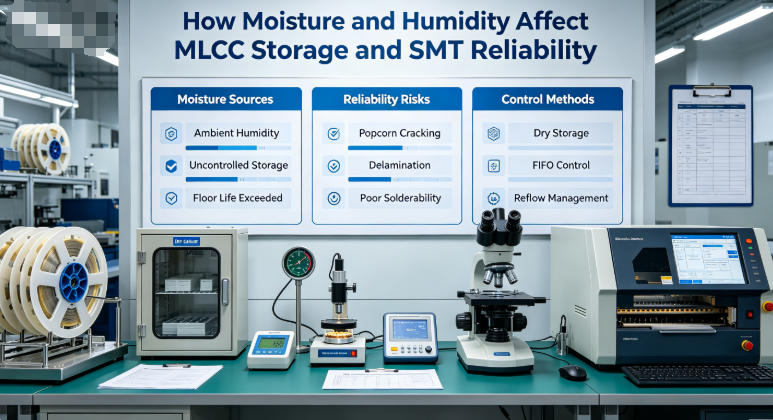
How Moisture and Humidity Affect MLCC Storage and SMT Reliability

Understanding the MLCC Piezoelectric Effect Why Do Ceramic Capacitors Sing and How to Stop It
Related Article