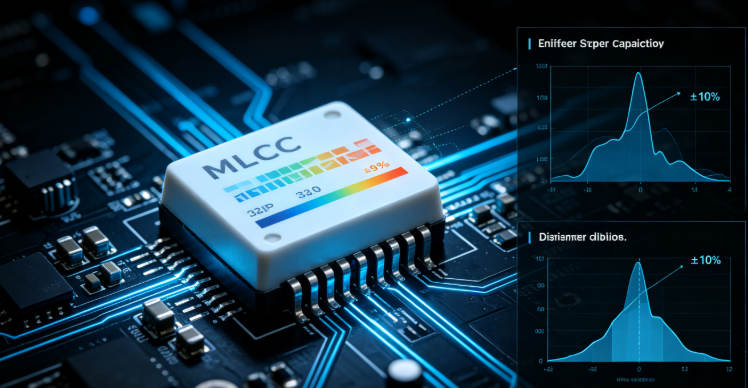
Demystifying MLCC Dielectrics C0G vs X7R in High Reliability PCB Designs
Demystifying MLCC Dielectrics: C0G vs. X7R in High-Reliability PCB Designs
When engineering modern Printed Circuit Boards (PCBs), choosing the right Multilayer Ceramic Capacitor (MLCC) goes far beyond selecting a nominal capacitance and voltage rating. The underlying dielectric formulation dictates how the component reacts to environmental changes, thermal shifts, and electrical loads. For design engineers and procurement teams sourcing components via www.barronmlcc.com, understanding the operational differences between Class 1 (C0G/NP0) and Class 2 (X7R) dielectrics is essential to preventing field failures.
1. Class 1 C0G (NP0): The Gold Standard for Precision
C0G (often designated as NP0) is a Class 1 ceramic dielectric renowned for unmatched thermal stability and minimal electrical loss.
- Temperature Stability: Exhibits a near-zero temperature coefficient (±30 ppm/°C) across a wide operational range of -55°C to +125°C. A capacitance value chosen today remains virtually identical under varying thermal conditions.
- Absence of DC Bias Effect: Unlike high-density ceramics, C0G capacitors experience zero capacitance loss when subjected to direct current (DC) voltage.
- Zero Piezoelectric Noise: Because they are not ferroelectric, C0G components do not suffer from the inverse piezoelectric effect, eliminating audible microphonic "singing" or acoustic noise on the board.
- Ideal Applications: High-frequency RF circuits, precision timing loops, crystal oscillators, analog filter networks, and resonant circuits.
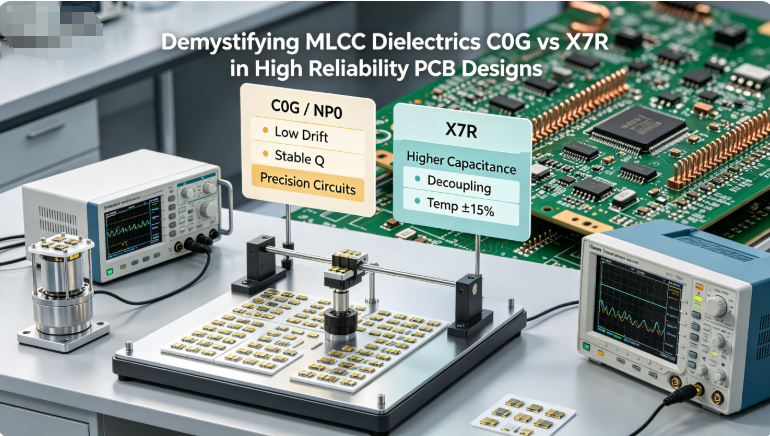
2. Class 2 X7R: The Versatile Powerhouse
X7R is a Class 2 dielectric acting as the reliable workhorse for general-purpose digital circuit design, offering high volumetric efficiency (more capacitance in a smaller package).
- Temperature Characteristics: Operates effectively from -55°C to +125°C, with a predictable maximum capacitance variation of ±15%.
- The DC Bias Reality: A critical design consideration for X7R is the DC bias effect. As DC voltage increases across an X7R capacitor, its effective working capacitance drops. Engineers must review manufacturer DC bias curves to ensure the component delivers adequate capacitance under operational load.
- Aging Phenomenon: X7R formulations naturally lose a small percentage of their capacitance over time (typically 2% to 3% per decade hour), which must be accounted for in long-life industrial or infrastructure applications.
- Ideal Applications: Power supply decoupling, power distribution network (PDN) bypass lines, bulk energy storage, and general filtering.
3. Quick Comparison Matrix for Circuit Designers
| Parameter | C0G (NP0) | X7R |
|---|---|---|
| EIA Classification | Class 1 (Temperature-Compensating) | Class 2 (Temperature-Stable) |
| Temperature Coefficient | ±30 ppm/°C | ±15% (-55°C to +125°C) |
| DC Bias Performance | None (Stable across voltage) | Moderate to Severe (Drops under voltage load) |
| Acoustic Noise (Microphonics) | None | Present in AC/switching circuits |
| Primary Design Focus | High Precision & Stability | High Capacitance Density & Cost-Efficiency |
Sourcing High-Reliability Components with HLAIPOPNY
Selecting the correct dielectric prevents costly board respins and field returns. Whether you are engineering ultra-stable RF modules with C0G or dense power rail decoupling networks with X7R, matching the right component specification to your circuit parameters is paramount.
To explore certified batch specifications, custom tape-and-reel packaging options, and bulk quotation details for your upcoming production runs, visit us at www.barronmlcc.com.
HLAIPOPNY — Empowering global electronics manufacturing with uncompromising component quality and engineering-grade reliability.
What specific capacitance ranges or case sizes (e.g., 0402, 0603, 0805) are you currently prioritizing for your active bill of materials (BOM)?
Contact Us:
EM: hyc2355937758@gmail.com
WhatsApp:8615913754866
Tel: 86+18824523083
Website: www.barronmlcc.com
Navigating MLCC Failures Understanding Thermal Cracks Flex Cracks and Mitigation Strategies
The Butterfly Effect on Circuit Boards How a Resistor-Capacitor Component Worth Less Than A Penny Can Sink a Multi-Million-Dollar Project
Related Article