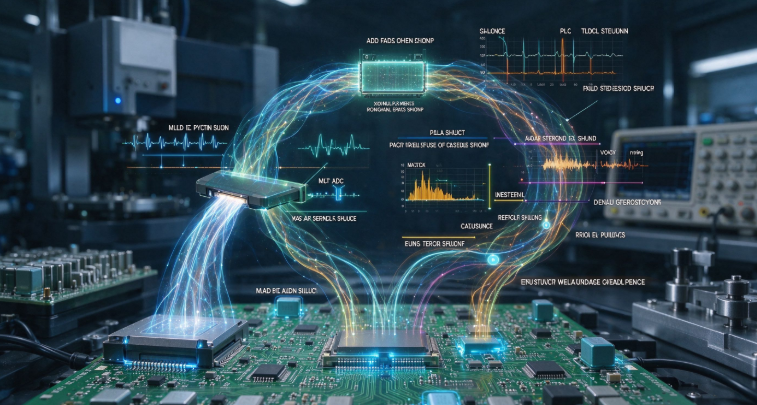
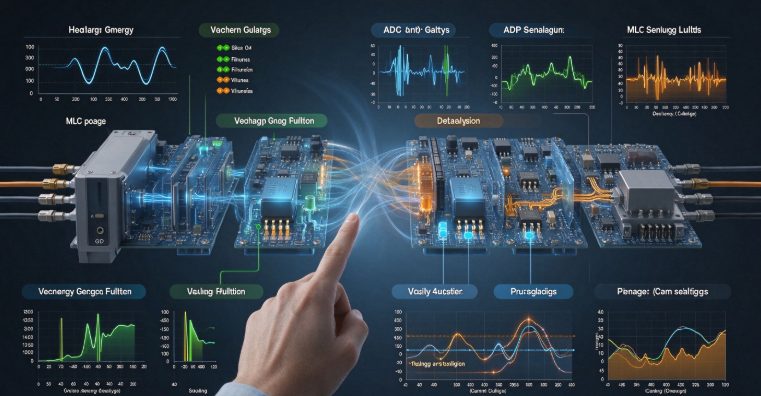
MLCCs for Smart Grid Power Quality Analyzers Supporting Accurate Signal Measurement
MLCCs for Smart Grid Power Quality Analyzers: Supporting Accurate Signal Measurement
MLCC for smart grid equipment, ceramic capacitors for power measurement, MLCC for harmonic analyzers, precision measurement capacitors
Modern power grids require accurate monitoring of voltage, current, frequency, and harmonic distortion. As renewable energy systems, industrial loads, and electric vehicle charging equipment become more common, maintaining power quality is increasingly important.
Smart grid power quality analyzers help engineers identify electrical disturbances, measure harmonic components, and evaluate the condition of power systems.
Inside these instruments, electronic circuits process small electrical signals and convert them into digital measurement data. Multilayer ceramic capacitors (MLCCs) are used in many of these circuits for power supply decoupling, signal filtering, and noise reduction.
Selecting suitable MLCCs is important for building stable measurement equipment.
1. Voltage and Current Signal Conditioning
Power quality analyzers receive voltage and current signals from measurement inputs. These signals may come from voltage transformers, current transformers, or other sensing circuits.
Before reaching the analog-to-digital converter (ADC), the signals usually pass through an analog front end.
MLCCs can support this stage through:
- Filtering high-frequency noise
- Stabilizing amplifier power supplies
- Supporting signal coupling where the circuit design requires it
- Helping establish filter characteristics
For precision measurement circuits, engineers should consider capacitance tolerance, temperature characteristics, and dielectric stability.
C0G/NP0 capacitors may be suitable for certain precision or low-loss filter positions, depending on the circuit requirements.
2. Anti-Aliasing Filters for Harmonic Measurement
One important function of a power quality analyzer is measuring harmonic distortion.
Electrical waveforms may contain frequency components beyond the fundamental power frequency. Before sampling, the analog signal generally needs appropriate bandwidth control to reduce unwanted high-frequency components.
An anti-aliasing filter is commonly placed before the ADC.
MLCCs may be used in the filter network together with resistors and operational amplifiers.
When selecting capacitors for this application, engineers should evaluate:
- Capacitance tolerance
- Temperature coefficient
- Frequency response
- Dielectric loss
- Long-term stability
The capacitor value and filter topology should follow the required measurement bandwidth and ADC sampling design.
3. Stable Power Supplies for Analog Circuits
Power quality analyzers often contain sensitive analog circuits, digital processors, display modules, and communication interfaces.
Noise from digital switching circuits can affect the power rails used by sensitive analog components.
MLCCs are commonly placed near IC power pins to provide local decoupling.
Different capacitance values may be used to support different frequency ranges, depending on the power distribution network.
X7R and X5R MLCCs are widely used for general power decoupling. However, engineers should check effective capacitance under actual DC bias and operating temperature rather than relying only on the nominal value.
For sensitive analog supply rails, capacitor placement and PCB grounding are also important.
4. ADC Reference and Precision Measurement Circuits
The ADC converts analog voltage signals into digital data for further processing.
Some ADC designs require external reference filtering or local decoupling around the reference input. Capacitor selection in these positions should follow the ADC manufacturer's recommendations.
In certain designs, a stable C0G/NP0 capacitor may be considered where its electrical characteristics match the reference circuit.
However, not every ADC reference pin requires the same capacitor type or value.
Engineers should check the datasheet for recommended capacitance, ESR, layout, and stability conditions. Using an unsuitable capacitor may affect settling behavior or circuit stability.
5. Communication and Data Processing Modules
Modern power quality analyzers may support Ethernet, RS-485, USB, or wireless communication.
These interfaces transmit measurement results to monitoring platforms, control rooms, or energy management systems.
MLCCs may be used in the associated power supply and filtering circuits to help reduce local electrical noise.
The required capacitance, voltage rating, and dielectric type depend on the interface design and the power management IC.
For high-speed signal paths, engineers should also consider PCB layout, signal integrity, and the recommendations of the interface IC manufacturer.
6. How to Select MLCCs for Power Quality Analyzers
Choosing an MLCC based only on capacitance and package size may lead to unexpected circuit behavior.
The following factors should be reviewed before purchasing.
Capacitance and tolerance: Precision filter circuits may require tighter tolerance than ordinary power decoupling positions.
Rated voltage: Select a voltage rating suitable for the actual circuit voltage and expected transients. Apply appropriate design margin.
Dielectric type: C0G/NP0 may be suitable for certain stable signal-processing circuits, while X7R or X5R may be appropriate for general power decoupling.
DC bias characteristics: Class II MLCCs can lose effective capacitance under DC voltage. Check the manufacturer's bias curves.
Temperature performance: Consider the analyzer's operating environment and the temperature characteristics required by each circuit.
Package size: Confirm PCB footprint, mounting conditions, and mechanical stress considerations.
7. Why Component Consistency Matters in Measurement Equipment
Power quality analyzers may be used for long-term monitoring and repeated measurements.
Changes in component characteristics can affect filter behavior and power supply performance. For this reason, manufacturers should maintain clear component specifications and review material substitutions carefully.
When replacing an MLCC with an alternative model, compare more than its nominal capacitance and voltage rating.
Important comparison items include:
- Dielectric type
- Capacitance tolerance
- Rated voltage
- Package dimensions
- Temperature characteristics
- DC bias performance
- Frequency-related parameters
Any replacement should be verified in the actual circuit before mass production.
Frequently Asked Questions
Q1: Where are MLCCs used in power quality analyzers?
They may be used in analog signal filters, ADC-related circuits, power supply decoupling, and communication module power circuits.
Q2: Are C0G capacitors suitable for precision measurement circuits?
C0G/NP0 capacitors offer stable capacitance and low dielectric loss, making them useful in certain precision filter applications. Actual suitability depends on the circuit design.
Q3: Can X7R capacitors be used in power quality analyzers?
Yes. X7R MLCCs are commonly considered for general power decoupling and filtering. Their effective capacitance under DC bias and temperature changes should be checked.
Q4: Why is capacitance tolerance important in harmonic measurement circuits?
Capacitance affects filter characteristics. In precision measurement paths, component variation may change the filter response, so tolerance should match the required measurement performance.
Q5: What should buyers check when sourcing MLCCs for power measurement equipment?
Buyers should confirm capacitance, tolerance, voltage rating, dielectric type, package size, manufacturer specifications, and application requirements.
Conclusion
Smart grid power quality analyzers depend on carefully designed measurement circuits to capture voltage, current, and harmonic information.
MLCCs support these systems through local power decoupling, analog filtering, and signal conditioning. Selecting the right capacitor requires attention to dielectric characteristics, capacitance tolerance, DC bias, temperature performance, and circuit position.
For engineers and purchasing teams, comparing complete electrical specifications is more useful than selecting components by nominal capacitance alone.
Visit Barron MLCC at //www.barronmlcc.com/ to explore MLCC product information. You can also submit your required specifications and target quantities to discuss suitable sourcing options for your project.
EM: hyc2355937758@gmail.com
WhatsApp:8615913754866
Tel: 86+18824523083
www.barronmlcc.com
MLCCs for Industrial Battery Formation and Testing Equipment Supporting Stable Multi-Channel Electronics
MLCCs for Industrial Battery Formation and Testing Equipment Supporting Accurate Measurement and Stable Control
Related Article