MLCC Capacitors for IoT Devices A Practical Selection Guide
MLCC Capacitors for IoT Devices: A Practical Selection Guide
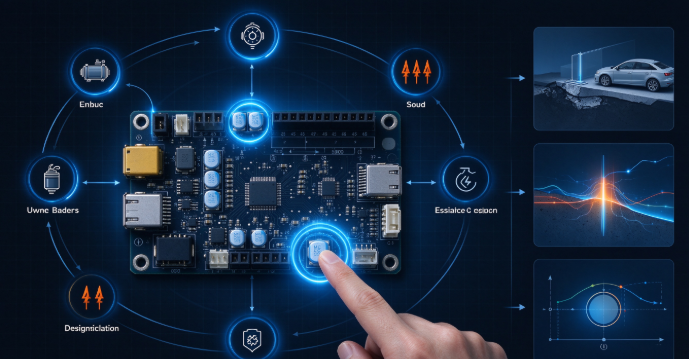
Internet of Things (IoT) devices are becoming smaller, smarter, and more connected. From wireless sensors and smart meters to wearable electronics and industrial monitoring systems, these products depend on stable electronic circuits to collect data and communicate reliably.
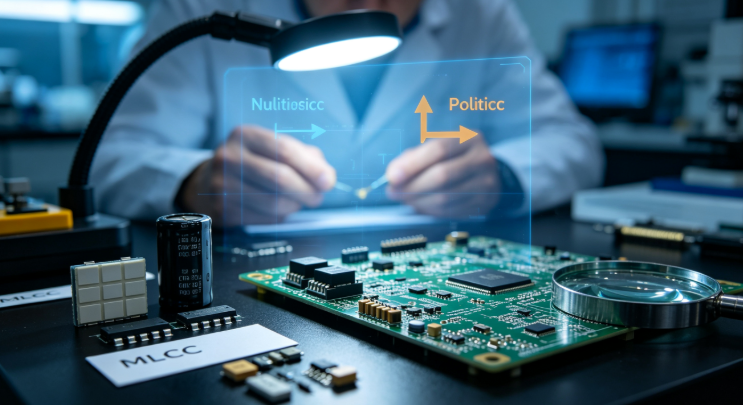
Multilayer ceramic capacitors (MLCCs) play an important role in these designs. They help stabilize power supplies, filter electrical noise, and support signal circuits in compact electronic products.
But how do engineers choose the right MLCC for an IoT application? Here are the key factors to consider.
1. Why Are MLCCs Commonly Used in IoT Devices?
Many IoT products have limited PCB space and strict power requirements. Their circuits may combine a microcontroller, wireless communication module, sensors, and a battery in a small enclosure.
MLCCs are useful because they offer several practical advantages:
- Compact size: Small SMD packages help designers save PCB space.
- No polarity requirement: Standard MLCCs can generally be mounted in either electrical orientation.
- High-frequency performance: Suitable MLCCs can provide effective local decoupling and noise filtering.
- Multiple capacitance options: Different values support different functions across the same circuit.
The best component depends on its position in the design. A capacitor used near a wireless module may have different requirements from one supporting a sensor or a power converter.
2. Power Supply Stability in Wireless Devices
Wireless IoT modules can draw short bursts of current when transmitting data. If the power supply cannot respond quickly enough, the supply voltage may dip and affect system operation.
Designers often place decoupling capacitors close to the power pins of microcontrollers, sensors, and communication modules. These capacitors help supply transient current and reduce high-frequency noise.
However, simply increasing capacitance is not always the best solution. The required value depends on the device manufacturer's reference design, supply impedance, transient current demand, and PCB layout.
For reliable performance, follow the module datasheet and evaluate the power supply under realistic operating conditions.
3. Choosing the Right Capacitance and Dielectric
Two common MLCC dielectric types are X7R and C0G/NP0. Each serves different needs.
X7R capacitors are widely used for power decoupling because they can provide relatively high capacitance in a small package. Their effective capacitance can decrease under DC bias and vary with temperature and aging.
C0G/NP0 capacitors provide excellent capacitance stability and low losses. They are useful in selected timing, filtering, and frequency-sensitive circuits, although their available capacitance is generally lower than that of comparable-sized X7R components.
For IoT designs, the correct choice depends on the circuit function. Check the actual capacitance required under operating conditions rather than relying only on the nominal value printed in the datasheet.
4. How Battery Operation Affects MLCC Selection
Many IoT devices operate from batteries or energy-harvesting sources. Every part of the power system must support the product's energy budget.
MLCCs are often used in local decoupling, filtering, and power conversion circuits. Their suitability depends on the required capacitance, voltage rating, dielectric, and operating conditions.
A few points deserve attention:
- Effective capacitance: DC bias can reduce the capacitance of Class II MLCCs, such as X7R and X5R.
- Operating voltage: Select a rated voltage appropriate for the actual circuit conditions and transients.
- Standby operation: Consider how the overall circuit behaves during sleep and wake-up cycles.
- Temperature: Verify performance across the expected operating environment.
An MLCC does not automatically reduce a device's total power consumption. Battery life also depends on the radio, processor, firmware, sensors, power converter, and duty cycle.
5. MLCCs in RF and Sensor Circuits
IoT devices often contain antennas, wireless transceivers, and sensitive analog sensors. Electrical noise or poorly controlled signal paths can affect communication and measurement accuracy.
MLCCs may be used for RF matching, filtering, coupling, or decoupling, depending on the circuit design.
For frequency-sensitive applications, C0G/NP0 is often considered because of its stable capacitance and low losses. However, the required component must be selected using the circuit's actual frequency range and design calculations.
Engineers should check:
- Capacitance tolerance and stability
- Equivalent series resistance (ESR) and equivalent series inductance (ESL), where relevant
- Self-resonant frequency and impedance behavior
- Package size and PCB layout
- Manufacturer recommendations for the intended frequency range
At RF frequencies, even small differences in component construction and PCB layout can affect circuit performance. Follow the reference design where available and validate the finished board.
6. Package Size and Mechanical Reliability
Smaller packages can help reduce PCB size, but they also introduce practical design and manufacturing considerations.
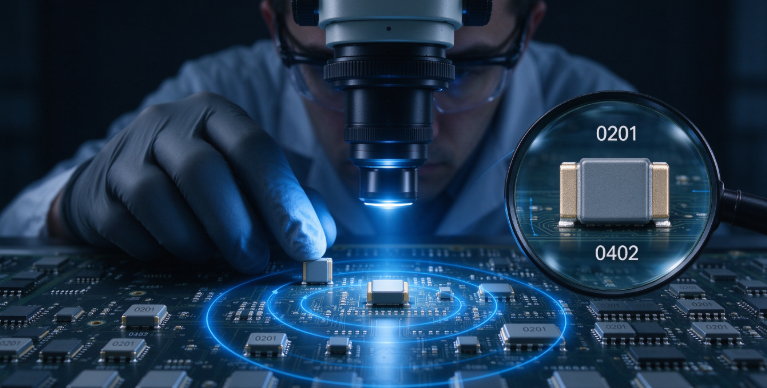
Common MLCC package sizes include 0201, 0402, 0603, and 0805. The appropriate choice depends on capacitance, voltage, board space, assembly capability, and reliability requirements.
Ceramic capacitors are mechanically brittle. PCB bending, depanelization, or other mechanical stresses can cause cracks that may lead to electrical failure.
For IoT products exposed to vibration, movement, or repeated handling, engineers should consider PCB support, component placement, and assembly procedures. Where available and appropriate, components designed with improved mechanical robustness may also be worth evaluating.
A smaller package is not automatically the best choice if it compromises the design's electrical or mechanical requirements.
7. What Should Buyers Check Before Ordering?
IoT products can contain many different capacitor values across power, RF, sensor, and control circuits. Clear purchasing specifications help prevent incorrect substitutions.
Before ordering MLCCs, confirm:
| Parameter | What to check |
|---|---|
| Capacitance | Required nominal and effective capacitance |
| Rated voltage | Suitability for operating voltage and transients |
| Dielectric | X7R, X5R, C0G/NP0, or another specified type |
| Tolerance | Required capacitance accuracy |
| Package size | PCB footprint and assembly compatibility |
| Temperature range | Expected environmental conditions |
| Quantity | Prototype, pilot run, or mass production demand |
| Part number | Exact manufacturer part number and approved alternatives |
If a component is unavailable, do not approve a substitute based only on matching capacitance and package size. Verify the complete specification and test the alternative in the intended circuit.
8. How to Improve MLCC Sourcing for IoT Projects
For new IoT products, it helps to separate prototype requirements from future mass-production demand. Early samples may be needed for circuit testing, while production orders require consistent specifications, traceability, and delivery planning.
When contacting a supplier, provide the part number or a complete specification, along with the quantity and application. If you are developing a new design, explain whether the capacitor is intended for power decoupling, RF circuitry, sensing, or another function.
This information helps narrow down suitable options and reduces unnecessary back-and-forth during quotation.
Conclusion
MLCCs support many functions in IoT electronics, from power decoupling to RF filtering and sensor circuits. Choosing the right component requires attention to effective capacitance, voltage, dielectric type, frequency behavior, package size, and mechanical conditions.
The goal is not simply to find the smallest or cheapest capacitor. It is to select a component that meets the circuit's requirements and can be sourced consistently throughout the product lifecycle.
Looking for MLCC capacitors for IoT or other electronic applications? Visit www.barronmlcc.com and share your required specifications, part number, and quantity to discuss suitable options.
Contact Us
Email: hyc2355937758@gmail.com
WhatsApp: +86 15913754866
Tel: +86 18824523083
Website: barronmlcc.com
MLCC Capacitors for Industrial Automation What Engineers Should Know
MLCC Capacitors for LED Lighting What Designers Should Know
Related Article
Multilayer ceramic capacitors (MLCCs) are commonly used in these circuits
The short answer is that most standard multilayer ceramic capacitors (MLCCs) are non-polarized. However