MLCC CapacitorTolerance Explained What Does
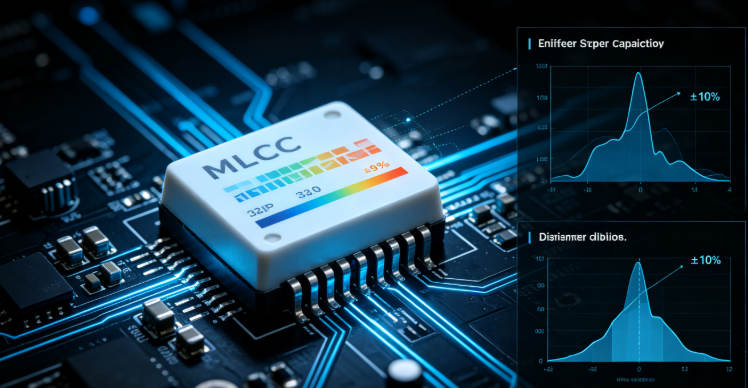
MLCC Capacitor Tolerance Explained: What Does ±5% or ±10% Really Mean?
When buying an MLCC capacitor, you may see specifications such as ±1%, ±2%, ±5%, ±10%, or ±20% tolerance. But what do these numbers actually mean? Does a 100nF capacitor with ±10% tolerance always measure exactly 100nF? And when should you choose a tighter tolerance?
For engineers and buyers, understanding MLCC tolerance is important because the wrong tolerance can affect circuit performance, cost, and product consistency. The good news is that the basic idea is simple.
1. What Does MLCC Tolerance Mean?
MLCC tolerance describes how much the actual capacitance can differ from the nominal capacitance shown in the specification.
For example, suppose you purchase a:
100nF ±10% MLCC
The actual capacitance can normally be within approximately:
90nF to 110nF
A 100nF capacitor with ±5% tolerance would have a narrower range:
95nF to 105nF
Therefore, a smaller tolerance means the capacitance is controlled more closely around the nominal value.
However, this does not mean that ±5% is always better than ±10%. The correct tolerance depends on the application.
2. Why Are Different Tolerances Available?
Different circuits have different requirements.
Some applications need very accurate capacitance because a small change can affect frequency, timing, filtering, or signal characteristics.
Other applications are much less sensitive to capacitance variation.
For example, a basic power supply decoupling capacitor may not require extremely tight tolerance. If the circuit only needs approximately 100nF, a 100nF ±10% MLCC may be perfectly suitable.
In contrast, precision circuits may require tighter control.
Choosing an unnecessarily tight tolerance can increase component cost without providing any real benefit to the product.
3. Common MLCC Tolerance Options
Common MLCC tolerances include:
- ±0.1%
- ±0.25%
- ±0.5%
- ±1%
- ±2%
- ±5%
- ±10%
- ±20%
Not every tolerance is available for every capacitance, dielectric, voltage, and package combination.
For example, very tight tolerances are more commonly associated with stable dielectric materials such as C0G/NP0, while higher‑capacitance Class II MLCCs often use wider tolerances.
When selecting a capacitor, check whether the required tolerance is actually available for your desired specification.
4. Tolerance Is Not the Same as Operating Stability
This is one of the most important points.
A capacitor may have a very tight initial tolerance but still experience capacitance changes during operation.
MLCC capacitance can be affected by factors such as:
- DC voltage
- Temperature
- Aging
- Frequency
- Mechanical stress
For example, an X7R capacitor may have a nominal tolerance of ±10%, but its effective capacitance can change when a DC voltage is applied.
Therefore, selecting a ±5% capacitor does not automatically mean that its capacitance will remain within ±5% under every operating condition.
The initial tolerance and the stability of the capacitor during operation are two different considerations.
5. How Does Temperature Affect MLCC Capacitance?
Temperature characteristics depend heavily on the dielectric material.
C0G/NP0 capacitors are known for excellent capacitance stability over their specified temperature range.
X7R capacitors are designed to provide relatively stable performance across a wider temperature range, but their capacitance can still change.
Other high‑capacitance ceramic dielectric types can show greater changes with temperature.
Therefore, if your application operates in a large temperature range, do not look at tolerance alone.
Check the dielectric type and temperature characteristics as well.
This is especially important for automotive, industrial, outdoor, and other applications where the operating temperature can change significantly.
6. Does Tighter Tolerance Always Mean Better Quality?
Not necessarily.
A ±5% capacitor is not automatically a higher‑quality component than a ±10% capacitor.
The two products may simply be designed for different applications.
For example, if your circuit only requires approximately 1µF for filtering, using a ±5% component may not provide any meaningful advantage over a ±10% component.
On the other hand, if your circuit is sensitive to capacitance variation, a tighter tolerance may be necessary.
The best approach is to select the widest tolerance that still meets the actual requirements of the circuit.
This can help control component cost without sacrificing performance.
7. How Should Buyers Compare MLCC Tolerance?
When comparing two MLCC quotations, do not look at tolerance as an isolated number.
Instead, compare the complete specification:
Capacitance + Tolerance + Voltage + Dielectric + Package + Temperature + Application
For example:
100nF, ±10%, 50V, X7R, 0603
and
100nF, ±5%, 50V, X7R, 0603
may look very similar.
The ±5% version provides tighter initial capacitance control, but it may also cost more.
If your application does not require the tighter tolerance, the ±10% version could be a more economical choice.
8. When Should You Choose a Tight Tolerance?
A tighter tolerance may be worth considering when capacitance directly affects circuit performance.
Typical examples can include:
- Precision timing circuits
- Filters
- Oscillators
- RF circuits
- Measurement equipment
- Certain analog circuits
- Applications requiring close component matching
For ordinary decoupling, bypassing, or general filtering applications, wider tolerance may often be sufficient.
The exact requirement should always come from the circuit design rather than from the idea that “smaller tolerance is always better.”
9. What Should You Tell Your MLCC Supplier?
When requesting a quotation, provide the complete specification whenever possible.
For example:
Capacitance: 100nF
Tolerance: ±10%
Voltage: 50V
Dielectric: X7R
Package: 0603
Quantity: 100,000 pcs
Application: Industrial electronics
If you are unsure about the required tolerance, you can also provide the original part number.
A supplier can help confirm the specification and identify whether a wider or tighter tolerance is available.
This can be particularly useful when you are trying to reduce cost or find an alternative source.
Conclusion
MLCC tolerance tells you how much the initial capacitance can vary from the nominal value. A 100nF ±10% capacitor, for example, can have an initial capacitance within approximately 90nF to 110nF under the specified measurement conditions.
But tolerance is only one part of MLCC performance.
Voltage, temperature, dielectric type, DC bias, aging, frequency, and mechanical conditions can also affect the actual capacitance during operation.
So, before choosing ±5% instead of ±10%, ask a simple question:
Does the circuit really need the tighter tolerance?
If not, a wider tolerance may provide the required performance at a more competitive cost.
If you are sourcing MLCC capacitors and need help confirming capacitance, tolerance, voltage, dielectric, package size, or quantity, send us your existing part number or specifications. We can help check suitable options for your application and purchasing requirements.
Contact Us for MLCC Support & Quotation
Email: hyc2355937758@gmail.com
WhatsApp: +86 15913754866
Tel: +86 18824523083
Website: www.barronmlcc.com
MLCC Capacitor Derating How Much Voltage Margin Do You Really Need
MLCC Capacitor Replacement What Should You Check Before Switching
Related Article