MLCCs for Smart Air Purifiers Supporting Air Quality Sensors Fan Control and Reliable Operation
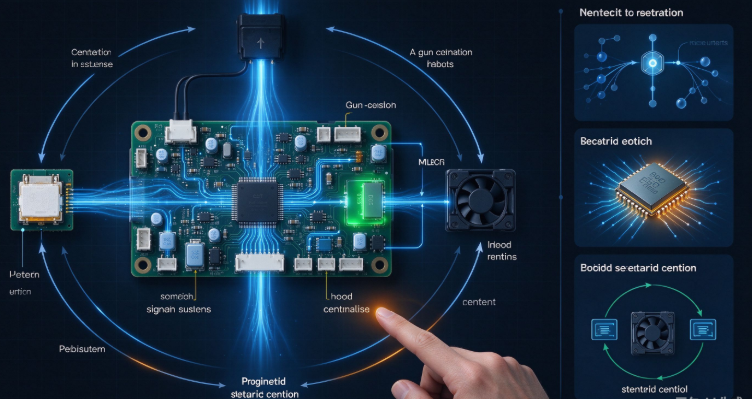
MLCCs for Smart Air Purifiers: Supporting Air Quality Sensors, Fan Control, and Reliable Operation
Smart air purifiers are widely used in homes, offices, hospitals, and commercial buildings. Modern devices do more than circulate air through filters. They may include PM2.5 sensors, laser particle detection modules, temperature and humidity sensors, automatic fan control, digital displays, and wireless connectivity.
These functions depend on electronic circuits that must operate continuously and respond to changing environmental conditions.
Multilayer ceramic capacitors (MLCCs) are commonly used in smart air purifier control boards. They support power decoupling, filtering, and selected signal-processing applications while occupying relatively little PCB space.
This article explains where MLCCs are used in smart air purifiers and what engineers should consider when selecting them.
1. PM2.5 and Air Quality Sensor Circuits
Air quality monitoring is a major feature of smart air purifiers. Many products use particle sensors to estimate airborne particulate concentrations, including PM2.5.
Some sensors use laser scattering technology. A small fan draws air through a measurement chamber, while optical components detect scattered light from airborne particles.
The sensor module contains optical detection circuits, signal processing components, and a local power supply.
MLCCs may be used for:
- Power decoupling around sensor ICs
- Filtering on selected analog power rails
- Noise reduction in supporting circuits
- Local filtering around signal-processing components
Sensor circuits can be sensitive to electrical noise. Engineers should follow the sensor manufacturer's recommended circuit design and pay attention to grounding and PCB layout.
C0G/NP0 capacitors may be considered for selected precision circuits requiring stable capacitance, while X7R and X5R are common for general power decoupling.
2. Laser Particle Detection Modules
Laser particle detection modules require carefully designed optical and electronic systems.
Depending on the sensor architecture, the module may contain a laser diode, photodetector, amplifier, and signal processing circuit.
MLCCs may support these components through local power decoupling and filtering.
Important design considerations include:
- Power supply noise
- Capacitor placement near sensitive ICs
- Effective capacitance under operating voltage
- Temperature characteristics
- Grounding and PCB layout
Capacitors are only one part of the complete detection system. Actual particle measurement performance also depends on optical design, airflow, sensor calibration, and signal processing.
3. Fan Motor Control Circuits
The fan is responsible for moving air through the purifier's filter system. Depending on the product, the device may use a DC motor or a brushless DC (BLDC) motor.
The motor control circuit adjusts fan speed according to user settings or air quality measurements.
MLCCs may be used in:
- Power decoupling around motor driver ICs
- Filtering on control board power rails
- Local decoupling for microcontrollers
- Input and output filtering around voltage regulators
Motor switching can generate electrical noise and voltage transients. Designers should evaluate the complete motor drive circuit, including inductive load protection and any required suppression components.
MLCCs should not be treated as replacements for flyback protection, TVS devices, or snubber circuits.
4. Main Control Board and Automatic Operation
The main controller coordinates sensor readings, fan speed, display information, filter replacement reminders, and operating modes.
A microcontroller processes the sensor data and controls different parts of the purifier.
MLCCs are commonly placed near the power pins of microcontrollers and supporting ICs.
Typical applications include:
- Local processor decoupling
- Voltage regulator filtering
- Sensor interface power filtering
- Communication circuit decoupling
Engineers should use the microcontroller manufacturer's reference design to determine recommended capacitor values and placement.
5. Display and User Interface Circuits
Many smart air purifiers include digital displays that show PM2.5 readings, operating modes, fan speed, and filter status.
Some models also feature touch controls.
MLCCs may be used around display driver ICs, touch controller circuits, and related power supplies for local decoupling and filtering.
Designers should consider switching noise from display circuits and avoid unnecessary interference with sensitive sensor sections.
PCB layout, grounding, and separation of sensitive analog circuits from noisy power sections are important parts of the design.
6. Wi-Fi and Smart Home Connectivity
Smart air purifiers may connect to mobile applications or home automation systems through Wi-Fi or Bluetooth.
Wireless connectivity allows users to monitor air quality, adjust operating modes, and receive maintenance notifications.
MLCCs may be used for:
- Local power decoupling
- High-frequency supply filtering
- RF matching networks where specified
- Filtering around communication ICs
X5R and X7R capacitors are commonly used for general power decoupling. C0G/NP0 may be suitable for selected RF matching applications where stable capacitance is important.
The communication module manufacturer's reference design should guide capacitor selection and placement.
7. Temperature, Humidity, and Environmental Conditions
Air purifiers may operate for long periods in bedrooms, offices, and other indoor environments.
Their electronic components can experience temperature changes, dust exposure, vibration from fan operation, and humidity variations.
When designing the control board, engineers should consider:
- Operating temperature: Confirm that the MLCC temperature range meets the expected circuit conditions.
- Dust protection: The enclosure and airflow design should prevent excessive dust accumulation on sensitive electronic sections.
- Mechanical vibration: Fan vibration and PCB mounting conditions should be considered during product development.
- Moisture protection: Depending on the product environment, suitable enclosure protection or PCB coating may be necessary.
- Mechanical stress: PCB bending during assembly or enclosure installation can contribute to ceramic capacitor cracking.
These factors should be evaluated as part of the complete product reliability design.
8. How to Select MLCCs for Smart Air Purifiers
Choosing the right MLCC requires matching its electrical characteristics to the circuit function.
- Capacitance: Select values based on the sensor, controller, or power supply requirements.
- Rated Voltage: Choose a suitable voltage rating and maintain appropriate design margin.
- Dielectric Material: X5R and X7R are common for general filtering and decoupling. C0G/NP0 may be suitable for selected precision or RF circuits.
- Package Size: Common package options include 0402, 0603, and 0805. The choice depends on capacitance, voltage rating, PCB space, and assembly requirements.
- DC Bias Performance: Class II MLCCs can lose effective capacitance under applied DC voltage. Review the manufacturer's DC bias curves.
- Temperature Range: Verify that the component can operate within the expected temperature range.
- Mechanical Reliability: Consider board flexure, vibration, mounting conditions, and termination options where appropriate.
9. Common MLCC Selection Mistakes
Engineers and purchasing teams should avoid several common mistakes when selecting MLCCs for air purifier control boards:
- Selecting capacitors only by nominal capacitance
- Ignoring DC bias effects
- Using unsuitable components in sensitive sensor circuits
- Overlooking noise from fan motor switching
- Ignoring operating temperature and humidity
- Replacing components without checking the full specifications
- Neglecting PCB layout and mechanical stress
A suitable selection process should consider both the electrical requirements and the actual operating environment of the finished product.
Frequently Asked Questions
Q1: Where are MLCCs used in smart air purifiers?
They are commonly used in PM2.5 sensor modules, laser detection circuits, fan motor control boards, microcontrollers, displays, and wireless communication modules.
Q2: Which MLCC dielectric is commonly used in air purifier control boards?
X5R and X7R are widely used for general power decoupling and filtering. C0G/NP0 may be considered for selected precision or RF applications.
Q3: Can MLCCs improve PM2.5 measurement accuracy?
MLCCs can support stable sensor power supplies and filtering. However, measurement accuracy depends on the complete sensor system, optical design, calibration, airflow, and signal processing.
Q4: Are MLCCs suitable for fan motor control circuits?
Yes. They can be used for local decoupling and filtering around motor driver ICs and supporting power circuits. Additional protection components may be needed to manage motor switching transients.
Q5: What information should buyers provide when sourcing MLCCs for air purifiers?
Useful information includes capacitance, tolerance, rated voltage, dielectric type, package size, operating temperature range, preferred manufacturer, and required quantity.
Conclusion
Smart air purifiers combine air quality monitoring, laser particle detection, fan control, digital displays, and wireless communication.
MLCCs support these electronic functions through local decoupling, power filtering, and selected precision or RF applications. Selecting suitable components requires attention to capacitance, voltage rating, dielectric material, DC bias performance, temperature range, and mechanical conditions.
For more MLCC product information and sourcing options, visit Barron MLCC at //www.barronmlcc.com/. You can also submit your required specifications and target quantities to discuss suitable component options for your smart air purifier projects.
Contact Us For MLCC Inquiry
Email: hyc2355937758@gmail.com
WhatsApp:8615913754866
Tel: 86+18824523083
Website: www.barronmlcc.com
MLCCs for Smart Dehumidifiers Supporting Compressor Control Humidity Sensing and Reliable Operation
MLCCs for Smart Water Purifiers Supporting Water Quality Monitoring and Reliable Control Systems
Related Article