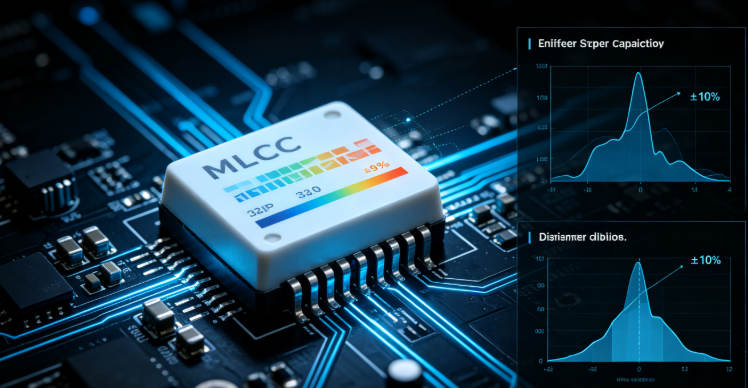
The Self cultivation of Dramatic Capacitors Why Your Circuit Boards Keep Playing High speed Life or death Chase
The Self-cultivation of Dramatic Capacitors: Why Your Circuit Boards Keep Playing "High-speed Life-or-death Chase"
Introduction: The Embarrassing Breakdown of a Circuit Board
Among hardware engineers, there is a well-known horror story:
It was five o’clock on Friday afternoon, only ten minutes left before off-duty. Everyone was about to shut down their computers for the weekend, when the brand-new industrial control motherboard loaded with cutting-edge technology on the test bench twitched unexpectedly. With a crisp pop and faint burnt smell, the screen went black completely.
The project manager turned pale and looked at the power design engineer: "What happened? Didn’t we just adopt the flagship main chip?"
Wiping cold sweat, the engineer probed the circuit nervously with a multimeter. Finally, like a desperate forensic inspector, he announced: "The chip is fine, the main board is not fully burned out... But that ceramic capacitor in the corner, costing less than fifty cents, exploded on the spot."
Dead silence filled the room. No one expected that a high-end equipment worth tens of thousands of dollars would be sent straight to the "IC funeral parlor" by a tiny capacitor smaller than a fingernail.
1. Tiny as a Soybean, Yet a Total Drama Star
When talking about ceramic capacitors, outsiders may regard them as ordinary electronic components. They look like flattened sesame seeds or soybeans, simply soldered onto the PCB and ready to work once powered on.
But this understanding is far too superficial. Ceramic capacitors have countless roles and volatile characteristics on circuit boards, deserving the title of "Oscar winner" in electronics:
Face-changing effect under DC bias:
You select a capacitor rated 10μF, expecting stable filtering performance. Once powered up, due to physical changes inside dielectric powder under voltage stress, its actual capacitance drops sharply, sometimes down to only 3μF. Such unpredictable capacitance decay allows high-frequency noise to interfere freely, leaving the main controller working abnormally.
Thermal expansion & contraction risk:
At a steady laboratory temperature of 25°C, everything runs smoothly. When installed in an outdoor inverter exposed to summer heat up to 85°C, internal mechanical stress tears the component structure. It may short-circuit and explode suddenly as a drastic response to extreme temperature.
Gap between datasheet promises and real performance:
To save a few cents, buyers may source discounted loose components from unknown small manufacturers. They perform well in initial lab tests, yet mass production brings massive troubles such as microcracks, cold solder joints and batch failures, disrupting the entire SMT production line.
2. How to Tame This Stubborn Tiny "Soybean"
If you want to stop your hardware system from experiencing constant emergency failures, more rigorous selection rules should be followed during design and procurement:
Do not treat compromise as cost saving:
Never choose cheap alternative capacitors with exaggerated parameters and low-quality dielectric materials for core power loops and high-voltage filtering circuits. The savings you gain will cost you dearly in troubleshooting and after-sales work.
Focus on thermal shock resistance and batch consistency:
High-quality ceramic capacitors not only meet datasheet specs, but also withstand repeated extreme temperature cycling and high ripple current.
Cooperate with reliable professional suppliers:
Trust professional original manufacturers. From precise dielectric material selection to strict outgoing quality inspection, full control over component quality prevents unexpected circuit failures.
3. Conclusion: Buy a Lifelong Insurance Policy for Your Circuit Boards
Hardware development is a challenging journey. Do not let a tiny ceramic capacitor become the final straw crushing your whole team.
Next time you draw schematics or review BOM lists, pay extra attention to these small components. Choose qualified materials and trusted manufacturers, so your equipment remains stable and reliable even under harsh real-world operating conditions!
Need stable, high-performance ceramic capacitors to avoid unexpected board failures?
Contact Barron MLCC for free samples, technical consultation and reliability evaluation service.
WhatsApp: +86 15913754866 phione: +86 18824523083
Email: hyc2355937758@gmail.com
Website: www.barronmlcc.com
On the Self cultivation of a Cerami Capacitorc How Driven Crazy by the Violent Current Surges on Circuit Boards
Uncovering the Boiled Frog Trap in Hardware Industry How Hidden Costs Are Slowly Eroding Your Profits
Related Article